INTERNATIONAL PROGRAMS
MISSION To prevent blindness and restore sight. VISION The elimination of avoidable blindness.
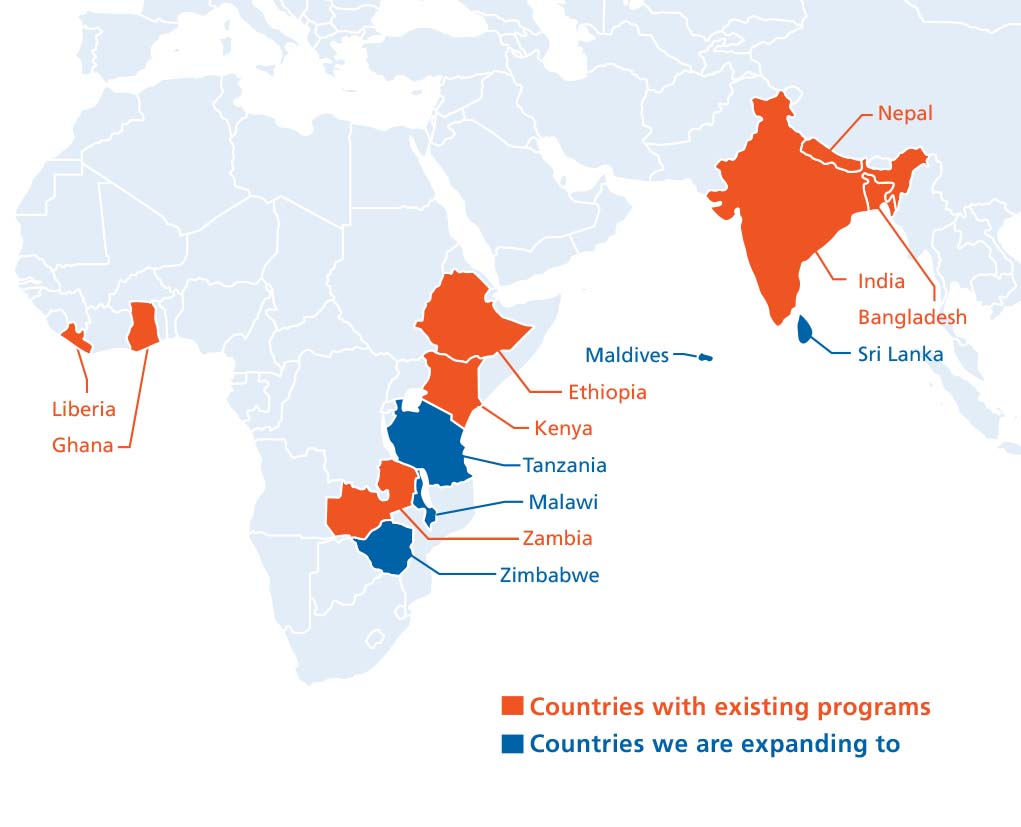
In 2019, we declared 159 villages and communities as avoidable blindnessfree (ABF) in India and Nepal, for a total of 1,150 since 2014. Since then we have declared villages ABF in Kenya, and we are on track to making similar declarations in Zambia and Ghana soon.
Our method of declaring villages avoidable blindness-free has been validated by L V Prasad Eye Institute in Hyderabad, a designated collaborating centre of the World Health Organization. Our model is also recognized by the governments of the countries where we work.
Our vision centres are widely recognized as a reliable means to providing quality eye care services at the community level. Thanks to longterm donors and funding from grants, including Seeing is Believing (a partnership between Standard Chartered Bank and the International Agency for the Prevention of Blindness), we established 28 new vision centres this year, for a total of 143.
In Africa, we’ve adopted all aspects of the WHO-recommended SAFE (Surgery, Antibiotics, Facial cleanliness and Environmental management) strategy to eliminate trachoma. As a result, we have successfully reduced the prevalence of active trachoma to less than 5 per cent in the Sinazongwe district and in the Mkushi district of Zambia, and from a number of sub-counties of Narok county in Kenya. According to the WHO, a prevalence rate of less than 5 per cent is no longer a public health concern.
As part of the environmental management component of SAFE, we have drilled 175 new boreholes and rehabilitated over 100 dysfunctional boreholes to bring clean water to communities and minimize the spread of trachoma. We have also ensured local committees are in place to take responsibility for the maintenance of the boreholes and to manage fair distribution of water.
In 2019 alone, the world-class Operation Eyesight Eye Cancer Institute within L V Prasad Eye Institute in Hyderabad screened 51,413 patients, and diagnosed 1,402 children with eye cancer. A total of 1,956 children were treated for eye cancer. This institute primarily treats children, including children from across India, from other Asian countries, and from African countries. The institute also trains ophthalmic personnel from across the world in diagnosis and treatment of eye cancer.
In 2019 we saw a 6.4 per cent increase in people accessing eye care services compared to the previous year. We saw a 10.1 per cent increase in cataract surgeries and other sight-saving surgeries we were able to provide.
We continue to remain focused on gender equity in our service provision. Of the total number of people we reached through our community eye health model during 2019, about 54 per cent were women and girls. In Zambia and Kenya, where women are overwhelmingly affected by blinding trachoma, 62 per cent of people who received surgery for trachomatous trichiasis (the blinding stage of trachoma, which can only be treated with surgery) were women.