


Six-year-old Innocent lives in Nchenga Village, Zambia. Since the age of four, he has been suffering from conjunctivitis. Also known as pink eye, conjunctivitis is an inflammation or infection of the transparent membrane that lines your eyelid and covers the white part of your eyeball. In areas where access to clean water is limited, this unpleasant infection can spread quickly.
Although Innocent’s mother, Theresa, knew that her son had an eye infection, she was unable to take him for treatment because the nearest clinic was 22 km away. With no other option, she resorted to administering traditional herbal remedies that did little to improve the infection.

Fortunately, Operation Eyesight conducted an outreach screening program in Nchenga Village in November 2020. These screening camps are critical to ensure that eye care is accessible for all by eliminating the barriers caused by a lack of transportation and significant time needed to reach the nearest health facility.
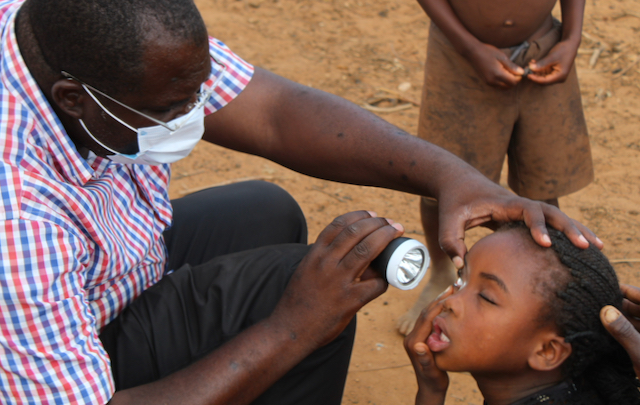
Theresa was thrilled to finally have an opportunity to get her son the medical attention he needed. At the outreach camp, Innocent was screened by an ophthalmic nurse and diagnosed with conjunctivitis. Thanks to the generosity of donors like you, he was given antibiotics free of charge. Now, Innocent’s eyes are no longer bothering him, and he can play with his sister and his friends unimpeded.
Support from donors like you help make these outreach programs possible. Donate today to help more children like Innocent get access to the eye health care they need.
Right across the street from a new Operation Eyesight-supported vision centre in Sahaspur, India is a small shop that sells a variety of items. The shop is run by a man named Sarjeet, who had been struggling with gradual vision loss for a year. Unable to read the currency notes given to him by his customers or the ones he gave them as change, Sarjeet’s struggled to balance his books and his business began to lose money. The situation grew even more dire when lockdowns swept across the country in response to the COVID-19 pandemic.
As India gradually started to adapt to the pandemic and people settled in to the new normal, Sarjeet once again opened his shop. By this point, his vision had deteriorated so much that it was hard for him to even move around the shop or step out on the street. He became reliant on his son to help him run the shop.
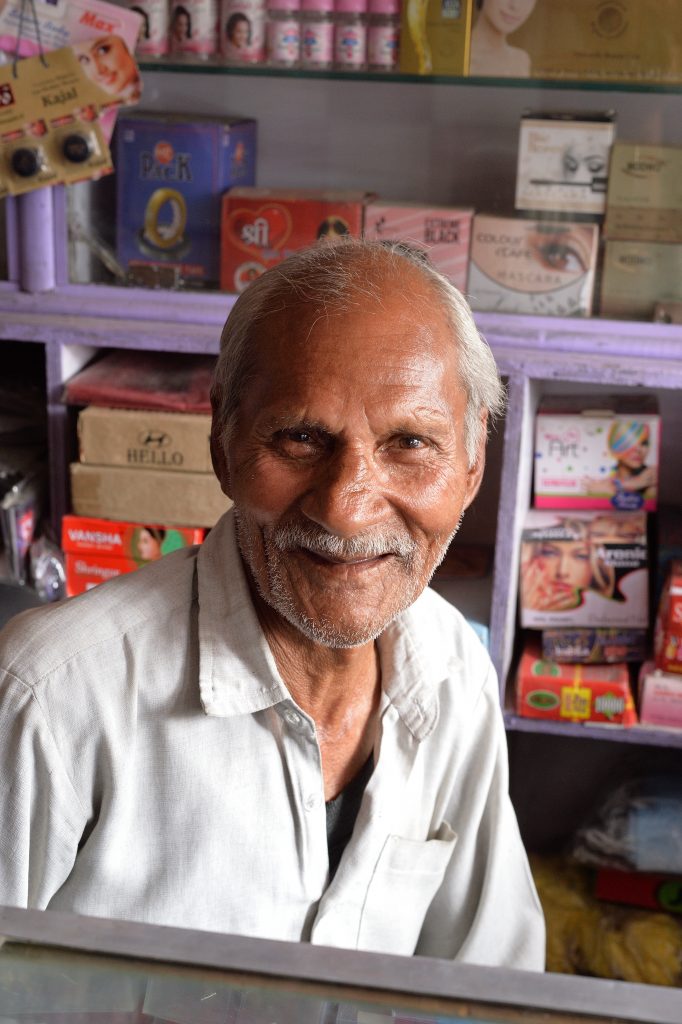
When the vision centre opened up across the street, Sarjeet was initially skeptical of approaching them. He had concerns about the quality of care that would be offered at this centre, because it was so far away from the nearest hospital. After talking with his neighbours, Sarjeet found out that the vision centre was actually an extension of the main hospital, and therefore followed all of the same quality and safety protocols. Reassured by this, he consulted the resident optometrist who diagnosed him with cataracts.
With the support of the staff at the vision centre and thanks the generosity of donors like you, he received sight-restoring cataract surgery. Now, he is able to manage his shop on his own and is no longer reliant on his son. Sarjeet is grateful to Operation Eyesight for helping him get back to his normal life, even if normalcy is looking a bit different these days.
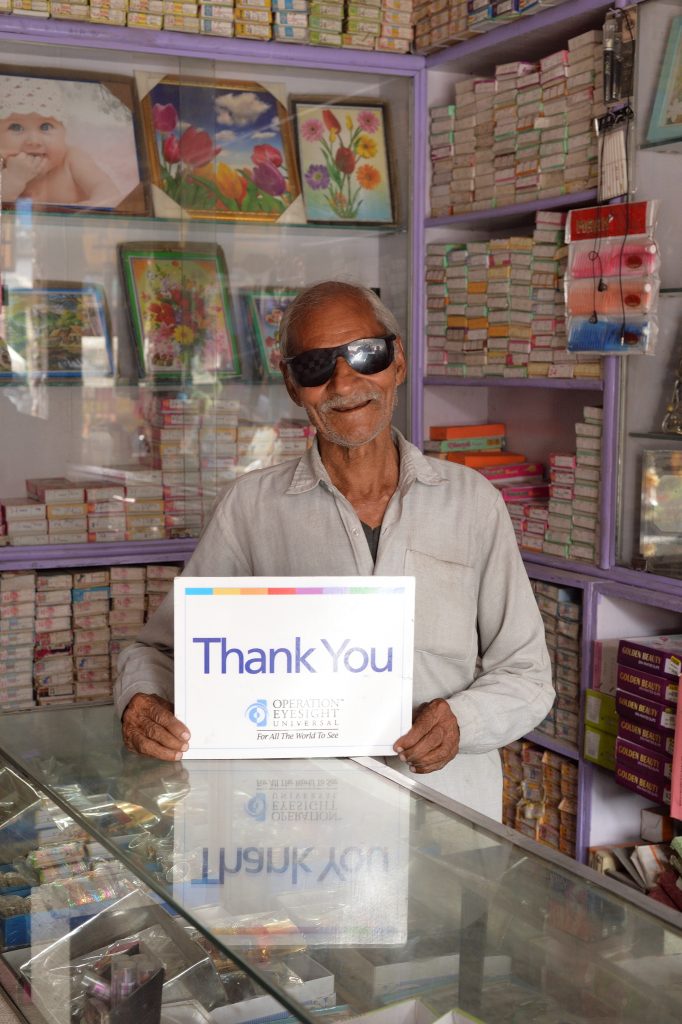
Unfortunately, India is currently going through a second, deadly wave of COVID-19. Businesses are once again being shut down. People like Sarjeet continue to need sight-restoring eye care, but several of our partner hospitals have been converted into COVID-19 care units and eye health care services are extremely limited or unavailable. The situation is overwhelming, and the hospitals need our support now so they can return to delivering eye health care services once the situation has improved.
Click here to learn more about our COVID-19 emergency response in India and how you can help.
Every year, the second week of May is World Retinoblastoma Week. It is an opportunity to raise global awareness of retinoblastoma, a life-threatening eye cancer that is almost exclusively found in young children. Although retinoblastoma can be treated with chemotherapy, globally there is a low survival rate because patients are often diagnosed too late. This problem is especially prevalent in developing countries, where it can be difficult to access specialized eye health care.
In 2015, we opened the Operation Eyesight Universal Institute for Eye Cancer at the L V Prasad Eye Institute (LVPEI) in Hyderabad, India. The Institute provides comprehensive treatment for the entire range of ophthalmic tumors in both children and adults, and patients who cannot afford to pay are offered treatment free of cost. The Institute also offers critically required services to India and other low- and middle-income countries through research, capacity-building and education programs. It has trained several ophthalmologists and optometrists as part of its fellowship program, and has published several research papers in reputable, peer-reviewed journals. The Institute is playing a critical role in increasing awareness about eye cancer, leading to early diagnosis and treatment.

Anvitha is a 21-month-old toddler from Kerala, India. She has been receiving chemotherapy treatment for retinoblastoma at the Institute. She was due for her next chemotherapy treatment when the COVID-19 pandemic caused a nationwide lockdown. Her parents, Vineeth and Gopika, were worried that they would be unable to safely travel to Hyderabad to take Anvitha for her treatment. Vineeth took to social media to talk about their plight and requested support.
Fortunately, the local health ministry was able to help arrange their travel and provide necessary permissions. Anvitha safely reached Hyderabad in time to receive her treatment.
According to Dr. Swathi Kaliki, the Head of Eye Cancer Services at LVPEI, 90 percent of retinoblastoma cases can be cured if they are diagnosed and treated in time. In Anvitha’s case, Dr. Kaliki says that there are good chances that both her eyes and sight will be saved as well.

Thanks to the generosity of our donors, thousands of families across India have hope that their children can beat eye cancer. Please consider donating today to support our work around the world to ensure that everyone has access to the eye health care they need.
Fourteen-year-old Grace lives in Saltpond, Ghana with her parents and two younger siblings. She is a junior high school student, but lately was struggling to see the blackboard. She started relying on her classmates to read the blackboard to her, and was afraid that over time, she would lose her vision completely.
Noticing her struggles, Grace’s headteacher called her parents in and expressed his concerns about Grace’s vision. He suggested they take her to nearby Saltpond Government Hospital, one of Operation Eyesight’s partner hospitals. An optometrist from the facility had visited the school to conduct school eye screenings in 2019, which is how the headteacher knew how to recognize Grace’s condition and where to send her for treatment.
Her mother was worried that their family would not be able to afford treatment, but she heeded the headteacher’s advice and took Grace to the hospital anyway. The family was relieved to hear that Grace’s vision problems could be solved with a pair of prescription eyeglasses, and that our generous donors made it possible for her to get the eyeglasses free of charge.

Today, Grace can read the blackboard with ease. Even better, if she notices one of her classmates struggling to see clearly, she’ll know to tell them to visit Saltpond Government Hospital for help.
Globally, uncorrected refractive errors are the main cause of visual impairment. A simple eye examination and a pair of prescription eyeglasses can transform a person’s life. Please donate today to help more students like Grace.
One of the key pillars of our work is hospital strengthening. This means that we collaborate with hospital and government partners to ensure that hospitals have the resources necessary to provide quality eye health care. Our partner hospitals are identified based on the eye health needs of the areas they serve, and then they then go through a thorough vetting process to ensure suitability. Although we do work with hospitals to confirm that adequate facilities, equipment and supplies are available, the largest aspect of our hospital strengthening is training. In 2020 alone, we trained 139 people to provide eye health care. This included training primary health care workers in eye care and training ophthalmologists and eye health technicians in regions where these roles are in high demand.
Read a testimony from an Operation Eyesight-trained Vision Technician:

After decades of success using this method, we have been invited by ministries of health to present it as a proven way of addressing gaps in current eye health offerings in a number of countries, including Zimbabwe, Malawi, the Maldives and Sri Lanka. After seeing the impact of our programs on the lives of their citizens, we have been asked by the governments of Zambia and Arunachal Pradesh state in India to replicate our model in other parts of the country/state. In doing so, we share the principles of our model while still leaving room for adaptation to best meet local eye health needs and to successfully operate in the local cultural context. We also provide input on governments’ national eye health strategies, advocating for the inclusion of eye health in primary health care programs. This is a critical component of achieving universal health coverage and the Sustainable Development Goals.
Read about a day in the life of an Operation Eyesight program officer:

As a result of longstanding, trusting relationships that we have with our partners and with local ministries of health, we were able to adapt our approach quickly at the onset of the COVID-19 pandemic. Our locally-based program teams quickly mobilized to help our partners address the immediate concerns caused by the pandemic. This included reaching out to communities to provide clean water, safety supplies and education to help them protect their families and prevent the spread of the virus. These efforts helped prevent our partner hospitals from becoming overwhelmed, giving them support to help them get back to a state where they are facilitating better health outcomes, including eye health, for their citizens. The flexibility shown by our international team demonstrated that we have an important role to play to help our hospital partners manage health risks as they emerge, even those unrelated to eye health.
COVID-19 proved that access to health care and robust health systems are more important now than ever. That’s why our focus this year and beyond is to continue our work to strengthen hospitals, establish vision centres and improve access to eye health care. Our work would not be possible without support from our generous donors. Donate today to help us support our hospital partners and eliminate avoidable blindness. – For All the World To See!
Although our mission to prevent blindness and restore sight is most commonly linked to the Sustainable Development Goals (SDGs) through SDG #3: Good Health and Well-being, our work touches on a number of other SDGs. A reliable supply of quality eye health care is one of the most effective ways to bring communities out of poverty, increase life opportunities and improve productivity. Eye health care intersects with the achievement of many other goals:
#1: No Poverty: by preventing blindness and restoring sight to help people keep their jobs or return to work, eye health care access helps break the cycle of poverty.

#5: Gender Equality and Women’s Empowerment: by training primarily women as community health workers, and by ensuring that women and girls receive equal access to eye health services, our programs give women the opportunity to expand their skills and work to support their families.

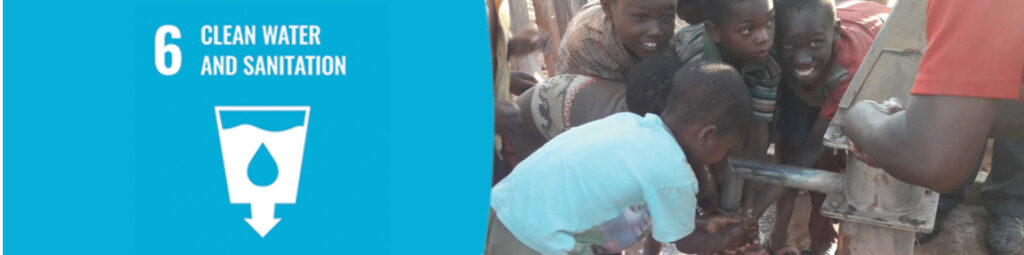
#6: Clean Water and Sanitation: by working with communities in Kenya and Zambia to drill boreholes to provide fresh water, and by educating communities to promote good hygiene, we help prevent bacterial infections that can cause blinding trachoma and digestive illnesses.
#17: Partnerships for the Goals: by establishing long-standing relationships with governments and Ministries of Health in the countries where we work, we work to ensure the sustainability and effectiveness of our work.

The World Health Organization’s 2019 World Report on Vision (WRV) estimates that at least 2.2 billion people suffer from vision impairment or blindness. It also estimates that at least 1 billion of these people live with vision impairment that could have been prevented or has yet to be addressed. The report warns that this is likely to increase dramatically in the coming decades due to population growth, aging, urbanization, and behavioral and lifestyle changes.
This report was released before COVID-19 began to overwhelm health systems around the world. If no significant investments are made in eye health care at this time, an even larger proportion of the world’s population will suffer from blindness and vision impairment. This means greater loss of livelihood opportunities, dependency, hunger and malnutrition, and poverty.
By following the WRV’s recommendations and incorporating eye health care into Universal Health Coverage, countries will be taking the first step towards ensuring that vision impairment doesn’t hold their citizens back in a cycle of poverty. Solutions exist right now, and the sooner countries employ them, the better off their citizens will be.
In August 2020, the World Health Assembly adopted a resolution to urge member countries to implement the recommendations of the WRV. This elevated eye health as a priority that must be integrated into national health systems. By working with our partner governments and local Ministries of Health to implement our community eye health model, we are moving one step closer to achieving good health and well-being and making eye health care accessible to entire communities.
Our work would not be possible without support from generous donors like you. Donate today to help us eliminate avoidable blindness. Not only will your gift help prevent blindness and restore sight for those in need, but you’ll also contribute to the achievement of the SDGs – For All the World To See!
Simon lives in Gathuthi Village, Kenya, on his family’s tea and coffee farm. Unfortunately, Simon started losing his vision around three years ago, and within one year he was completely blind. He felt like his life had come to a halt as he could no longer work in his farm. He says, “I could only see a blurry image and I couldn’t recognize people until they spoke.”
Simon didn’t know where he could get treatment and thought that he had to live with blindness. “I felt so fearful that I had changed from being my family’s breadwinner to a burden,” he explained. One day, Simon heard news that Operation Eyesight was conducting a free screening and surgical camp nearby. The ophthalmologist there diagnosed him with bilateral cataracts and assured him that a simple surgery would restore his sight.
Simon was transported to Kerugoya County Referral Hospital where he received sight-restoring surgery. He couldn’t believe it the next day when the doctor removed the bandage on his eye and he could see again. Simon and his family are very thankful to donors like you for bringing eye care services to the community.
You can help provide eye care services for more communities in Africa and South Asia. Donate today and give the Gift of Sight to someone like Simon.

Seventeen-year-old Raveena lives in Manakhedi, India. Like many teenagers, she enjoys watching TV, reading and spending time with her friends. About a year ago, Raveena started experiencing terrible headaches and her vision began to blur. It slowly got to the point where she was unable to read or help her family do chores. No one knew what was causing Raveena’s headaches or blurred vision.
Fortunately, Raveena’s family was visited by Karishma, a local community health worker who was trained at a nearby vision centre. Karishma immediately recognized that Raveena was suffering from refractive error, or near-sightedness. To Raveena and her family’s relief, they discovered that this could easily be solved by a pair of prescription eyeglasses.
Thanks to the generosity of a donor like you, Raveena has resumed her studies and no longer suffers from headaches. She can once again participate in activities that she had to stop due to her failing vision, and her future remains as bright as ever.


As the novel coronavirus continues to spread throughout the world, societies are adapting to stringent cleaning practices, social distancing measures, and, where possible, distance working and learning. In Canada, most schools across the country closed their physical doors in March, leaving students to finish out their remaining school terms online. Now, many schools are reopening with new safety protocols in place. For some students, there is also the option of distance learning and homeschooling. No school reopening plan is perfect, but arrangements and accommodations are being made across the country to try and safely resume classes under a “new normal” of mandatory facemasks, class pods and staggered class times.
When Kenyan schools closed their doors in March, after the first cases of COVID-19 were detected in the country, there were no alternative learning options. The committee in charge of overseeing schools reopening in Kenya has recommended that schools do not open until January 2021, and that’s only if the COVID-19 curve has flattened in the region. Kenya does not have the infrastructure to handle a health crisis with the size and scope of the current pandemic. Social distancing is the best way to stop the spread of COVID-19 before it can overwhelm their health system. Kenya is also facing a shortage of resources - such as masks, hand sanitizers, and soap - to facilitate a safe return to school. According to the John’s Hopkins Coronavirus Research Centre, at the time of writing Kenya has 13,873 active COVID-19 cases.

In the meantime, the government has introduced virtual learning sessions online, on television and on the radio, but most students cannot access these lessons as they do not have electronics or reliable internet access at home. Even for those students who can access them, the lessons are lecture-style, and a teacher is not present to help students understand a concept. The national exams Kenyan students need to take to advance to the next grade will not be held this year, which means students will need to begin their school year over again and graduate a year later. (In Kenya, the school year begins in January, so most students were only in school for two months of the school year).
There are many benefits that come with distance working and learning. Less time is spent commuting, there are positive environmental impacts and a healthier work-life balance. In health, including eye health, there are significant opportunities for tele-health delivery, which has the potential to bring specialized health care to rural and remote regions. But there are limitations. For all the benefits of migrating operations online, there is a significant risk of online and remote working and learning exacerbating existing inequalities.

Not only are schools an important resource for academic learning, they are also a source of important health education, too. Nutrition, eye health and sexual and reproductive health were all taught in classrooms or after school groups. In the absence of this education and supervision, teenage pregnancies have significantly increased in Kenya in recent months.
Although COVID-19 continues to dominate global headlines, as the pandemic stretches on the economic, mental and physical side effects of the pandemic are becoming increasingly apparent. With schools closed, it means that Operation Eyesight is unable to conduct school screenings and refer children with visual impairment to the care they need. It’s almost an entire year of education lost, as well as another year for students to potentially live with an avoidable eye health issue.
The recent adoption of the World Health Assembly resolution, ‘Integrated people-centred eye care, including preventable vision impairment and blindness’ (IPEC resolution), by 194 countries is a major milestone for global eye health.
In 2019, the World Health Organization launched the World Report on Vision. The first report of its kind, it laid out a comprehensive global strategy directed towards addressing global inequalities in access to eye health care and service provision. The report found that 2.2 billion people suffer from vision impairment globally, but nearly half of those cases could have been prevented or have yet to be addressed. In many cases, a pair of eyeglasses or a simple surgery can correct vision impairment. Yet for many – especially those in developing countries, those in rural areas, and women and girls – these simple solutions are out of reach.
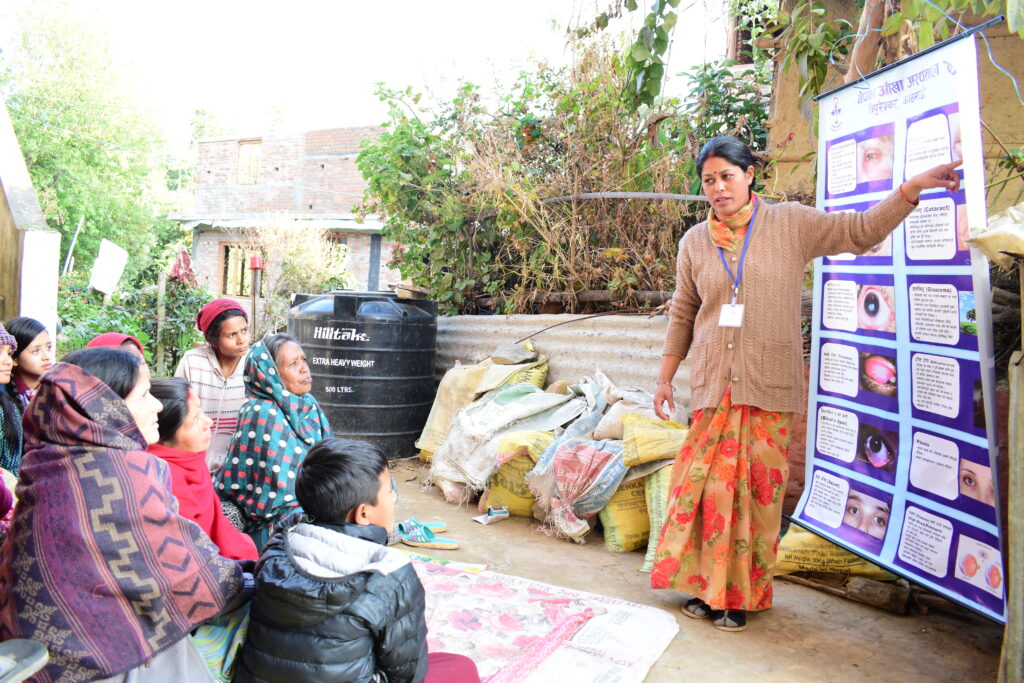
On August 4, 2020, a new World Health Assembly resolution was adopted by the 194 member states of the World Health Organization. The integrated people-centered eye care (IPEC) resolution, which was sponsored by 45 countries, is a political commitment to advancing eye health care as part of universal health care. The World Report on Vision estimated that the number of people living with blindness could triple by 2050, and that was before the COVID-19 pandemic strained health care systems even further.
Operation Eyesight welcomes the new resolution and is pleased to note that its recommendation to focus on people-centered eye care is an approach that we are already taking in our service provision. Operation Eyesight is thrilled to see that eye health is being recognized as a key component of overall health and well-being and not just a peripheral health issue. The IPEC resolution is a compelling confirmation of how crucial our mission is, now more than ever.
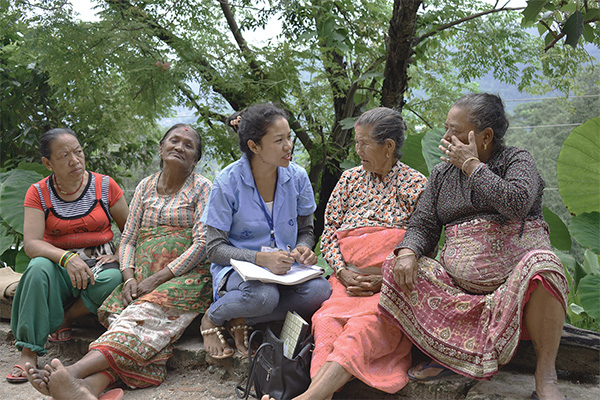
Although the COVID-19 health crisis has captured the world’s attention, the global eye health crisis has not diminished – it’s been exacerbated. As COVID-19 spreads around the world, it is continuing to strain health care resources in each of the countries where we work. As a result, it remains a challenge to our eye health programs. Operation Eyesight pivoted our day-to-day tasks to respond to COVID-19, but that did not detract from our focus. Our intent in supporting health care systems was to facilitate their ability to resume the provision of eye health services as soon as possible.
Operation Eyesight is working towards promoting a safe environment to start implementing our regular outreach activities, including re-launching community interventions, establishing new vision centres, and implementing new technologies such as telehealth. We have exciting plans to bring affordable, sustainable, quality eye health care to more people than ever before. COVID-19 has changed our day-to-day activities this year, but it has not changed our focus. We remain committed to ensuring entire communities are avoidable blindness-free.