

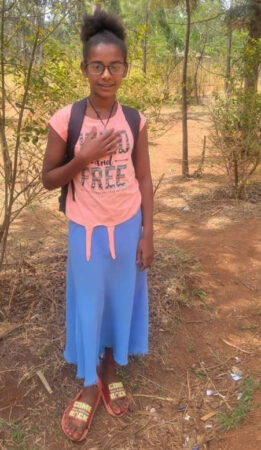
Sixteen-year-old Vanessa dreams of being a doctor someday. But when she started having trouble reading the blackboard at school, her grades began to suffer, and she worried she would never have the opportunity to study medicine.
The Grade 11 student lives in Matero, a high-density neighbourhood in Lusaka, Zambia. Last year, her school’s health club coordinator suggested that she get her eyes checked at the Matero Vision Centre, a clinic established with Operation Eyesight's support in 2021. From there, Vanessa was referred to Lusaka’s University Teaching Hospital.
At the hospital, Vanessa received a diagnosis for cataracts. She also learned that she has diabetes, a metabolic disease that put her at a high risk of developing various eye conditions, including cataracts. Doctors helped her get her blood sugar levels under control and she underwent surgery on both eyes.
But Vanessa’s struggles weren’t over yet. After the cataract surgery, she went back to school but still had trouble reading the blackboard, and she couldn’t see clearly at night. Her grades continued to slip, and she had trouble concentrating in class. During a follow-up appointment, Vanessa was told she also needed eyeglasses. She received a prescription, but her parents couldn’t afford the cost of the glasses.
Working with our partners at the OneSight EssilorLuxottica Foundation, we paired up Vanessa with the eyeglasses she needed. Since 2021, EssilorLuxottica has provided thousands of eyeglasses to patients at the Matero and Maamba Vision Centres in Zambia so that more children like Vanessa can get a pair of glasses quickly and free of charge.
Now, Vanessa proudly wears her tortoiseshell-framed glasses to school every day. “Now, I can see faraway objects clearly,” she said. “This will help me concentrate in class and achieve my dream of becoming a doctor.”
With files from Zambia Program Manager Kelly Kaira.
Give the Gift of Sight today and help restore sight and independence for more girls like Vanessa. Vision impairment disproportionately affects women and girls, but they are less likely to be prioritized for eye health care. That’s why our Hospital-Based Community Eye Health projects are aimed at reaching everyone in need of eye care, regardless of gender or family income.
Before she had cataract surgery, Ratna’s family worried about her non-stop. Each day, her husband, son and daughter-in-law would leave her at home with her young grandson so they could tend to the farm. But due to her fading vision, Ratna couldn’t safely care for the boy, and eventually she even had trouble looking after herself.
After taking a few bad falls, the family decided her daughter-in-law would have to stay home with her, a move that had a serious effect on the family’s income.
“I felt very depressed,” says Ratna of her loss of independence. The grandmother, who lives in Tokha, Nepal, explained that she couldn’t even recognize her own son and had to ask him to call out to her so she could identify him. She needed an escort just to get to the bathroom and back, and she despaired about not being able to care for her family the way they were caring for her.
When a community health worker visited the household, Ratna was referred to the Nepal Eye Hospital, where she was diagnosed with cataracts. She explains that she hadn’t realized that her condition could be treated, and initially she was nervous about getting surgery.
“I gathered strength,” she says, “Because the community health worker told me the treatment would change my world.”
Thanks to our partnership with the Nepal Eye Hospital, Ratna underwent phacoemulsification surgery – a technique that doesn’t require sutures and has a short recovery time – free of charge.

Soon, Ratna was back in the family home, thrilled to get back to a more independent lifestyle.
With her son sitting as a ward chairman in the community, Ratna feels that she can set an example by telling others about her success with the surgery.
“Now I am a strong pillar for the family, setting an example for others to get the eye care services without fear,” she proudly says.
But the best part, according to her son? “Now, she is happy,” he says.
Give the Gift of Sight today and help restore sight and independence for more women like Ratna. Vision impairment disproportionately affects women and girls, but they are less likely to be prioritized for eye health care. That’s why our Hospital-Based Community Eye Health projects are aimed at reaching everyone in need of eye care, regardless of gender or family income.
The last few months of 2022 were busy ones for Caroline Ikumu, our program manager in Kenya (pictured above at far right). She spent much of that time on the road, travelling to visit our projects in Elgeyo Marakwet County.
But she isn't complaining. The cause of all this busyness was one to celebrate. Between October and the end of December of last year, 20 villages in the county were declared Avoidable Blindness-Free.
Far from being a mere formality, these declarations are the culmination of years of collaboration between the community, the local government and the partner hospital.
“In simple terms,” Caroline explains, “Avoidable Blindness-Free means that nobody in the village is suffering from blindness or visual impairment due to treatable and avoidable conditions, and the community is aware of where to get the services for new cases.”
Our approach
We call our approach the “Hospital-Based Community Eye Health Model.” It's a mouthful, but essentially it means we facilitate door-to-door screening to communities in remote and underserved villages and make referrals to our partner hospitals where people can access treatment.
In Kenya, we work with community health volunteers who are trained in primary health care and provide health education and services at the village level throughout the county. We deliver additional training in eye health, and then the volunteers go door to door in our project area to screen community members for eye conditions.
As they screen, the volunteers make referrals to the partner hospital, the eye unit at the Iten County Referral Hospital, where people can get treatment, such as cataract surgery or a pair of eyeglasses, free of charge. A volunteer might return to the same household several times to make sure every member of the family has been screened.
The community health volunteers also encourage people identified with eye problems to attend outreach camps that are centrally located within the villages to make sure everyone has access to further screenings. From there, transport may be arranged for those needing treatment at the partner hospital.
Working with community leaders and health care workers, we make sure that the community is in support of the project and can take ownership of it.
Health education
Another part of the community health volunteer’s role is providing education about health issues, often attending social meetings such as micro-savings groups called “chamas” to make sure they’re reaching people when it's convenient for them.

Due to misconceptions about surgeries, not everyone jumps at the chance to get treatment, so the volunteers identify community members who have had success with their treatment to act as ambassadors. “So they tell them, ‘I was not able to see. I could not work. Now I’m back at my farm. I’m evidence that you can be treated and start your life again,’” explains Caroline.
Our programmers also conduct PACEH meetings – PACEH being an acronym for Participatory Approach to Community Eye Health. These meetings help our team understand the perception of the community on eye diseases, eye health providers and treatment received. They also identify misconceptions and address gaps in knowledge on eye health, and they ask community members if they know of anyone who might still be experiencing vision loss or blindness. Finally, they ensure community members know where and when to seek treatment so that they can take responsibility for their own eye health going forward.
Resurvey, validation & declaration
Community health volunteers conduct door-to-door surveys again towards the end of project duration to ensure that there are no backlog cases. During these screenings, ophthalmic workers screen at least 10 per cent of the population to see if the volunteers are accurate in their assessments and whether they need any refresher training.
After a village has gone through the resurvey process and we have determined that all those requiring treatment have received it and that the level of eye health awareness is high, the next step is a declaration event. The partner hospital works with community health volunteers and local government officials to arrange a time and date for a village celebration, and they often erect a billboard to mark the achievement.

During the declaration, beneficiaries speak about how their restored sight has changed their lives. Caroline recalls one older woman who had never seen her two grandchildren due to cataracts. After surgery, the grandmother laid eyes on the children for the first time and cried with joy.
“Everyone is happy because they can see their hard work paying off,” says Caroline of the declaration events. “They are proud of themselves because it’s a milestone that we have achieved together.”
Sustainability
Caroline explains that the idea behind eye health education is to change behaviour, so that the community members take charge, prioritize their own eye health and seek treatment when necessary, without anyone having to remind them. By constructing and equipping the eye units and training ophthalmic workers, we ensure the community will continue to have access to treatment for years to come.
Operation Eyesight Universal is committed to working toward the United Nations’ Sustainable Development Goals, which are a universal call to action to create a more fair, just and equitable world ensuring no one is left behind. Sign up for our eNews to learn more about how we are working to end poverty, promote good health and well-being, increase gender equality, provide access to clean water and promote partnerships to achieve the goals.
Thanks to her determined mom, two-year-old Venus is getting treatment for an eye condition that could have caused her irreversible vision loss.
The cheerful toddler was born in 2020, the same year her parents moved back to their home village after widespread lockdowns in India were announced. The little girl was thriving under the care of her extended family when her mother Priyanka noticed that Venus’s eyes were not symmetrical.
It’s a common belief that strabismus, the condition that causes someone’s eyes to point in different directions, goes away on its own. However, children rarely outgrow the condition without treatment. Priyanka wasn’t willing to wait and see.
She worried about the stigma that her little girl would face due to the misalignment of her eyes, knowing she’d be teased by classmates. She also wondered how the condition would affect her daughter’s vision, and consequently, her education and her future.
So when she took Venus in for a routine check-up at the government hospital, Priyanka asked about her daughter’s eyes but was told that there was no treatment for eye conditions at the facility. Priyanka became more and more concerned, worrying that the eye condition would affect Venus’s schooling and professional life.

When a community health worker from the nearby Khanapur Vision Centre knocked on the family’s door, Priyanka had her daughter examined. The health worker identified Venus’s eye condition as strabismus and said that it needed to be treated as quickly as possible. Venus got a referral to the vision centre where an optometrist explained that the little girl’s eye condition could be treated with simple procedures at our partner hospital, the MM Joshi Eye Institute in Hubli, just a few hours away.
Priyanka took Venus to the hospital, where she started undergoing patch therapy. Now, Priyanka is thrilled to see the improvements in her daughter’s eye condition.
Vision is a basic human right. Through door-to-door community outreach in remote villages combined with counselling and health education, every single child, woman and man in a community can be reached. Learn more about our unique approach by signing up for our newsletter.
Twelve-year-old Paul is excelling in school for the first time in years. Until recently, the Kenyan sixth grader found schoolwork tiring and difficult because of his poor vision. But now he's taking charge of his own eye health – and it’s paying off. He's discovered a new passion and has new dreams for the future.
Paul’s mother first noticed when he was a toddler that his eyes didn’t point in the same direction. She took him to a hospital where a clinician told her that Paul might lose his eyesight completely if he had surgery to fix the problem. She decided not to take the risk, and by grade four, Paul was having trouble reading. Eventually he could not read the blackboard at all and had to copy notes off other students. His eyes became tired after the long school day, and his classmates teased him about his appearance.

Things changed for Paul in October 2021, when his school was a participant in our School Eye Health Program, funded by the United States Agency for International Development’s (USAID’s) Child Blindness Program. The program has screened more than 86,000 school children in Kenya’s Uasin Gishu County by training teachers to identify students with visual impairments using a smartphone app called Peek Acuity. After the initial screening, students with possible eye conditions are referred to a nearby vision centre or hospital for further assessment.
After the screeners looked at Paul’s eyes, they advised him to go to our partner hospital in nearby Eldoret. When he told his mother, she initially hesitated due to her previous fears that he could lose his vision entirely. But Paul would not give up. “The boy insisted that I take him to hospital because technology has improved and things have changed,” his mother explained.
After consulting with the teacher who screened him, Paul’s mother took him to the Moi Teaching and Referral Hospital. As a partner in the School Eye Health Program, the hospital’s ophthalmic staff had recently received updated training in pediatric eye health as well as some new medical equipment. At the hospital, Paul was formally diagnosed with a squint, also called strabismus, a condition that causes misalignment of the eyes. He had surgery for the condition, the cost of which was covered through our program.

Today, Paul can see clearly and reads the blackboard with ease. Before surgery, he was always the second last in his class, but now he is among the top 10 of 40 students, and he says that kids no longer make fun of him. With his newly discovered love of math, Paul hopes to become an engineer someday.
With files from Caroline Ikumu
Donate today to help open a world of possibilities for more children like Paul.
Today, 36-year-old Benson keeps himself busy by managing his flourishing corn and cassava crops. But that wasn’t always the case.
Benson lives in a village northeast of Nairobi, in an arid part of Kenya’s Embu County. In 2015, his vision began to fade. Neither he nor anyone in his family knew what caused the vision loss, and as it worsened, his frustration mounted. He started to distance himself from his family, and he tried punishing his own eyes for their failure to see clearly.
“I decided to never open my eyes and I would beat them for not seeing,” he said, recalling how confused he was at the time.
No longer able to farm and feeling isolated from others, Benson turned to alcohol and street drugs to fill his time. He spiralled into depression, and his family noticed his behaviour was becoming more and more unpredictable.
Things came to a head when Benson became violent, breaking the windows of his mother’s home with a walking stick. Concerned for his wellbeing, Benson’s family intervened by taking him to a rehabilitation centre, hopeful that with the right support, he might overcome his addictions.
While in rehabilitation, a doctor visiting the centre took a look at Benson’s eyes and diagnosed him with bilateral cataracts. A manager, having heard of a new eye clinic at a local hospital, took Benson into the city for further care.
At the eye unit at Kerugoya County Referral Hospital, Benson’s diagnosis was confirmed, and he was booked in for cataract surgery. The eye unit was made possible by a collaboration between the hospital and Operation Eyesight, with our organization providing the medical equipment and training for the ophthalmic workers. Before the eye unit was established, people like Benson had to travel more than two hours to Nairobi to get eye health services – a huge barrier for people who don’t own a vehicle.
When the bandages came off, Benson couldn’t believe the difference the surgery had made. He asked for a mirror, then jumped up and down with excitement when he saw his own face grinning back at him. After years of living in darkness, he could once again see.
When he went back to the rehabilitation centre, the other patients could hardly believe it when he said he had regained his vision in just a few short days.
His father, after hearing the news, had his own eyes checked and was also diagnosed with cataracts. Like Benson, he received cataract surgery free of charge, and regained his sight.
After Benson left the rehabilitation centre, he decided to take up farming. He’s grateful that he no longer has to rely on his family financially. Now in recovery, with his depression being managed, Benson's ambitions are growing. He hopes to buy more land soon, so he can continue to flourish and become more independent.
With files from Patrick Wainaina, IT Officer, Kenya
Mangos, guavas, lemons and heaps of vegetables – all things that students at a Mweela Primary School in Sinazongwe can cultivate now, thanks to a hand pump in the courtyard.
Imagine going to school and not being able to access clean water. How would you stay hydrated? Stay clean and sanitary? Stay engaged in your learning?
“Water is life,” says Nene Kaunga. “In school, we teach learners the importance of water and the sources of water.”
The school’s deputy head teacher goes on to explain that the borehole saves them from walking long distances to fetch water and may provide the only safe drinking water that some of their rural students have access to throughout the day.
Operation Eyesight, with help from our generous donors, installed the borehole in 2008 to help prevent the spread of trachoma. The spread of this infectious disease, which causes vision loss, eye pain and eventually blindness, can be prevented with frequent hand and face washing. For that, you need safe, clean water.
“Hygienically, this water is very safe,” says Nene. “We’ve never had any child who has suffered from waterborne diseases as a result of drinking this water.”
On site access to clean water enables the Gift of Sight for students, but there are even more ripple effects. Since the borehole was installed, teachers have seen more girls enrolling and staying in school. And they’re no longer staying home from school during their periods, thanks to the fresh water, soap and pads the school provides.
As well as tending to an orchard and vegetable garden, the students also use the water to wash their hands and faces, clean the latrines and, on Fridays, mop their classrooms.
The ability to attend school and without the barrier of unsafe water provides not only the Gift of Sight for students in our areas of work, but also a life with endless potential.
Please give the Gift of Sight today.
When Yeshiworque first started school, she was as bright and eager to learn as any kindergartener. She loved going to class, and by the end of first grade, she was among the top three students in her class.
But during second grade, everything changed.
That year, Yeshiworque started having trouble seeing the blackboard. She had to sit in the front row to read it and had to hold her textbooks close to her eyes. As she struggled with her schoolwork, her grades dropped her to near the bottom of her class.
Over the years, as Yeshiworque’s vision continued to worsen, school became more and more of a struggle. She could no longer read the chalkboard at all, so her friends had to whisper to her as they copied notes, risking a scolding from the teacher.
Other times she would just pretend to take notes. She fell behind in her homework. Her teachers didn’t understand or believe her when she explained that she couldn’t see well enough to do the work.
Over the years, as Yeshiworque’s vision continued to worsen, school became more and more of a struggle. She could no longer read the chalkboard at all, so her friends had to whisper to her as they copied notes, risking a scolding from the teacher.
Other times she would just pretend to take notes. She fell behind in her homework. Her teachers didn’t understand or believe her when she explained that she couldn’t see well enough to do the work.
School became a daily ordeal. She’d turn in incomplete homework and was constantly reprimanded for her inability to read. To avoid the continued embarrassment, Yeshiworque started skipping classes.
Luckily, Yeshiworque was in attendance on the day an eye health team came to her school. Along with her classmates, she was screened for visual acuity. The test showed that Yeshiworque could only count fingers from up to three meters away with her left eye. Her right eye was even worse, with only a one-meter range on the test.
After the screening, Yeshiworque was sent to see an optometrist with our partners at Tibebe Ghion Hospital for a thorough visual acuity test and eye examination. She received a pair of prescription eyeglasses, free of charge, to restore her vision.
“Using the eyeglasses, I was dizzy at first,” she says. “But I got over that quickly and everything is alright now. I can see what is written on the chalkboard from any distance in the classroom. I don’t need any help from my friends to read to me aloud. In fact, I tell them not to distract me when they try.”
Now a sixth-grader, Yeshiworque studies hard, both at school and at home, with a new career goal in mind: to become a doctor, so that she can help others as she has been helped.
Yeshiworque was screened through a school-based eye screening project run by Partners in Education Ethiopia and Operation Eyesight.
With files from Marnat Adugna at Partners in Education Ethiopia.
Whether you call him Baba, Tata or Dad, he’s been there since the start to pick you up when you’ve fallen down, to listen to your problems or just to give you a hug. Today, join us in celebrating the fathers and grandfathers in our Operation Eyesight community.
Today, Bhagiram is proud to be supporting his family by growing wheat, mustard and other crops, but just a few years ago, that was not the case. The farmer had developed cataracts in both eyes, and they progressed to the point where he couldn’t do anything on his own. Even finding his way around his home became a challenge, and he often stumbled and fell. He had to give up farming, and became financially dependent on his son, who sells clothing for a living.

When a neighbour told him about a nearby vision centre, Bhagiram went in for a consultation. He was diagnosed and referred to our partner hospital for surgery. Today, he’s grateful that his vision has been restored and that he no longer has to rely on his son.
Our team went to check up on Bhagiram and he proudly toured them around his now-flourishing farm, served tea and gave them each a bunch of fresh cilantro to take home.

For the last six years, the highlight of Aaron’s week has been reading to his two granddaughters. “My job as grandpa is to make sure they grow up nurturing their dreams and imagination,” he says.
But as the years went by, Aaron noticed that the taller his granddaughters grew, the smaller the fonts in their favourite books became.
Aaron had found reading more and more difficult, and it even started giving him headaches. Eventually, he could only read one page to the girls at a time. “They were getting restless,” he chuckles, “saying ‘grandpa, grandpa, we need to know what happens next!’” Aaron realized that he needed help to prevent his vision from getting any worse, so he went to the nearby Matero vision centre where he was given a diagnosis and equipped with a pair of sleek, silver reading glasses.
“I know the girls won’t want me to read to them forever,” he says. “These glasses allow me to enjoy this quality time with them while I can.”
When a new vision centre was built on property owned by Haji Khurshid’s family, he became interested in learning more about Operation Eyesight’s work. His wife, Kudshiya Fatima, made some inquiries about jobs, and she soon started training as a community health worker.

With his daughter married and settled in another city and his wife off at work, Haji Khurshid found time heavy on his hands. He wanted to be more involved in his community, and to help his wife spread the word about the importance of eye health.
He decided to spend his spare time sitting outside the vision centre and assisting those who crossed his path – lending a shoulder to patients who need help getting to and from appointments and helping alleviate the fears of those preparing for eye surgeries. A caring dad through and through, Haji Khurshid is enjoying spending his retirement years by supporting those around him.
It was a moment of great joy. After seven years of blindness, Maureen could finally see again. She had just undergone cataract surgery, and when she got home from the hospital, she was over the moon to set eyes on her five children, relieved and happy that she could see their precious faces once again.
Then she stepped inside her house and got the shock of a lifetime.
The walls of her home were covered top to bottom with crayon drawings! It seems her youngest children had become quite the little artists, leaving a rainbow of colours throughout the entire house. And while it was certainly a gift to be able to see her kids’ masterpieces, a messy home just wouldn’t do.

So, Maureen did what many tireless and dedicated moms would do in this situation… She got out a bucket and rag, and started cleaning.
It’s no wonder Maureen didn’t realize her kids had become such prolific muralists. Her husband died in 2015, leaving her to raise their children on her own.
At the time, all five kids were under the age of 10. Shortly afterward, Maureen lost her sight entirely. Her life became a daily struggle, and she had to rely on the oldest children to help her get around and manage the household.
She considered getting medical help, but her relatives discouraged her, telling her she would lose her eyes entirely if she did.
This past January, two Operation Eyesight community health workers showed up at Maureen’s doorstep in Matero, Zambia during a community screening. They identified her as having mature cataracts in both eyes, and within a week she was transported to the nearby University Teaching Hospital’s eye unit for surgery. The operation was successful, and after spending a night in hospital, Maureen went home, sight restored.
When Operation Eyesight employees called on Maureen six weeks later to check in, you can guess what she was up to – still cleaning.
“I am so happy that I got my vision back!” she told them, “I no longer struggle to take care of and cook for my children.”