When Yeshiworque first started school, she was as bright and eager to learn as any kindergartener. She loved going to class, and by the end of first grade, she was among the top three students in her class.
But during second grade, everything changed.
That year, Yeshiworque started having trouble seeing the blackboard. She had to sit in the front row to read it and had to hold her textbooks close to her eyes. As she struggled with her schoolwork, her grades dropped her to near the bottom of her class.
Over the years, as Yeshiworque’s vision continued to worsen, school became more and more of a struggle. She could no longer read the chalkboard at all, so her friends had to whisper to her as they copied notes, risking a scolding from the teacher.
Other times she would just pretend to take notes. She fell behind in her homework. Her teachers didn’t understand or believe her when she explained that she couldn’t see well enough to do the work.
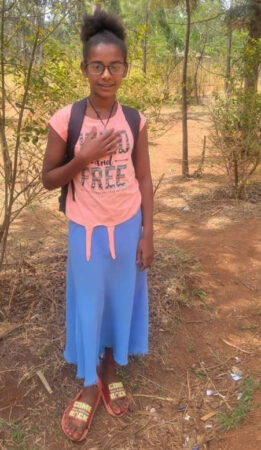
Yeshiworque poses for a portrait as she walks to school.
Over the years, as Yeshiworque’s vision continued to worsen, school became more and more of a struggle. She could no longer read the chalkboard at all, so her friends had to whisper to her as they copied notes, risking a scolding from the teacher.
Other times she would just pretend to take notes. She fell behind in her homework. Her teachers didn’t understand or believe her when she explained that she couldn’t see well enough to do the work.
School became a daily ordeal. She’d turn in incomplete homework and was constantly reprimanded for her inability to read. To avoid the continued embarrassment, Yeshiworque started skipping classes.
Luckily, Yeshiworque was in attendance on the day an eye health team came to her school. Along with her classmates, she was screened for visual acuity. The test showed that Yeshiworque could only count fingers from up to three meters away with her left eye. Her right eye was even worse, with only a one-meter range on the test.
After the screening, Yeshiworque was sent to see an optometrist with our partners at Tibebe Ghion Hospital for a thorough visual acuity test and eye examination. She received a pair of prescription eyeglasses, free of charge, to restore her vision.
“Using the eyeglasses, I was dizzy at first,” she says. “But I got over that quickly and everything is alright now. I can see what is written on the chalkboard from any distance in the classroom. I don’t need any help from my friends to read to me aloud. In fact, I tell them not to distract me when they try.”
Now a sixth-grader, Yeshiworque studies hard, both at school and at home, with a new career goal in mind: to become a doctor, so that she can help others as she has been helped.
Yeshiworque was screened through a school-based eye screening project run by Partners in Education Ethiopia and Operation Eyesight.
With files from Marnat Adugna at Partners in Education Ethiopia.
Whether you call him Baba, Tata or Dad, he’s been there since the start to pick you up when you’ve fallen down, to listen to your problems or just to give you a hug. Today, join us in celebrating the fathers and grandfathers in our Operation Eyesight community.
Bhagiram: India
Today, Bhagiram is proud to be supporting his family by growing wheat, mustard and other crops, but just a few years ago, that was not the case. The farmer had developed cataracts in both eyes, and they progressed to the point where he couldn’t do anything on his own. Even finding his way around his home became a challenge, and he often stumbled and fell. He had to give up farming, and became financially dependent on his son, who sells clothing for a living.
When a neighbour told him about a nearby vision centre, Bhagiram went in for a consultation. He was diagnosed and referred to our partner hospital for surgery. Today, he’s grateful that his vision has been restored and that he no longer has to rely on his son.
Our team went to check up on Bhagiram and he proudly toured them around his now-flourishing farm, served tea and gave them each a bunch of fresh cilantro to take home.
Aaron: Zambia
For the last six years, the highlight of Aaron’s week has been reading to his two granddaughters. “My job as grandpa is to make sure they grow up nurturing their dreams and imagination,” he says.
But as the years went by, Aaron noticed that the taller his granddaughters grew, the smaller the fonts in their favourite books became.
Aaron had found reading more and more difficult, and it even started giving him headaches. Eventually, he could only read one page to the girls at a time. “They were getting restless,” he chuckles, “saying ‘grandpa, grandpa, we need to know what happens next!’” Aaron realized that he needed help to prevent his vision from getting any worse, so he went to the nearby Matero vision centre where he was given a diagnosis and equipped with a pair of sleek, silver reading glasses.
“I know the girls won’t want me to read to them forever,” he says. “These glasses allow me to enjoy this quality time with them while I can.”
Haji Khurshid: India
When a new vision centre was built on property owned by Haji Khurshid’s family, he became interested in learning more about Operation Eyesight’s work. His wife, Kudshiya Fatima, made some inquiries about jobs, and she soon started training as a community health worker.
With his daughter married and settled in another city and his wife off at work, Haji Khurshid found time heavy on his hands. He wanted to be more involved in his community, and to help his wife spread the word about the importance of eye health.
He decided to spend his spare time sitting outside the vision centre and assisting those who crossed his path – lending a shoulder to patients who need help getting to and from appointments and helping alleviate the fears of those preparing for eye surgeries. A caring dad through and through, Haji Khurshid is enjoying spending his retirement years by supporting those around him.
In honour of Father's Day, we invite you to make a donation and give the gift of sight to more people like Bhagiram, Aaron and Haji Khurshid.
It was a moment of great joy. After seven years of blindness, Maureen could finally see again. She had just undergone cataract surgery, and when she got home from the hospital, she was over the moon to set eyes on her five children, relieved and happy that she could see their precious faces once again.
Then she stepped inside her house and got the shock of a lifetime.
The walls of her home were covered top to bottom with crayon drawings! It seems her youngest children had become quite the little artists, leaving a rainbow of colours throughout the entire house. And while it was certainly a gift to be able to see her kids’ masterpieces, a messy home just wouldn’t do.
Maureen stands outside her home in Matero, Zambia.
So, Maureen did what many tireless and dedicated moms would do in this situation… She got out a bucket and rag, and started cleaning.
It’s no wonder Maureen didn’t realize her kids had become such prolific muralists. Her husband died in 2015, leaving her to raise their children on her own.
At the time, all five kids were under the age of 10. Shortly afterward, Maureen lost her sight entirely. Her life became a daily struggle, and she had to rely on the oldest children to help her get around and manage the household.
She considered getting medical help, but her relatives discouraged her, telling her she would lose her eyes entirely if she did.
This past January, two Operation Eyesight community health workers showed up at Maureen’s doorstep in Matero, Zambia during a community screening. They identified her as having mature cataracts in both eyes, and within a week she was transported to the nearby University Teaching Hospital’s eye unit for surgery. The operation was successful, and after spending a night in hospital, Maureen went home, sight restored.
When Operation Eyesight employees called on Maureen six weeks later to check in, you can guess what she was up to – still cleaning.
“I am so happy that I got my vision back!” she told them, “I no longer struggle to take care of and cook for my children.”
Salina, a community health volunteer in Kenya, is proud to be making a difference in her community.
The mother of six, who also has several grandkids, lost her husband several years ago, leaving her to support her burgeoning family on her own. She continued farming corn for income, but low grain prices meant she was barely able to sustain her family.
When the government started recruiting health volunteers in her village, Salina’s name was put forward because of her involvement in community work. She was excited about the prospect, but worried when some community members pointed out her lack of a formal education.
Eventually, she got the position and started training with Operation Eyesight as a community health volunteer. Now she does door-to-door eye health screenings throughout her region in Elgeyo Marakwet County.
The stipend she receives from Operation Eyesight helps her feed her family and keep her kids in school. She looks forward to sending her daughter to college soon.
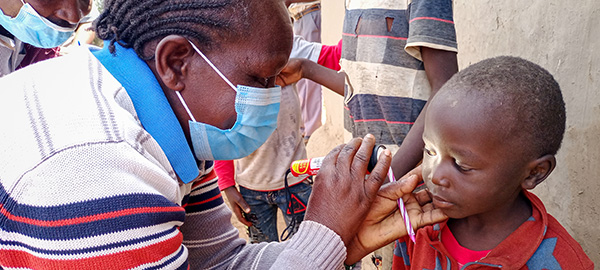
Salina examines the eyes of a child in Elgeyo Marakwet County, Kenya. Photos: Patrick Wainaina, MIS Officer
At 56, Salina admits the job is not an easy one – she puts in long hours and walks long distances to complete her work. But she adds that her passion for helping people in the community keeps her going.
She says that she was surprised one morning when a local cattle herder showed up on her doorstep at 6 a.m. He told her he was having trouble seeing, but couldn’t get to the hospital to have his eyes checked. She took a look and diagnosed him with cataracts, and promptly got him in for free treatment at a nearby Operation Eyesight surgical camp. She says whenever she sees the young man around town, he thanks her for her help.
Salina says she’s also excited about everything she’s learning about health care.
“The biggest benefit,” she explains, “is that I have been equipped with knowledge on how to take care of my health and that of my family.”
She adds that despite the initial naysaying, her work has helped raise her profile as a trusted community member and that people now come to her to discuss issues the village is facing.
Every year, Operation Eyesight trains hundreds of women as health workers and leaders in their own communities. This year on Mother's Day, help moms like Salina support their families by making a donation or purchasing an eCard for your own mother, wife or another amazing woman in your life.
To weave cloth using a handloom, you need patience, coordination and most of all – keen eyesight.
So when Junmoni, a handloom weaver, started having trouble with her vision, she knew her livelihood was in peril.
The mother of two lives in Chakala, a village near the Brahmaputra River in Assam, northeast India. Her husband works as a day labourer, which offers little financial stability. As a result, Junmoni’s weaving is the family’s primary source of income.
As her vision faltered, Junmoni was producing less and less cloth. She worried about the fates of her two children, nine-year-old Sarna and 13-year-old Sanjib. Her hope of keeping them in school and sending them off to higher education dwindled as the family’s situation became more and more precarious. She even considered selling off her weaving equipment to bring some money into the household.
A knock on the door changed everything for her.
Earlier this year, an Operation Eyesight community health worker showed up at Junmoni’s doorstep as part of a community-wide screening program. After Junmoni described her vision problems, she was referred to a free screening camp happening in her neighbourhood. Without needing to leave her village, Junmoni was diagnosed with near vision, and received a pair of free prescription eyeglasses.
She marvels at the difference a pair of eyeglasses can make. “It’s exciting how a small thing can change the world,” she says.
Today, she is back at her handloom supporting her family, her dreams of sending young Sarna and Sanjib off to college once again intact.
Janet Whitlock and Pastor Alex Craig proudly display their church’s fundraising progress. Members of the First Baptist Church in Petrolia were challenged to put away a dollar a day – the price of a cup of coffee – towards Operation Eyesight.
When members of the First Baptist Church in Petrolia, Ontario sat down to choose an organization to support for the church’s 150th anniversary, the decision was unanimous.
“Operation Eyesight kept coming up because of the previous connection,” says Janet Whitlock, the project’s lead. “It was one of the easier decisions.”
The previous connection she refers to is the church’s long history of giving to Operation Eyesight. It began back in the early sixties when Dr. Ben Gullison arrived in Petrolia to deliver a talk at the church.
A medical missionary in Sompeta, India, Dr. Gullison helped build a hospital in the region and later established a service to provide free cataract surgeries to people in the area. That initiative would become the inspiration behind Operation Eyesight.
When Dr. Gullison visited Petrolia’s First Baptist Church on behalf of Operation Eyesight, he impressed the congregation with his vigor and passion for the cause.
“He seemed quite elderly when he came to speak to our church,” recalls Diane O’Dell. “And my mother was just so thrilled with him because he jumped down from the church platform like he was a 14-year-old.”
The church continued to invite Operation Eyesight representatives to speak in the decades to come, and when Diane’s late sister Ruth took over the Sunday School, her students would raise more than $13,000 to donate to our organization.
Ahead of the church’s 150th anniversary on May 1, 2022, the congregation decided on a fundraising goal of $15,000. Church and community members stepped up to save a dollar a day to put towards the goal.
“We don’t have a lot of children now,” adds Diane, “but obviously we have a congregation of very generous seniors.”
The congregation has already raised more than $16,000, breaking past their initial goal weeks ahead of schedule.
Happy 150th anniversary, First Baptist Church of Petrolia – and thank you for marking the occasion by giving the Gift of Sight. We are incredibly grateful for your decades of support. Together, we are preventing blindness and restoring sight – For All The World To See.
Today, on International Women’s Day, we are excited to tell you about an innovative project we are undertaking in partnership with NorQuest College (Edmonton, AB) and the Rotary Eye and ENT Hospital (Udhampur, India). The goal of the project is to give people in a rural district in northwest India greater access to eye health care services while addressing myths that stigmatize women with poor vision.
Udhampur Block is a rural area perched high in the foothills of the Himalayas in India’s Jammu and Kashmir region. Due to the rugged terrain and roads that are often affected by flooding, it can be difficult for the people who live there to access services like eye health care. For women and girls, the barriers are even greater, as the men and boys in their families are often prioritized for health treatment.
The Operation Eyesight team meets with local community members in Udhampur.
What’s more, our research in the area revealed health myths affecting women, including those that suggest that a woman wearing eyeglasses is in poor health overall, that poor eye health is a result of sinful behaviour in a past life and that only elderly people should wear eyeglasses.
The idea behind this project is to outfit a four-wheel-drive vehicle as a fully functioning optometry clinic. An all-female heath care team will run the mobile clinic and deliver services to everyone in the project area.
We are training eight local women as Community Health Workers to do door-to-door eye screenings and to provide referrals to the Rotary Eye and ENT Hospital. They will also deliver educational sessions to women’s groups, with the goal of debunking the female eye health myths that exist in the communities.
A Community Health Worker examines a woman's eye in northern India.
People in the area will also be asked for their input on what kind of eye health education they would like to receive using a type of participatory research called PhotoVoice. This research will place cameras into the hands of locals, who will be asked to take pictures of things that highlight the themes of the research: activities, beliefs and circumstances of eye health.
Ninety per cent of blindness worldwide is preventable or treatable, but people in underserved areas like Udhampur Block often fall through the cracks. This project will help people get access to the eye health care they need while also addressing some of the gender inequalities related to poor vision.
This innovative project aims to: ✔ Address the barriers faced by women and girls by targeting feminine eye health myths that perpetuate inequality; ✔ Incorporate input from local women on the content of our eye health education sessions and the delivery of eye health services on an ongoing basis; ✔ Activate a Mobile Vision Centre to provide eye health services to people’s doorsteps, so that all residents, including women and girls, can avoid travel-related barriers; ✔ Make role models of local women and girls by publicly engaging them in good eye health practices; and ✔ Generate buy-in from men and boys about the importance of women’s and girls’ eye health.
We are grateful to partner with NorQuest College on this initiative, which was awarded the Fund for Innovation and Transformation by the Inter-Council Network and Global Affairs Canada. To learn more, sign up for our newsletter to receive project updates: operationeyesight.com/signup
Imagine not knowing what your wife looks like until three years after you’ve gotten married.
That was the case for 40-year-old Wasim in India.
When Wasim got married, he had already started developing cataracts. The couple was blessed with a son, but Wasim’s deteriorating vision was making life difficult for the family. He couldn’t work, he bumped into things, and he eventually couldn’t see well enough to take care of himself. One day, while carrying his young son, he tripped and fell, injuring them both.
Wasim and his wife explored options for cataract surgery, but the nearest hospital was 65 kilometres away. They didn’t have the means to reach the hospital, let alone pay for the surgery.
Thanks to a vision centre in his community, Wasim's vision has been restored and he is able to see the faces of his wife and son, as well as provide for his family.
When a vision center was established in his neighborhood, Wasim decided to get his eyes examined. He was nervous about venturing out into the community because of the COVID-19 pandemic, but he dropped in and was soon booked for a sight-restoring cataract surgery at Operation Eyesight’s partner hospital. He was grateful for the affordable treatment he received and for the strict COVID-19 protocols that were in place throughout his care.
After his cataracts were removed, he went home, and he was able to see his wife clearly for the first time. He couldn’t hold back, and told her that she was very beautiful, and that he had never really known that before. His son ran up to him to give him a hug, and Wasim took his first good look at the boy. It was truly a heartwarming moment for the whole family.
Today, Wasim earns a living by driving an electric rickshaw.
This one cataract surgery changed the lives of an entire family. This Valentine’s Day, please consider giving the gift of sight to a family like Wasim’s. Click here to donate now.