

Asafora is like many other small villages in central Ghana; its several hundred residents are mostly farmers growing cassava and plantain, and many community members have faced barriers to accessing eye health care.
What sets this community apart? It is the first village in the country we declared Avoidable Blindness-Free.
The December 2022 declaration event was several years in the making and is the product of collaboration between the community, the local government and our partner, Saltpond Government Hospital.
“Avoidable Blindness-Free means that the village is free of untreated vision loss,” explains Emmanuel Kumah, our country director for Ghana. “It also means that people in the community know where to receive care. This is important in communities like Asafora, where there has historically been resistance to receiving eye care.”
Our partnership with Asafora began in 2017 with primary eye care training for 10 local community health nurses. This team conducted door-to-door surveys to identify people with eye conditions, distributed vitamin A supplements and provided basic immunizations. Patients with cataract and other eye conditions were referred to the hospital for treatment.
We conducted a second door-to-door screening in 2021 to see how patients were doing and discovered several patients had refused care.
“We realized there was a lot of resistance to receiving eye care within the community, due to misconceptions about surgery,” Emmanuel explains. “We had to double down on our efforts to educate the community and inspire behavioural change.”
Community health nurses were deployed. They knocked on doors and attended churches, mosques, and child and newborn care sessions where they provided eye health education. Creating awareness and encouraging people to seek eye care helps ensure a village becomes, and stays, Avoidable Blindness-Free.
The declaration event was a landmark for public health in Ghana, and Asafora is the first of many rural villages to be declared Avoidable Blindness-Free in the country.
For her family, 14-year-old Preeti is more than a daughter and sister – she is a caregiver to her three younger brothers and helps her single father run their household.
Preeti also has big dreams for her family, who live together in a remote village in the Indian union territory of Jammu and Kashmir.
“I am passionate about my studies and dream of elevating my family out of poverty,” she says.
Preeti is also responsible for hauling drinking water from a nearby pond. One day while fetching water, she slipped and fell in a thorny bush, injuring her eye. Within a few days, her eye became red and swollen. Despite receiving eye drops from a local pharmacy, a month later her vision in her wounded eye had decreased dramatically, making even routine chores difficult. At school, Preeti struggled to participate in class and play with other kids.

A door-to-door eye health screening in her area eventually brought two community health volunteers to the family’s doorstep. Upon examination, the volunteers told Preeti and her father that she might have a cataract. On the volunteers’ advice, Preeti’s father took her to our nearby partner hospital, the Rotary Eye and ENT Hospital in Udhampur, where doctors diagnosed her with a traumatic cataract.
“I was worried about the cost of the treatment and was almost in tears,” her father says. “But I was relieved when the hospital told me that Preeti would undergo free surgery.”
Shortly after her operation, Preeti regained her vision.
“Operation Eyesight’s work began in India 60 years ago. In that time, we have built in-roads in communities and brought access to eye health care,” explains Tapobrat Bhuyan, our local program manager. “Vision loss of one family member can be devastating for the whole family.”
For Preeti, her restored sight has been life changing for her entire family.
“Our family has found a new life,” explains Preeti’s father. “The villagers have told her she is a very cheerful child and very active.”
Preeti’s future is now full of hope, made possible through the generosity of our donors. Thank you!
By making a donation today, you can help transform the life of a child like Preeti.
For Helen Young, generosity runs in the family. Her mom Betty was passionate about donating eyeglasses. Today, Helen continues to support Operation Eyesight as an annual donor.
“I remember my mother used to donate her old glasses to Operation Eyesight. She knew that within a few months her gift would have an immediate impact in someone’s life,” Helen recalls. “I’ve continued to support Operation Eyesight for that very same reason.”
Helen lost her mom 15 years ago, but giving to Operation Eyesight is a mother-daughter bond that’s now spanned more than two decades.
Although we no longer collect used eyeglasses, providing people with new prescription eyeglasses is still a critical part of our work, made possible through monetary gifts from donors like Helen. Helen says supporting Operation Eyesight still makes sense after all these years, because of the tangible benefits it brings in the lives of individuals and communities.
“The work Operation Eyesight does has evolved over time,” she adds. “But as an annual donor, it’s satisfying to know that, by the end of the year, several people will have benefited.”
Click here to become a donor today and join Helen and with our global community of donors.
Thank you, Helen and Betty, for your years of support!
For the Jenkyns family, supporting Operation Eyesight has become a family tradition.
“For two decades, our entire family has come together each year for a shinny hockey game and fundraiser dinner,” says Linda Jenkyns, daughter of our founder Art Jenkyns. “It’s great to see the little ones growing up and becoming part of it.”
Three generations of the Jenkyns clan – including 11 grandchildren and 14 great grandchildren – gather to raise money for the organization Art and Una Jenkyns created.

Art and Una’s son, Jim, says that Operation Eyesight has become a legacy for the entire family.
“Our parents modelled for us the importance of helping others,” he says. “We call it our ‘family culture,’ and it’s an honour to continue this work.”
As children, Jim, Linda and their three other siblings watched their parents lead Operation Eyesight. Six decades later, they say our organization has grown into something that would make their father proud.
“Dad’s whole life was service to others, from a very early age. He was making the world a better place for everyone, especially those who are underprivileged,” says Linda. “But he certainly didn’t expect it would last 60 years.”
Linda says there are many organizations people can choose to support, but she says Operation Eyesight has so many long-time supporters – and new donors as well – because we have stayed true to Art’s vision.
“I wonder how Dad would feel, now that others have taken on his vision and continued it with the same integrity,” Linda adds.

Six decades is a lifetime, and in that time Linda says the world has changed, and so has Operation Eyesight.
“It’s different from fundraising back in the 60s, when everything was dependent on speaking engagements,” Linda explains. “Today, there’s social media, and the way to get the word out is totally different and keeps changing.”
Jim agrees.
“Dad just wanted to do his part and see other people get involved,” he adds. “That’s what donors are doing today. It’s a tribute to our dad and mom.”
Thank you, Linda, Jim and your entire family, for your dedicated and passionate support over all these years! Visit operationeyesight.com/60years to learn more about our 60-year history.
Anyone who has ever experienced vision loss can appreciate the difference quality eye care makes. For a parent, it means the chance to provide for their family. For a child, it’s the chance to learn and thrive at school. For a senior, it means independence.
That’s why Vision Group has chosen to partner with Operation Eyesight Universal, year after year.
“We believe that everyone deserves access to clear vision, regardless of where they live – it’s universal,” says Darren Yaphe, Chief Marketing Officer of Vision Group, based in Montreal, Quebec. “Partnering with Operation Eyesight allows us to expand our mission beyond our clinic walls.”
It’s a partnership that has given their patients and staff the chance to have a wide-ranging impact in communities across South Asia and Sub-Saharan Africa by helping to improve access to quality eye care.
Since its early days as two LASIK MD clinics in Montreal and Toronto in 2001, Vision Group has grown to include 10 brands with over 60 clinics across Canada and the United States, which provide laser eye surgery, refractive lens exchanges and other ophthalmic services. The organization has been donating to Operation Eyesight for the past 10 of the company’s 22 years of operations in North America.
Darren explains that Vision Group’s founders, Dr. Mark Cohen and Dr. Avi Wallerstein, were interested in Operation Eyesight’s efforts to eliminate avoidable blindness, particularly our work to prevent blinding trachoma.
“We wanted to find an organization that aligned with our goal and mission to improve and preserve eyesight,” Darren adds. “It was a natural match for our organizations.”
Vision Group has given its staff and patients across the country the chance to give back. Through payroll deductions, staff are able to give a set amount from each paycheck to Operation Eyesight and receive a tax-deductible receipt. In 2021, the organization took its giving to the next level and began donating two dollars for every online review they received.
“We make a donation for any review we receive. So, if at the end of the year we have 10,000 reviews on Google and/or Facebook, that’s $20,000 that goes to Operation Eyesight,” he explains.
Our work extends beyond providing life-changing eye surgery and glasses to patients and families that need them. Through our partnerships with local hospitals and governments, we are providing ophthalmic equipment and infrastructure as well as equipping people to look after their own eye health, through staff, volunteers and health facilities in the community. This ensures our impact is felt long after we’ve left a project area.
Danielle Gibbie, our Director of Strategic Partnerships, says Vision Group’s staff and patients are helping address the root causes of avoidable vision loss, including poverty, poor sanitation and nutrition, and gender inequality.
“Through our outreach in the community, clean water and sanitation projects, and health education, we’re addressing the drivers behind avoidable vision loss,” Danielle says.
“Corporate giving programs like the one at Vision Group are giving staff and patients the opportunity to have sustainable impact in the lives of individuals and entire communities.”
It’s an ethos that Darren says resonates with Vision Group’s patients and staff.
“Together, we’re working to improve and preserve eyesight, one patient at a time. Beyond the work we do at our clinics, partnering with Operation Eyesight is part of being a responsible global citizen,” he explains. “Giving back is part of our DNA.”
Last year, the partnership between our two organizations helped support projects in Bangladesh, India, Nepal, Ethiopia, Ghana, Kenya, Liberia and Zambia. Darren explains that, for this year, Vision Group plans to partner with Operation Eyesight on specific community projects, which will allow staff and patients to directly see their impact in action.
“This is life-changing work we are doing together, and we’re proud to support it,” he says. “The future is bright.”
Thank you to everyone at Vision Group for their dedicated support! To learn more about how your company can give back, click here or email philanthropy [at] operationeyesight.com.
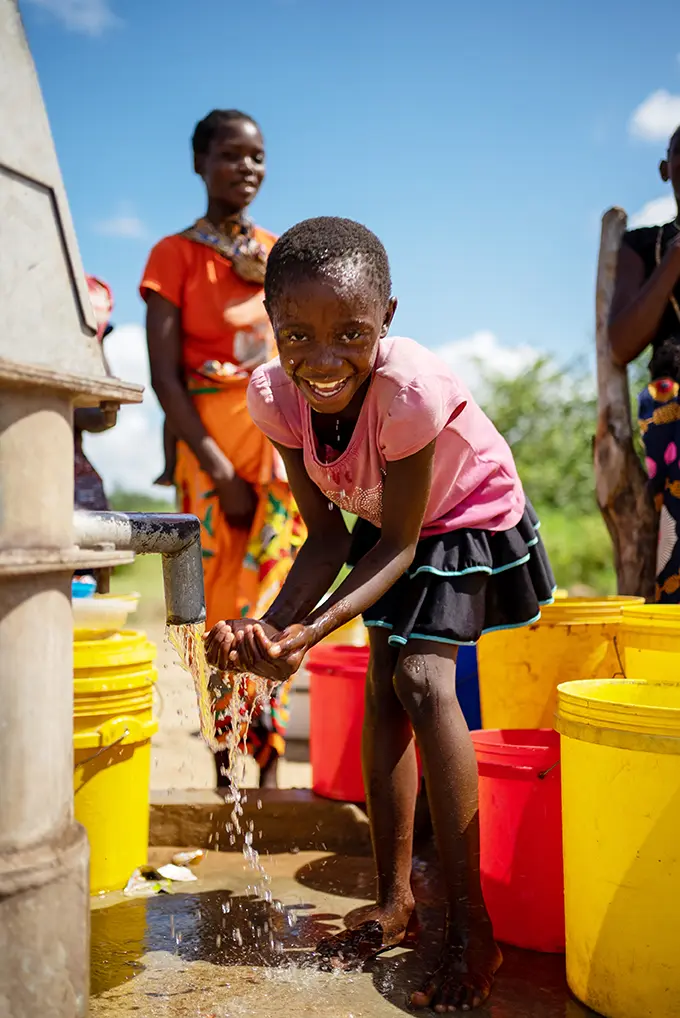
For the community of Lukanda B in central Zambia, the rehabilitation of the local water borehole has brought new life to the village.
It is one of 38 boreholes in Kapiri Mposhi District that Operation Eyesight repaired in 2022, thanks to a team of pump minders we have trained in the area. Locally available, safe water has made a difference in the lives of parents like Mutinta.
“When the borehole broke down in 2005, I was only able to wash my children’s clothes once or twice a month,” says Mutinta. “Now I’m able to wash clothes almost every day, because there is clean and safe water nearby.”
Before the borehole was fixed, Mutinta says her 15-year-old daughter, Memory, would frequently miss or be late for school because she had to walk long distances to fetch water for the family, a task that traditionally falls to girls. When Memory did attend school, she was often tired and her schoolwork suffered.
“I’m happy that my daughter will now be able to attend school regularly,” Mutinta adds.

Chali Chisala Selisho, our country director for Zambia, says that clean water nearby will play a key role in preventing the spread of trachoma, a bacterial eye infection that leads to irreversible blindness, as well as other diseases.
“Proper hand and face hygiene and sanitation are the best lines of defence against not only trachoma but other diseases like cholera, malaria, dysentery and diarrhea, which are on the rise in the area,” Chali adds.
Thanks to the generosity of our donors and the hard work of pump minders, Lukanda B’s future is bright!
Check out our new video from Zambia and learn more about how access to fresh water and sanitation is transforming the lives of individuals and entire communities.
For the past three years, headaches and watery red eyes were a constant reality for Tonnima, from a village in northern Bangladesh.
The 22-year-old works as a beautician and hopes to someday go to college, but vision trouble has meant difficulty reading, working and doing daily tasks at home.
“I thought that my sight problems would lead to bigger eye troubles in the future, which would affect my life,” she reflects.
Like many women in South Asia who face social barriers to seeking healthcare, Tonnima was embarrassed to tell others about her vision problems. She says her family felt helpless and anxious.
Tonnima was grateful to learn that there was a vision centre just a kilometre away from her home, where she received an eye exam, a pair of prescription glasses and eye medication.
The impact has been life changing.
“I’m very happy now, as I can see everything clearly and can do my regular work, and read and write,” Tonnima says.
“I hope to live a happy and prosperous life.”
Donate today to help make more dreams come true.

Thirteen-year-old Isaya shoulders more than most boys his age. As one of eight children in a farming family in the village of Inkinye, in Kenya’s Rift Valley, Isaya’s future livelihood has always depended on the success of the farm.
His father’s efforts to tend to the land deteriorated due to age, leaving the responsibility to the children. Despite worsening vision since childhood, Isaya has been responsible for helping with many of the farm chores.
“I was always worried for Isaya, especially when he took the cattle to graze, that he would be injured,” says his older sister, who works outside the home to support their family.
Isaya says his failing vision also made it difficult to read and complete his schoolwork. While other boys his age are in grade eight and preparing to enter high school, Isaya is in grade five at the local primary school. Sadly, their responsibilities at home and their lack of finances prevented Isaya and his family from seeking medical attention.
Last year, a local health worker, trained by Operation Eyesight, identified Isaya’s vision problems during a door-to-door screening. The screening was part of a larger community eye health project we’re implementing in partnership with CBM and Peek Vision. Isaya was diagnosed with cataract and referred to our partner Kajiado County Referral Hospital, where he received cataract surgery in one of his eyes, free of charge.

“Before the surgery, I could not clearly read the blackboard and had to sit near it so I could see what the teacher was writing,” Isaya says.
“I can now read without much struggle.”
With Isaya’s vision restored, his sister no longer has to skip work to assist him. She says she’s excited for what the future has in store for Isaya and their entire family.
“It is wonderful to see Isaya full of life and promise again,” she says.
“This blessing has ensured that both of our futures are secured and that our family will thrive!”
Donate to help provide the Gift of Sight for more children like Isaya.
In her village of Kormantse, in Ghana’s Central Region, 38-year-old Mabel wears many hats – she’s a single mom, a nurse and a leader in her community.
She’s also proof of the unique role women can have in impacting the health of communities across Africa.
“I was working as a community health nurse before I was invited to be trained as a primary eye care worker,” Mabel says, referring to her work with the care team at the government-run Kormantse Clinic. “There’s a high prevalence of eye conditions among the fisher folk in my community. The nature of their work makes them more likely to suffer from eye diseases. That’s why I joined the fight against avoidable blindness in the municipality.”
Today, thanks to the training she received through Operation Eyesight, Mabel provides education and eye health screening to others across the Municipality of Mfantseman. “I still carry out my duties as a community health nurse, but eye care is now well integrated in the things I do,” she says.

Vision impairment disproportionately affects women and girls across the globe, yet they are less likely to be prioritized for eye care. Lack of income and transportation are common barriers, as are traditional female responsibilities like child care and collecting water. That's why it’s so important to have women like Mabel trained to screen for eye conditions. She can reach women and girls at home, provide referrals, and offer the information and reassurances that some may need to seek treatment.
As a single working mom, Mabel needs to balance her work with caring for her young daughter. She says she enjoys the flexibility that comes with working with Operation Eyesight.
“Operation Eyesight supports me with transportation and meals when I go to the field,” she says. “I save part of my wages to pay for my child’s school fees.”

Mabel says she’s passionate about helping others, especially those experiencing poverty.
She recalls a patient whose story has stuck with her. Yaw, a 69-year-old man who lives in Kormantse, had been experiencing blurred vision for three years. Mabel says she visited his home as part of a routine door-to-door screening and quickly discovered that he had cataracts. She referred him to the base hospital for surgery, which he promptly visited the next day. He underwent sight-restoring surgery and today he can see clearly.
Other times, Mabel may face more reluctant patients, so part of her job is to encourage those who have had little interaction with the healthcare system to get treatment, and to assure them that it’s both safe and worthwhile. She adds that spending time with people in her community is what makes her work so rewarding.
“The job gives me the opportunity to interact with many people,” Mabel says. “My family sees this job as an opportunity to change the perception about eye health through education.”
March 8, 2023 is International Women’s Day – it’s an opportunity to spread the message of gender equality and highlight the importance of creating a society free of gender bias. It’s also a chance to celebrate the unique role women like Mabel play in communities globally.
Most of the community health workers trained by Operation Eyesight partner hospitals are women. When women are employed as community health workers, they have an opportunity to become trusted leaders in their communities and act as catalysts for positive health outcomes. This employment improves their ability to become active participants in their family’s socioeconomic stability.
Not only is empowering women and reducing gender inequalities the right thing to do, it’s also the smart thing to do. Evidence shows that empowering women is one of the strongest catalysts for driving sustainable development across all sectors. It enhances economic growth, improves education and increases positive health outcomes. You can learn more about our gender strategies by signing up for our eNewsletter.
For 38-year-old Shakuntala, healthy eyes are just one piece of a much larger puzzle when it comes to a person’s health and wellness.
In addition to being a full-time mom, Shakuntala also works as an Accredited Social Health Activist (ASHA) with the Government of India, providing healthcare and referrals for others in her community of Gadhara Village.
For the past eight years, she has provided advice to women regarding their pregnancies, referring several women each month to local health facilities. She has also supported home-based newborn care and vaccinations for children in her community.
Thanks to primary eye care training offered by Operation Eyesight in August 2022, Shakuntala can also identify common eye conditions and provide referral for those experiencing eye health issues.

“I got to learn a lot about eye health care,” she explains. “The training program has built my skills in measuring the vision of a person. Now I screen the eyesight of my community members with these simple techniques and refer them to Health and Wellness Centres.”
Dec. 12 is Universal Health Coverage Day – an opportunity to shine a light on the importance of smart investment when it comes to health services. Across the globe, millions of people still don’t have access to basic health care. Through training local health staff like Shakuntala, we are working to change that.
“We are helping ensure health care staff in the community have the skills and knowledge they need to deliver quality health care to people who need it,” explains Kashinath Bhoosnurmath, President & CEO of Operation Eyesight.
“Universal health coverage is needed now more than ever before. Equipping health staff through eye health training brings us one step closer to making that a reality.”
Shakuntala performs basic vision tests and identifies symptoms of conditions like cataracts, refractive error and pterygium – a growth on the eye’s conjunctiva. Armed with the knowledge and skills she gained both during her ASHA training and additional eye care training, she is able to address many of the determinants of health, including some of the root causes of avoidable blindness such as vitamin A deficiency and poor hygiene.
One of the key recommendations of the World Health Organization’s (WHO’s) 2019 World Report on Vision is to implement Integrated People-centered Eye Care (IPEC), as it will play a critical role in addressing the global eye health crisis. ‘Integrated' eye care is care that is part of the local health system. This often requires partnership with local hospitals and often means utilizing local health resources, personnel and infrastructure. ‘People-centred’ means focusing on the needs, preferences and values of individuals and communities.
IPEC has been a core component of Operation Eyesight’s approach for decades, because we focus on the unique needs of individuals and communities, as well as partner with local governments and health programs. In India, this includes opening local vision centres or vision points and recruiting local health workers who are predominantly women to conduct door-to-door screenings.
“Trainings give health care staff in a community the skills and knowledge they need to make eye health care a standard part of the care they provide. Ultimately, this helps make eye care both accessible and sustainable for a community long-term,” explains Dr. Troy Cunningham, our Country Director for India. “Training local health workers like Shakuntala is a key part of that.”
Operation Eyesight has been working closely with the state governments in both Arunachal Pradesh and Madhya Pradesh to establish vision care facilities within already-existing government health centres, such as Health and Wellness Centres. Additionally, we are providing training for ASHAs and other healthcare providers. This has helped make eye health care services available to the most underserved populations.
“Our approach helps ensure that we leave no one behind, especially girls and women, which translates into empowered communities that can care for their own health,” Troy adds. “This work is so exciting because it aligns with the transformative impact on India’s health system.”
For Shakuntala, it has enabled her to cater services to the unique needs of the patients and families she serves in her own community.
To donate to Operation Eyesight Universal and help provide training for more health workers like Shakuntala, click here.
With files from Subhadip Bhattacharya, Head, Resource Mobilization, Operation Eyesight.