

Across the globe, eye health took centre stage as Operation Eyesight teams celebrated World Sight Day on Oct. 13 with public eye health screenings, community education and other awareness events.
“World Sight Day is a reminder for us all to love our eyes and prioritize our eye health, but in many areas where we work across sub-Saharan Africa and South Asia, that’s easier said than done,” explains Kashinath Bhoosnurmath, President & CEO of Operation Eyesight.
“That’s why celebrations often focus on upping efforts to bring eye health care to places where it’s needed most, particularly in schools and in remote communities.”
In Ghana, our teams partnered with Ghana Health Service and hosted an eye health screening event at St. Mary Anglican Primary and Junior High School, where 334 students and teachers were screened for eye conditions, and nearly 100 were referred to our partner hospital, Watborg Eye Services, for further treatment.
“Eye health conditions will impact nearly every person in their lifetime, but due to a variety of factors, whether it’s financial or geographic limitations, eye health care is simply not an option for many people,” explains Emmanuel Kumah, our Country Director for Ghana.
“It’s partnerships with local leaders and the health system that made this year’s World Sight Day Celebrations such a success.”
But that was just the beginning.
In Kenya, community screenings and surgical camps screened 1,381 people and treated 749.
“We were honoured to partner with the Iten county government to break ground on the construction of the operation theatre at the Iten Eye Unit,” says Alice Mwangi, our Country Director for Kenya.
“This is an important step for the community, because it means eye health care will be available locally to patients with complex eye conditions. This is fantastic news for patients who will no longer have to travel long distances to receive care.”

In Zambia, our team hosted the country’s Vice President for the official opening of the Eye Unit at Maamba General Hospital, where nearly 300 people received eye health screenings, diagnosis and treatment. Additionally, our Zambia team, working together with other eye health NGOs, hosted community screenings at several locations in the Zambian capital city of Lusaka, as well as a screening event for Members of Parliament and staff.

“We were pleased to see so many government leaders come out to show their support and interest for eye health on World Sight Day,” says Chali Chisala Selisho, our Country Director for Zambia.
“It’s a sign that decisionmakers are beginning to take note of the importance of eye health. World Sight Day and other awareness activities are a big part of that.”
WSD in India and beyond
We didn’t stop there.
At Kompass Junior College in Hyderabad, India, our team hosted an eye health screening for 130 junior college students, and nearly a third of students screened were prescribed eyeglasses. Kompass was one of six school eye health screenings we hosted across the country to celebrate World Sight Day. It’s also part of a unique program where one school in turn ‘adopts’ another underserved school to receive free eye health screening.

Our India team also hosted nine other free eye health screening camps as part of World Sight Day 2022 celebrations. In all, 2,248 people were screened across India, with 344 patients identified as having eye conditions and referred to an Operation Eyesight vision centre or partner hospital for treatment. Our teams and partners also dispensed 100 pairs of prescription eyeglasses to people who needed them.
“Along with bringing eye health screening and care to the heart of the community, our World Sight Day celebrations also highlighted the need for more eye health facilities in rural parts of the country, where eye conditions frequently prevent kids from attending and thriving in school,” says Dr. Troy Cunningham, our Country Director for India.
“All this was bolstered by education and awareness activities, including the launch of new eye health materials, awareness rallies, and street plays at local parks and police stations.”
Throughout India, our 144+ vision centres in the community – including our newly-inaugurated vision centre in Jamalpur, offered free walk-in eye exams, regardless of patients’ ability to pay.
In partnership with local leaders, our teams also declared nine villages avoidable blindness-free – that is free of untreated cases of avoidable blindness and vision loss.
“The impact we are having together transforms not only individual lives, but entire communities,” Troy adds.
“These celebrations were the culmination of months of work by our teams, beginning with identifying villages, mobilizing local leaders and community members, hosting screening camps and validating our work.”

Troy also says that these events helped show just how effective our community-focused model is in the lives of both individuals and entire communities.
A global issue
In Canada, ahead of World Sight Day, Operation Eyesight and others took to Parliament Hill, as we were invited to meet with Members of Parliament and Senators to advocate for the development of a national eye care strategy that will support equitable access to eye health care.
Additionally, we promoted the World Sight Day #LoveYourEyes theme across social media and were featured on CTV Morning Calgary sharing tips on how Albertans can love their eyes and support our sight-saving work.
“It’s the passion and tireless efforts of our local staff, volunteers and partners that made World Sight Day 2022 one for the books,” says Elizabeth Roden, Director of Marketing and Communications.
“World Sight Day highlights the important work our teams are doing worldwide all year round. It’s proof of what we can accomplish, together.”
For seven-year-old Misba, the Gift of Sight has meant so much more than a pair of prescription eyeglasses – it’s also been a chance to thrive at school and build connections with friends.
For her parents, who live with their daughter in a small village in West Bengal, India, it’s the unmistakable way Misba’s eyes now light up when she looks up at them.
It wasn’t always this way. Her father, Mahabul, and mother, Ruku, say worsening vision issues made it impossible for Misba to read a book without great difficulty, and their usually happy daughter often became irritated during play and at school.
Sadly, financial hardship prevented them from seeking help for their daughter.
When an Operation Eyesight health worker knocked on the family’s door, it was a turning point in the little girl’s life. After screening Misba’s eyes, the health worker identified her with myopia – better known as nearsightedness. She was referred to the Operation Eyesight vision centre near her home and partner hospital Siliguri Greater Lions Eye Hospital, where she received an eye exam and a pair of corrective eyeglasses.
Today, Misba is thriving in school and happily playing with her friends.
Vision loss: the world’s most unaddressed disability
Almost everyone on the planet will experience an eye health issue in their lifetime. Although 90 per cent of vision loss is treatable or preventable, today more than a billion people still don’t have access to eye care services to correct, treat or prevent vision loss.
“In communities where we work across sub-Saharan Africa and South Asia, untreated vision loss often closes the door to getting an education, particularly for girls, who are disproportionately impacted by eye health problems,” explains Kashinath Bhoosnurmath, our President and CEO.
“Thanks to the generosity of our donors, we are not only providing prescription eyeglasses and life-changing surgery to those who need it – we are also transforming entire communities.”
Together, we are creating a world where quality, affordable and inclusive eye health care is available for everyone, everywhere. We are also improving people’s overall health and well-being, bringing local access to clean water and sanitation, and improving equality for women and girls, who are more likely to suffer poor vision and less likely to get treatment.
The Gift of Sight: the gift that keeps on giving
By giving the Gift of Sight this holiday season, you can give a child like Misba the chance to learn and thrive.
You can give a parent the ability to provide for their family and care for their children.
You can give a senior the gift of independence.
Misba’s parents say they are grateful for the care she received at their local vision centre and for the health worker doing door-to-door eye health screening in their community.
Most of all, they are relieved that they have their joyful, bright-eyed daughter back. Misba’s smile says it all!
Please give the Gift of Sight today, so you can restore sight for more children like Misba tomorrow.
From learning in the classroom to playing in the schoolyard and at home, vision is vital to how kids grow and develop – so vital in fact, that up to 80 percent of early learning is visual. Whether you're two or 102, vision plays a key part in quality of life.
Dr. Boateng Wiafe, our technical advisor and author of The healthy eyes activity book: A health teaching book for primary schools, says there are five things everyone should do to take care of their eye health.
1. Book that annual eye exam – In Canada, some provinces offer free eye exams to children and seniors as part of provincial health care. Just like regular visits to the dentist, annual eye exams should be part of your family’s self-care routine.
2. Know the signs – Identifying a vision problem early is a critical first step. If you or a family member squints, tilts their head, closes or covers one eye, has difficulty concentrating or needs to sit close to the TV, these are all signs that a vision problem could be at play.
3. Limit screen time – A 2021 study found that extended screen time is associated with a 30 per cent higher risk of myopia (nearsightedness) and therefore needing prescription eyeglasses. When combined with excessive computer use, the risk more than doubles, reaching approximately 80 per cent.
What’s a person to do? Remember the 20-20-20 rule – every 20 minutes, look at an object approximately 20 feet (six metres) away, for 20 seconds. Pro tip: it works for both kids and adults!
4. Get outside – Getting outside to walk, play or move is a great way to take a break from screens – not to mention get some fresh air and vitamin D. According to the Canadian Association of Optometrists, increased time outdoors protects people from the onset of myopia, or nearsightedness.
5. Protect your eyes – Besides making you très cool, the right pair of sunglasses protects eyes from ultraviolet rays from the sun. Also remember to stay safe and avoid eye injuries by using protective eye gear when you’re doing household chores and ensuring your kids have the right eye protection for sports.
Visit our child eye health page for a free eye health tip sheet and activity sheet for kids.

In 2021 we distributed 186,400 pairs of prescription eyeglasses to people who need it across Africa and South Asia, including children like six-year-old Misba from the Jalpaiguri district of West Bengal, India.
In focus: global eye care
In many parts of South Asia and sub-Saharan Africa, lack of access to proper eye care isolates children from their peers and often prevents them from attending school.
For adults, vision loss and lack of adequate eye health care can impact a person's ability to work, care for their family and build social connections.
Through our community eye health programs, we are giving children, women and men access to prescription glasses, treatment and surgery, with the help of our partner hospitals and through the generosity of our donors.
Whether you live here in Canada or in one of our countries of work across Africa and South Asia, we believe everyone should have access to affordable, high quality eye health care.
Learn more about what you can do to help make eye health services accessible for all.
For more eye health information and the latest news from Operation Eyesight, subscribe to receive our emails.
As a teacher working in special needs education in Uasin Gishu County, Kenya, Mary Benzo has seen the difference eye health care can make in the lives of students.
As part of our school eye health program, we trained Mary and other school staff to do vision screenings using the smartphone app Peek Acuity.
Students are then referred to one of our eye units if they need more testing or need prescription eyeglasses. We also connect patients with one of our local partner hospitals if additional treatment is required. Mary says seeing children thrive is the most rewarding part of her work with students.
“When they were given their glasses, they were very happy because their self-esteem was raised up,” Mary recalls.
“They had the confidence to socialize, because they are able to study and read fine details and see on the blackboard.”
Mary has helped identify students who need eyeglasses, students with cataract or tumors, and those suffering from allergies.
“As an eye screener...when learners come for an eye assessment, if there is an eye issue, I use my smartphone to screen them,” Mary explains.
“I feel very much empowered.”
Mary says the benefits of school screening don’t stop at the end of the school day. She says it’s rewarding to see the impact access to affordable eyecare has on not only students but their families at home as well.
“I have learned that I can talk to their parents, to the children and screen them,” she adds. “I’m proud that I’m able to reach the unreached.”
When six-year-old Piu began experiencing painful watery, red eyes, blurred vision and headaches, her mother, Sathi, and father, Dipongok, were understandably worried.
“I felt sad that others could read and write in class while my child was unable to do that,” Sathi says.
Piu, who lives with her parents and four-year-old brother in Bangladesh, began losing interest in her studies.
Anxious and helpless, Piu’s parents feared what their daughter’s future might look like.

During a community screening at Piu’s school, our local health workers referred her to a vision centre less than a kilometre from her home, where she received prescription eyeglasses and medication for her eyes.
With Piu’s vision restored, her parents say they no longer worry about her future and are confident their daughter will thrive at school.
Amandah is a girl with big dreams.
“I hope to be a designer when I grow up,” explains the fourth grader in Uasin Gishu County, located in Kenya’s Rift Valley region.
Sitting in class, Amandah throws her hand into the air as her teacher asks the class a math question – but it wasn’t always this way.
“Before I got my glasses, I couldn’t see very well from afar, no matter how close I was to the blackboard,” says Amandah.
Last year, she received free prescription eyeglasses through our school eye health program. Launched in 2021, the program has to date screened more than 86,000 children and 2,200 teachers for eye conditions across 220 schools in the county.
It’s part of our focus on achieving the UN’s Sustainable Development Goals, including improving access to quality education and achieving gender equality. Thanks to partnership with Kenya’s national government, Peek Vision and the United States Agency for International Development’s (USAID’s) Child Blindness Program, more than 8,000 students have been identified as having eye conditions and were referred for treatment.
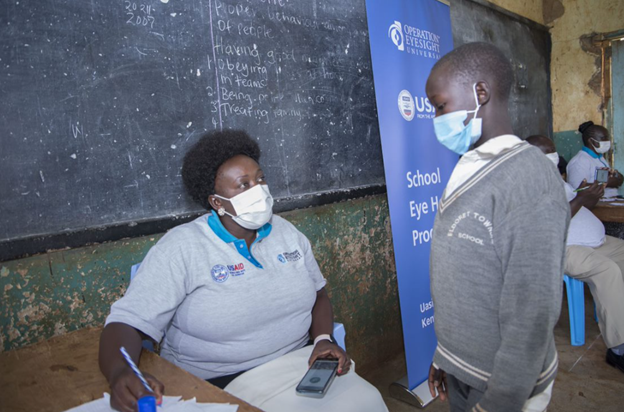
“People often do not seek eye health care – or are simply unable to access it – for a variety of reasons,” says Alice Mwangi, our Country Director for Kenya. “We also know that women and girls are more likely to suffer vision impairment and face barriers to care.”
Today, we’re partnering with communities, focused on expanding school eye health programs in Africa and South Asia. “I would like to thank the people who gave me the glasses,” says Amandah. “Now that I can read and see well, I hope I will be able to achieve my dream.”
Learn more about our school eye health programs and how you can help.
This story and media content is made possible by the generous support of the American people through the United States Agency for International Development (USAID). The contents are the responsibility of Operation Eyesight Universal and do not necessarily reflect the views of USAID or the United States Government.
Have you ever wondered how we managed to screen more than 70,000 students and nearly 2,000 teachers in schools across Kenya in 2021?
The answer: partnership.
Sharing ideas and expertise has made all the difference for Operation Eyesight and Peek Vision. For both organizations, collaboration has spurred innovation and led to more lives changed.
“We have a special place in our heart for Operation Eyesight – especially in Kenya, because Operation Eyesight was our first real partner from the beginning of our work there,” explains Farhana Rehman-Furs, head of Programme Partnerships at Peek Vision.
“At the time, Peek was still in the research and development phase. But Operation Eyesight has been involved from the beginning, really through the product development phase.”
Peek Vision offers smartphone and software-based tools that enable staff and volunteers to perform school and community eye health screenings, as well as capture and analyze data. Developed by eye health experts, Peek is using the power of technology to bring better vision and eye health to everyone.

Peek is relatively unique in their space and in a short time has become a key player in providing technology and public health-based tools to help eye health providers optimise their services. Think tech start-up meets NGO.
In its 10-year history, Peek has continued to evolve from initially developing hardware and software to detect eye health issues, to eventually focusing on holistic solutions that cover eye health programs from screening to referral.

“We knew this was an area where we could have the most impact – working with program providers and existing health systems, using Peek’s software.”
Since the early days of research and product development, the meeting of minds between our two organizations has blossomed into larger projects involving more partners.
In 2015, Operation Eyesight and Peek Vision first partnered with Standard Chartered Bank and Kenya’s ministry of health, in a trial school screening program covering 50 schools across Trans Nzoia County. In just nine days, using the technology, we were able to screen 20,000 children for eye conditions and identified 900 students with visual impairment.
The following year, we scaled up Kenya’s school eye health screening program to reach 168,000 children. Our goal is to provide treatment to at least 90 per cent of children identified as having a visual impairment receiving. The rest is history.
Today, we are collaborating across the eye health sphere, including the Vision Impact Project in Kenya, where we are partnering with Peek, Kenya’s ministries of health and education, as well as Christian Blind Mission (CBM). Together, we are focused on school eye health screening, eye health education, prescription eyeglasses, along with referral of students and school staff who need additional treatment.
Our CEO and President Kashinath Bhoosnurmath says that although our teams bring very different skills and expertise to the table, we have the shared goal of bringing eye health care to communities and individuals who need it most.

“One thing that our organizations have in common is that we are both innovators,” explains Kashinath. “It’s about increasing the impact we can both have together, by listening to the needs of communities, and continually adjusting our course.”
Together, we are leveraging the power of data to make eye health programs as impactful as possible in schools and communities. How? By focusing on public health principles and methodologies.
“We are able to understand why people aren’t seeking treatment and work with implementation partners like Operation Eyesight to help teams on the ground adjust how they deliver care,” Farhana says. “Because our software provides real-time data, program implementers can respond in real time.”
Partnering with local health systems is a key part of both Peek and Operation Eyesight’s ability to have impact. For example, for our school eye health program in Kenya, we are partnering with Kenya’s ministry of health and ministry of education.
Both organizations are also utilizing data to identify gaps and bottlenecks in local health systems.
“One part of our success is our ability to work within and bring value to existing health systems, and build partnerships with facilities and institutions that can deliver advanced eye care,” Kashinath says.
“Focusing on enhancing existing services and existing infrastructure really ensures that our impact is sustainable.”

In Kenya, where we first began working together, Peek and Operation Eyesight teams are meeting with stakeholders, as part of the Vision Impact Partnership led by CBM, to design the workflow that will become part of the software in Kajiado County, located in the country’s arid southwest.
Both organizations are also focused on involving communities from the very beginning of a project.
“Making eye health screening available on a smartphone app is a game changer,” explains Alice Mwangi, our Country Director for Kenya. “In our partnership with Peek, both teams play an important and necessary role. Peek delivers the tool, but bringing this to students and staff is where we come in. Really, it’s a perfect match.”
The sky’s the limit when it comes to data and how it can improve patient experience and our ability to reach more people with eye health care.
From following patients through their entire eye health care journey, to connecting people with their local healthcare system to understanding trends in gender, Farhana says the future of eye health care is partnership.
“It’s about how we leverage data and use learnings to have more impact in terms of vision restored and lives changed.”
This story and media product are made possible by the generous support of the American people through the United States Agency for International Development (USAID). The contents are the responsibility of Operation Eyesight Canada and do not necessarily reflect the views of USAID or the United States Government.
Our school screening programs in Kenya are also made possible through the generosity of Standard Chartered Bank.

For more project insights and our latest news, subscribe to receive our emails.
We recruit and train health workers and volunteers from the community, who provide vision screening, referral, health assessments and health education.
Across South Asia and Africa, these local eye health champions also reached nearly 800,000 people with education sessions about key health issues, like child and maternal health.
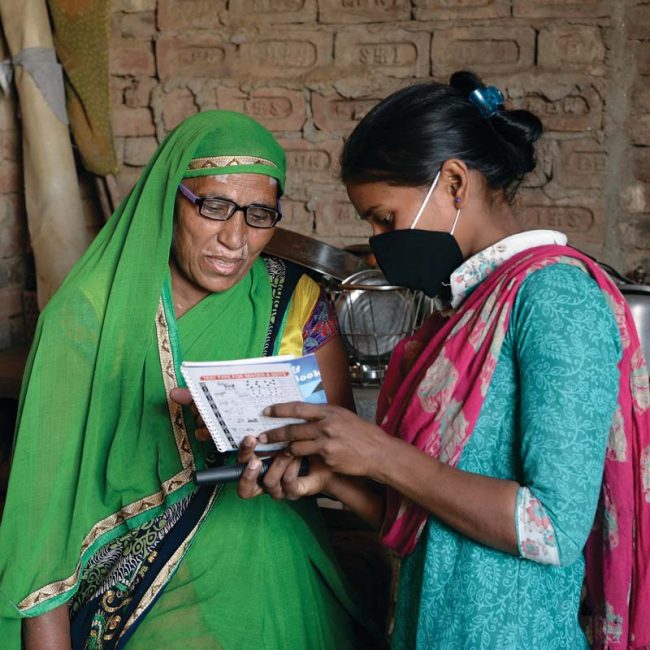
After Sonam’s mother received sight-restoring cataract surgery at one of our partner hospitals, she was inspired by the impact it had on her entire family.
“My mother’s surgery helped me experience the impact avoidable blindness can have on a family,” she says. “I was impressed by her visual outcome. I got free of my duties towards my mom and took up new responsibilities.”
In addition to now being able to work in the pasture and feed cattle, Sonam has been trained as a community health worker and joined our India project team.
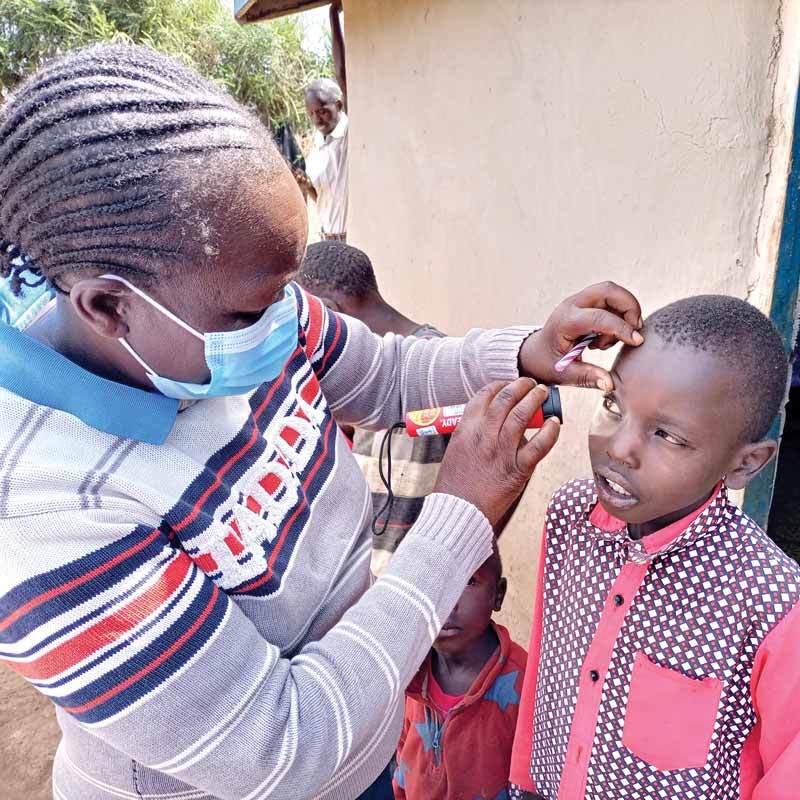
For Salina, what makes her work doing door-to-door screenings rewarding is the appreciation of patients and families in her community.
“Working as a community health volunteer makes me interact with the community, who appreciate the help they get through the door-to-door screening program,” she explains.
Learn more in our 2021 Annual Report at operationeyesight.com/annual-reports/annual-report-2021/.
If you ask Joana Annobil what it’s like to pursue a degree in ophthalmic nursing, her answer is simple.
“It’s a dream come true,” she smiles.
Growing up, Joana remembers her grandmother going blind but not seeking treatment because blindness was believed to be caused by spirits.

"If they knew about eye services, they wouldn't have gone blind," she says.
Now in her final year at the Ophthalmic Nursing School in Korle-Bu, Accra, Joana says she is most excited that her presence in her community will have an impact on the health and quality of life of her neighbours as well as Ghana’s health system.
“Becoming an ophthalmic nurse will help improve the state of human resources for eye health in Ghana, especially in my district of Awutu Senya, where the need for eye health services is very high,” Joana explains. “The people at the community level will have quality eye care services at their doorsteps.”
Joana says that after her schooling she will return to her district and provide eye health care in her own community.
"They are expecting much from me, because in the whole district there is no eye nurse and there is no clinic apart from Watborg Eye Services."
Her school, Ghana’s only institute of its kind, recently upgraded from providing diplomas to awarding academic degrees, thanks to Operation Eyesight in partnership with the International Agency for the Prevention of Blindness. It’s a step up for Joana and her whole community.
“This will enhance my career in the health service,” Joana adds. “I’m extremely grateful to Operation Eyesight for funding my studies.”
If you like reading stories like Joana's, make sure you are subscribed to receive our emails so you don't miss out.
It's our team's passion for working in the field and caring for patients that allowed us to impact more lives in 2021.
“I have seen people who never expected to see again, because eye care services were far out of reach, not affordable and not accessible. They waited for their death,” explains Bitul Hazarika, a paramedical ophthalmic assistant with one of our partner hospitals.
“But when we reach them…with services and care to see again, I feel satisfaction of seeing these people smiling and thanking us for the services.”
Bitul has been working in the field since 1996. In addition to working in a vision centre, over his 26 years of service he has attended more than 500 screening camps, provided prescription eyeglasses to 700+ people and referred more than 300 patients for surgery.
Today, he’s working to make his home state of Arunachal Pradesh completely free of avoidable blindness.
Learn more about what we did in 2021 in our Annual Report by visiting operationeyesight.com/annual-reports/annual-report-2021/.