


Samson Keitany is Head of the Eye Department at Huruma Eye Unit, our partner in Uasin Gishu County, Kenya.
“2021 was a blessed year for us. Despite the COVID-19 pandemic, our work in serving the community continued from the support we received from Operation Eyesight," Samson says.

"We started the year with school screening that saw an influx of workload at the eye unit. Our patients had their eyesight restored courtesy of consumables and spectacles we received from Operation Eyesight. When our patients are happy, we are also happy.”
Learn more about the impact we had in 2021, together, at operationeyesight.com/annual-reports/annual-report-2021/.
Did you know trachoma is the leading cause of preventable blindness in Kenya and many parts of Africa?
This painful bacterial infection causes irreversible blindness if left untreated. Worse yet, women and children are more likely to contract this condition.
We are supporting the distribution of antibiotics in Kenya’s Narok County to treat and reduce transmission of trachoma. This is happening in partnership with the local Ministry of Health and other partners, with the goal of eliminating trachoma from the county by 2025.
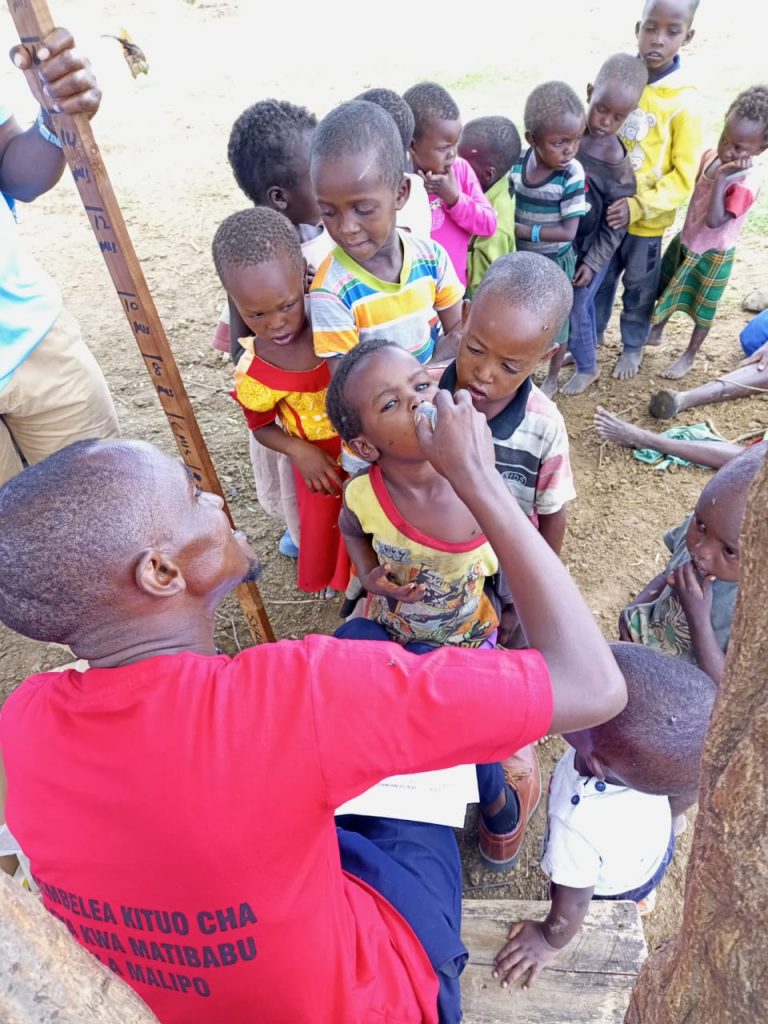
“Narok is home to many who raise cattle, which attracts flies that spread trachoma. We are now building on the success of our work to date in the area,” explains Alice Mwangi, our Country Director for Kenya. “Treating and preventing transmission of trachoma through distribution of antibiotics is one of the most effective ways to eliminate this condition from entire regions.”
In 2021, our Kenya team distributed antibiotics to more than 460,000 people in Narok, covering nearly 90 per cent of the target population for this program. In summer 2022, we are leading another planned Mass Drug Administration (MDA) in the region.
Our trachoma elimination projects are designed to implement all four components of the World Health Organization-recommended SAFE strategy:
• Surgery to treat advanced cases of trachoma;
• Antibiotics to eliminate infection, which includes Mass Drug Administrations (MDA);
• Facial cleanliness; and
• Environmental improvement such as wells, boreholes and latrines.
Today, nine-year-old Aaliya from the village of Vallabhnagar in Rajasthan can go to school and play with her friends – but it wasn’t always this way.
Failing vision from the age of three meant the gradual loss of sight in her right eye. Aaliya’s family took her to several hospitals seeking treatment, but these efforts were in vain; Aaliya could get neither diagnosis nor treatment.
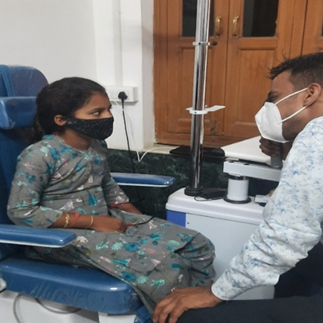
It wasn’t until an Operation Eyesight community health worker met the family during a door-to-door screening that Aaliya was directed to one of our local vision centres, where she was diagnosed with a squint. Also called a strabismus, this condition causes the eyes to point in different directions. If not treated early enough in life, squints can cause vision to be blurry or doubled and can impact how eyesight develops during childhood.
Aaliya was referred to our partner hospital, Alakh Nayan Mandir, for further treatment. She received prescription eyeglasses and over a number of months, received patching on alternate eyes to treat her eye condition. Doctors told her family that without proper and timely treatment, Aaliyah would have lost her vision.
"We never expected such an improvement in her vision,” says Aaliya’s father, Yusuf. “We are delighted.”
By partnering with hospitals and establishing a local presence in communities, we are strengthening India’s health system and making eye health care a standard part of primary health care. This approach allows us to bring quality eye care to patients like Aaliya, who were previously unable to access these services, as well as connect them with their local health system.

In the last six years, we have established more than 140 vision centres across India that provide eye exams, dispense prescription eyeglasses and refer patients to hospital for specialized treatment if needed. These self-funding facilities are established in accessible locations and staffed by trained eye health personnel.
Blindness and visual impairment are major public health issues in India, which is home to more than 20 per cent of those who are blind or visually impaired worldwide. The good news is 90 per cent of blindness and visual impairment is treatable or preventable.
Through the support of our donors and partners, in 2021 we referred nearly 150,000 patients for sight-saving surgery in India and provided nearly 160,000 pairs of prescription eyeglasses to patients who would not otherwise be able to afford them.
“A key part of our success is investment in infrastructure and training,” explains Troy Cunningham, our Country Director for India. “By training staff to deliver primary eye care and equipping facilities with the tools they need, we are ensuring the sustainability of our impact, long-term. We believe this approach can be replicated in states across India and are working with state governments to achieve this.
We also recruit and train hundreds of female community health workers, who who provide door-to-door eye health screening in target communities. These local eye health champions identify patients requiring care or referral to hospital. They also provide health counselling and education regarding various health issues, including maternal and child health.
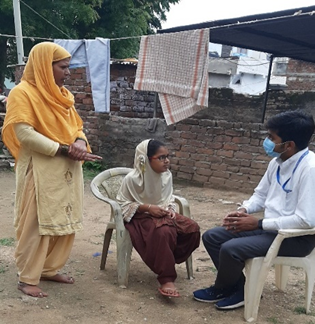
Remaining present in the community this way allows us to deliver eye health care that is truly integrated, because it's eye care that is preventive, provides treatment and follow-up care for all eye conditions. This integrated approach to eye care allows us to focus on the individual needs of patients and families.
By focusing on gender equality, promoting health and access to health services and bringing clean water and sanitation, we are also helping end poverty and the root causes of blindness. Together, we are helping achieve the UN Sustainable Development Goals (SDG).
The Government of India’s “Ayush Bharat” program aims to provide free access to healthcare to 500 million people nation-wide. While eye care is included in this program, many gaps still exist which prevent many Indians from accessing quality eye care.
By supporting policy development on eye health, establishing referral pathways, training staff and establishing facilities, Operation Eyesight is playing a key role in shaping India’s health system. Thanks to our partnership with state governments in Arunachal Pradesh and Madhya Pradesh, our primary eye care program is making eye care a key part of local primary health care in these regions.
“We are focused on strengthening existing health systems as well as equipping communities to look after their own eye health long-term,” explains our Global Director of International Programmes Vikas Gora.
“Eye care is primary care – thanks to our donors and partners who make our work possible, we are making this a reality in India.”
Visit operationeyesight.com/india/ to learn more about our work in India.
The presence of a vision centre in one Indian community has played a key role in the reduction of blindness and visual impairment for local patients and families, according to a new study published in the Indian Journal of Ophthalmology.
Over the course of the four-year study, the prevalence of blindness and visual impairment in the community was reduced by nearly 62 per cent.
It’s confirmation that Operation Eyesight’s focus on strengthening local health systems and empowering communities to look after their own eye health is not only effective, but also sustainable.

“We have known for some time that the presence of vision centres in a community, supported by door-to-door outreach, has a measurable impact on health outcomes for patients and families,” explains Kashinath Bhoosnurmath, our President & CEO and co-author of the study.
“Data like this only helps us become more effective in achieving our mission of preventing blindness and restoring sight.”
The study looked at approximately 44,000 people living in an urban slum area in Pune, Maharashtra, India, who were surveyed at a four-year interval by local health workers in the community. Patients identified as having vision loss were referred to Operation Eyesight’s local vision centre partner for more comprehensive examination and treatment if necessary.
Vision centres also have referral pathways in place for patients who require referral to hospital for surgery or additional treatment.
Over the course of the four-year study, led by Community for Eye Care Foundation, Pune and our team in in India, 8,211 patients were examined at the local vision centre. During this time, the prevalence of blindness due to conditions such as cataracts decreased from 0.25 per cent to 0.1 per cent over four years, and visual impairment decreased from 0.16 per cent to 0.05 per cent.
Vision centres are permanent facilities, established in strategic locations within a project area and staffed by trained eye health personnel. In addition to linking the community with the hospital, vision centres also provide eye exams, dispense prescription eyeglasses and refer patients for specialized treatment if needed. Vision centres are critical hubs for communities that do not have access to the most basic of eye healthcare, either due to economic or geographic factors.
“By providing access to prescription eyeglasses, eye health screening and referral to hospital, the decrease in rates of visual impairment and blindness in this community can be attributed to the presence of the local vision centre,” explains Bhoosnurmath.
Operation Eyesight’s focus on involving the community at every stage of a project has ensured the sustainability of our vision centres. This includes ensuring that demand is in place for the vision centre’s services and that a flow of revenue will fund the provision of services long-term.
Operation Eyesight has established 160+ new vision centres across India. Most vision centres become self-funding within six months of operation.

“The key to the success of vision centres is our ability to recruit local community health workers who provide door-to-door eye health screening,” says Soumya Moosa, one of our Program Managers in India and co-author of the study.
Moosa says this type of grassroots outreach in the community is particularly beneficial to health outcomes for women.
“The study found that women continue to have a higher prevalence of blindness and are less likely to seek care in low-income communities like the one surveyed. This is why the counselling by local female health workers is so pivotal to the project’s success.”
To learn more about our work in India, visit operationeyesight.com/india/
For more project insights and our latest news, subscribe to receive our emails.
When 62-year-old Lucia lost her left eye and then began losing vision in her remaining eye, she lost more than just her sight; she lost her art and source of income.
She also struggled to do her daily chores at home and on the farm.
After more than a decade in near-blindness, she received sight-restoring eye surgery and eyeglasses free of charge after being referred by an Operation Eyesight Community Health Volunteer (CHV) last year, during a door-to-door survey.
In addition to reminding us of the importance of taking charge of our eye health, Lucia taught us that an awkward hard-shelled fruit could be a work of art.
“I can now decorate my gourds with beads and make clothes,” she says. “This is something I abandoned 11 years ago.”
Lucia’s village of Lamaon in Kenya’s Elgeyo Marakwet County is one of 15 villages across the county that was declared avoidable blindness-free last year, bringing us one step closer to our goal of declaring 50 villages in the county free of cases of unidentified refractive errors, cataracts and other conditions.
By empowering volunteers to screen others in their community for vision problems, we are able to identify community members with vision problems and refer them to an eye unit or partner hospital for care.
CHVs also provide health education to communities regarding primary eye care and child and maternal health.
We conducted refresher training for 10 CHVs in Kenya in 2021, out of 82 volunteers that we work with. This community-based team reached 4,477 people in their communities with health education and eye health screening last year.
“It’s our Community Health Volunteer presence in communities that ensures these communities are free of avoidable blindness not just this year but in years to come,” explains Alice Mwangi, Country Director for Kenya.
In the village of Kwanga, in southern Zambia, the rehabilitation of a borehole has meant local access to abundant, fresh water for the entire community.
For Natasha, it’s brought the ability to attend school full time. Previously, she had to walk several kilometres each day to fetch water for her family. This took so much extra time and energy that she began missing school.
Together, we rehabilitated Kwanga’s borehole in 2021. It’s one of 96 non-functioning boreholes that we have rehabilitated in the past three years, in addition to the 106 that we have drilled in the Sinazongwe district, in Zambia’s arid south.
This has helped eliminate blinding trachoma infections from the district. Locally-available water has also brought a host of benefits across communities like Natasha’s, including improved health outcomes, thriving local economies and improved opportunities for women and girls.
"Access to fresh water prevents the spread of trachoma and other infections and also brings many benefits to the local community,” explains Vikas Gora, our Global Director of International Programs.

Now that the borehole in her village is functioning again, Natasha and several other girls in her class no longer have to haul water for long distances, and they are back attending school full time.
Access to clean water doesn’t just help reduce the spread of infection — it brings long-lasting and sustainable change to the entire community.
Thanks to our donors and partnerships with local Water, Sanitation and Hygiene (WASH) committees that are trained to maintain boreholes and ensure their longevity, we’re creating a ripple effect that is being felt in other communities across Zambia.