

Women play a critical role in the advancement of global health, both in formal roles and informally within their families and communities, but men continue to hold the majority of leadership positions. Women make up 75 percent of the global healthcare workforce, yet occupy less than 25 percent of the most influential leadership positions.[1]
Globally, women experience a disproportionate burden of disease and death due to inequities in access to basic health care, nutrition and education.[2] Women’s leadership in global health is essential to address these inequities, because women know first-hand the unique barriers women and girls face when accessing health resources. Therefore, they need to be involved in decision-making processes in addressing these gaps in health provision.
Shortly after COVID-19 was declared a pandemic, United Nations Secretary General António Guterres urged governments to put women and girls at the centre of their efforts.[3]
“That starts with women as leaders, with equal representation and decision-making power…Gender equality and women’s rights are essential to getting through this pandemic together, to recovering faster, and to building a better future for everyone.” - António Guterres
In Kenya, our Country Manager Alice Mwangi provides overall strategic direction and leadership for our Kenyan programs. Alice is a public health specialist with a wealth of experience in developing, managing and implementing programs. In her role, she develops valuable partnerships with hospitals, the Ministries of Health and Education and other non-profit organizations. These relationships are essential for implementing our flagship Hospital-Based Community Eye Health model.

Women have been bearing the brunt of COVID-19 around the world.[4] Alice knows first-hand that it is important to empower women to become catalysts of change to address health issues and create a lasting impact. Under her leadership, our COVID-19 response in Kenya focused on training female community health volunteers to provide critical health information to their communities. In total, these community health volunteers provided health education on COVID-19 to 602,366 individuals.
Globally, 55 percent of people experiencing vision loss are women or girls.[5] This is partially because women tend to live longer than men and are therefore at a higher risk of age-related eye health issues such as macular degeneration. In many of the countries where we work however, women face more barriers than men when accessing eye health services.
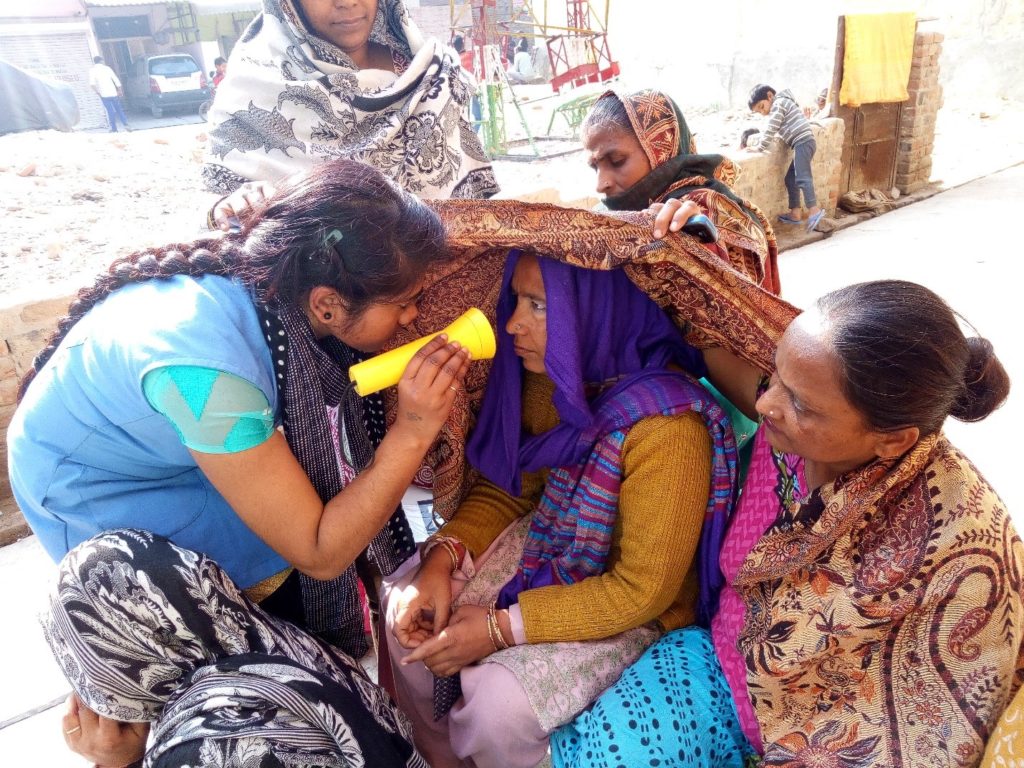
We’re working with communities to empower them to take ownership of their eye health needs, starting with female community health workers. Women like Pinky, an Operation Eyesight-trained community health worker from Berasia, India, are champions of eye health in their communities. Pinky, who is a single mother, visits households in nearby villages to screen people for eye conditions and refer them for follow-up care if needed. In this role, she is not only able to help people in her community, but she’s also able to independently support herself and her daughter without assistance from male family members.

Because of this, Pinky has become an inspiration to many young girls in her village. They look up to her for her tireless work ethic and independence. She says she finds her work so rewarding that she hopes that her daughter will one day also choose to work in the eye health sector. Pinky and many other female community health leaders like her are helping move the dial on eye health inequity.
In celebration of #IWD2021, we #ChooseToChallenge inequities in eye health and support female leadership in global health.
[1] https://www.lshtm.ac.uk/research/research-action/women-leaders-global-health
[2] https://www.ncbi.nlm.nih.gov/pmc/articles/PMC4167801/
[3] https://www.unwomen.org/en/news/stories/2020/4/statement-sg-put-women-and-girls-at-the-centre-of-efforts-to-recover-from-covid19
[4] https://news.un.org/en/story/2020/09/1071502
[5] https://www.iapb.org/learn/vision-atlas/inequality-in-vision-loss/gender/
The pandemic has forced organizations in nearly all sectors to shift their approach to work. This is particularly apparent in the international development sector, which in the past, has relied heavily on staff travelling from high-income countries to implement and monitor programs in low- or middle-income countries. With travel restrictions in place for the foreseeable future, many organizations are having to rethink their strategies.
Fortunately, Operation Eyesight’s approach of providing locally-driven solutions meant we were well-positioned to continue implementing and monitoring our programs in the long term, despite the challenges presented by the pandemic. Although Operation Eyesight is Calgary-based, a significant factor in our success is that we have team members in five countries across three continents. In our experience, we have found that the best way to ensure the success and sustainability of our work has been to apply the principle of localization to our work.
What does localization mean? The International Council of Voluntary Agencies defines localization as a process where international humanitarian actors shift power and responsibilities of development and humanitarian aid efforts toward local and national actors. Localization helps ensure that those who would benefit from the proposed initiative are a part of the solution, meaning they are consulted during every stage of the project, from design through implementation. When local actors are part of the solution, it ensures accountability and the long-term sustainability of the initiative. By strengthening the capacity of local and national actors, we can also enhance the speed, quality and scale of international development and humanitarian response efforts.
As an international development organization, we know we have a responsibility to increase the meaningful participation and leadership of local actors within our work – and we’re accomplishing this through our international and intercultural team, community-focused programs and network of local partners.
Equipped with knowledge of the local language and culture, the staff from our country offices tailor our programs to ensure they are meeting the specific eye health needs of the local communities. This helps to ensure that our initiatives are culturally appropriate and work within existing systems. It also meant that we were able to respond to the pandemic quickly by pivoting our day-to-day activities and utilizing our local team members to help our partner hospitals respond to the immediate threat of COVID-19.

Our program model is community focused. We believe in local solutions by local people. Operation Eyesight-trained community health workers empower people by giving them the knowledge and tools they need to care for their families. By amplifying local actors and engaging them in the solution we can effectively increase the sustainability of our programs.
Partnering with local governments and hospitals is the cornerstone of our work. We work with our network of over fifty-five partner hospitals to ensure they have the personnel, facilities and supplies available to provide quality eye health care to everyone in the surrounding communities. We also establish vision centres that serve as a link between the hospital and community. Vision centres are local eye health facilities equipped with the staff and resources to perform eye health screenings and basic eye health treatment procedures, eliminating the need for long-distance travel to regional eye hospitals. These vision centres are locally owned and financially self-sustaining, which helps to ensure the long-term impact of our efforts.
Operation Eyesight is committed to continuously improving and strengthening our model to ensure we carry out our mission to prevent blindness and restore sight in the most sustainable and impactful way possible.
This International Development Week, we invite you join us as we #GoForTheGoals. Click here to learn how our work contributes to the achievement of the Sustainable Development Goals.
Universal Health Coverage (UHC) is about ensuring people have access to the health care services they need, when they need them, without suffering financial hardship. UHC includes the full spectrum of health services from health promotion, prevention, treatment and rehabilitation. This also means having a qualified workforce of trained and motivated health workers.
When countries invest in UHC, they are investing in their greatest asset: people. Good health keeps people out of poverty and allows them to fully contribute to their families and communities. Men and women can go to work and children can go to school and learn. Good health enables prosperity for all.
A common misconception of UHC is the notion that all health services are available to everyone for free, regardless of the cost. Each country has its own path to achieving UHC. What coverage looks like will depend on a country’s resources and the needs of its people. It is important to note that UHC emphasizes the importance of access to health services and information as a basic human right.
UHC is not a new concept, it is based on the 1948 WHO Constitution which declares health a fundamental human right and commits to ensuring the highest attainable level of health for all. In recent years UHC has gained significant momentum. In 2019, at the United Nations General Assembly, world leaders adopted the goal of working together to achieve UHC by 2030 as part of the Sustainable Development Goals.
The COVID-19 pandemic has disrupted health systems globally. Countries everywhere have experienced shortages of hospital beds, medical supplies and health care workers. It has exposed gaps in public health care and has exasperated inequities. Many of the gains achieved towards achieving UHC have been lost due to the pandemic. The time to act is now.
Eye health, a critical component of UHC, has been severely impacted by the pandemic. Over 2.2 billion people globally suffer from vision impairment or blindness. Avoidable blindness is a global issue that has been made even worse by the strain COVID-19 has put on health systems particularly in low- and middle-income countries.
The pandemic has brought many challenges, but it also brings an opportunity to re-think how we deliver health care and services. At Operation Eyesight, we are focused on ensuring our hospital partners and community health workers can deliver care in a safe environment by protecting themselves and their patients. Looking ahead to 2021, we are imagining new ways to bring affordable, sustainable, quality eye health care to more people than ever before. This includes innovations and technologies to bring eye health services closer to communities, reducing the need to travel long distances to reach a hospital.
Operation Eyesight is committed to providing the highest quality of care to everyone regardless of their ability to pay. We work to address the root causes of avoidable blindness and remove barriers to access to care for women, girls, men and boys. In celebration of UHC Day 2020, we invite you to join us in eliminating avoidable blindness for the most vulnerable. Together, we have an opportunity to build a safer and healthier future for all.
References:
https://www.who.int/health-topics/universal-health-coverage#tab=tab_1
https://www.who.int/news-room/fact-sheets/detail/universal-health-coverage-(uhc)
WHO. (2019, October). World Report on Vision.
Vision impairment is a gender issue. Women and girls are more likely to suffer from vision impairment than men or boys. This is due to many factors, such as their traditional roles in the household involving cleaning and caring for ill family members, and the fact that they are less likely to receive access to care and treatment when available. More than 20 million women and girls are blind, and more than 120 million are visually impaired. The numbers are staggering.
The theme of International Women’s Day 2020 is an equal world is an enabled world. We know that a gender equal world benefits everyone, not just women. We imagine a world where women and girls no longer needlessly suffer from vision impairment because they are not prioritized for treatment. We envision a world where women and girls have equal access to essential care and are empowered to take ownership over their eye health needs. In 2015, the United Nations set out 17 Sustainable Development Goals (SDGs) as a blueprint for a better world. Access to quality health care for all is paramount to SDG #3 - Good Health and Well-Being. To achieve both the SDGs and the World Health Organization’s VISION 2020 goals, we must eliminate all forms of inequity in access to eye care for women and girls.
In spirit of IWD 2020, we are sharing the successes and challenges eye health organizations have had in their gender equity programming. This gives us an idea of where we’re presently at with integrating gender strategies into global eye health, while also highlighting the gaps that still need to be addressed going forward.
Two of the biggest challenges to gender equity programming that we face in eye health are addressing cultural barriers, and getting the full buy-in and support from local partner organizations. The Fred Hollows Foundation addressed these challenges by partnering with the Ministry of Women’s Affairs in Cambodia to conduct gender equity and eye health training within communities. They also partnered with the Ministry of Health to further embed gender equity within health programs. SDG #17 - Partnerships for the Goals, advocates for inclusive partnerships between governments, the private sector and civil society. By partnering with local, regional and national levels of government, we can address gender barriers to eye health and ensure the long-term sustainability of our efforts.
To achieve gender equity in eye health, we need the full participation of women and girls and men and boys. Operation Eyesight promotes this by training community health workers who conduct door-to-door surveys in their communities. They identify all people in need of eye care services and refer them to vision centres to ensure that they receive appropriate treatment. They also counsel the patient’s family members to ensure nobody is left behind. A champion of Operation Eyesight is Jaya Raju. Jaya is a widow who lost her husband in a fatal accident and was disowned by her in-laws. She suffered from severe depression following the accident, which was compounded by her fear regarding how she could support her child and aging parents. While looking for work, Jaya learned of an opportunity to work as a community health worker for Operation Eyesight and decided to apply. Although Jaya had very little experience, her determination and commitment landed her the job. Now, Jaya travels for two hours a day visiting households, talking to people and listening to their problems and concerns. She is now the breadwinner of her family. Her parents call her “Shanni Jaya” (Smart Jaya). They say, “she has now found the purpose of her life.” Jaya is an inspiration to other women in her community. Her willingness to learn and step outside of her comfort zone has allowed her to realize her full potential and achieve her dream of helping people by eliminating avoidable blindness from her community.
The International Agency for Prevention of Blindness (IAPB) Gender Equity Working Group brings together eye health organizations working to eliminate avoidable blindness and eliminate all forms of inequity for women and girls. Collectively, we are addressing SDG #1 – No Poverty, SDG #3 – Good Health & Well-Being, SDG #5 – Gender Equality, SDG # 6 – Clean Water & Sanitation, and SDG # 17 – Partnerships for the Goals.
Thank you to Fred Hollows Foundation, Seva, Mission for Vision and Operation Eyesight for their contributions to this article.
Last month, Operation Eyesight hosted a group of philanthropists as part of an educational series featuring Dan Pallotta – author of “Uncharitable: How Restraints on Nonprofits Undermine Their Potential.” The Stanford Social Innovation Review said that the book “deserves to become the nonprofit sector’s new manifesto,” and we couldn’t agree more.
Pallotta touched on a challenging subject many nonprofits face as we raise funds – administration costs. Pallotta asserts that for nonprofits to realize their full potential and make the greatest difference for their beneficiaries, they must be allowed to use the same strategies and tactics as the for-profit sector. These include activities such as investing in marketing and advertising and paying competitive wages to individuals who bring significant value to the organization. Furthermore, Pallotta argues that the public must get over its fixation on fundraising costs and overhead, as they are not accurate measures of the impact an organization is achieving.

A striking example of this was shown using pie charts to compare the overhead and program expenses for two different soup kitchens. Soup Kitchen A had less than 10 percent overhead, and Soup Kitchen B had 30 percent. A typical donor would look at the two pie charts and choose to donate to the soup kitchen with the lower overhead so “more money goes towards the cause.” However, Pallotta demonstrates how these pie charts are misleading. If the donor knew that Soup Kitchen A served meals that were not nutritious and only served 50 clients a day, while Soup Kitchen B fed a complete balanced meal, reached 200 clients a day, and has a program where clients could purchase fresh fruits and vegetables at reduced rates – which would they then choose? It is evident that a simple pie chart does not provide enough information for a donor to make an informed decision on how to spend their charitable dollars.
For the corporate sector, investing in “overhead,” by providing competitive salaries to attract the right people and spending money in marketing and advertising, is the status quo. This allows companies to become more profitable, maximize operational efficiencies, and improve their triple bottom line. However, if the same were applied to nonprofits, there is much scrutiny. The side of the story that isn’t told, and what Pallotta knows to be true, is that by allowing and perhaps even mandating charities to invest smartly in overhead, they can not only increase their value for money but also scale their impact. By doing so, they will improve more lives, build more resilient communities, and become more sustainable.
With that premise, we invite donors and prospective donors to get to know us. We pride ourselves on being focused on delivering evidence-based results and measurable impacts in the work we do. We have been recognized for this by Charity Intelligence, as one of the Top 10 Impact Charities of 2018. They measure impact by determining the return for every dollar donated, highlighting charities that accomplish more with the donations they receive.
Currently, we are introducing new ways of demonstrating our impact, including a new approach to storytelling and showing our impact through videos. We are using the UN’s sustainable development goals as a framework, allowing us to work side-by-side with governments and non-governmental organizations around the world to achieve a common purpose.
We look forward to building lasting relationships with our new and existing donors, as we move forward with exciting new initiatives and as we grow together to transform more lives.

What is Universal Health Coverage (UHC) and why is it important? Last month at the United Nations General Assembly, world leaders adopted the goal of working together to achieve UHC by 2030 as part of the Sustainable Development Goals (SDGs). Currently, more than half of the world’s population lacks access to essential health services. Those living in poverty are even more disadvantaged by having to pay for these services, pushing them even further into the cycle of poverty. In a world with UHC, every woman, girl, man and boy would have access to essential health services without facing a financial burden or exclusion.
At the Devex UHC Pavilion, I had the opportunity to hear from global leaders who discussed these challenges and shared insights about how we can work towards achieving the goal of UHC. Many ideas were shared, and it is clear UHC will not be achieved alone; we need to build collaborative, multi-sector partnerships that bring together a range of perspectives and expertise. Our beneficiaries must be at the centre of our solutions; a human-centred approach is essential to ensure we are fully meeting the needs of the end user. Further, we need to build scalable and sustainable models that can attract private sector investment to our solutions. Most importantly, through all of this we need to ensure we leave no one behind – that means developing innovative models to reach the most underserved and marginalized communities.
Uncorrected poor vision is the world’s largest unaddressed disability, with one in three people being affected – 89 percent of which live in developing countries (Essilor). Even more alarming, this costs our global economy US$272 billion in lost productivity every single year (Essilor).
Poor vision is a public health crisis, and it is both a cause and consequence of poverty. Those who live in poverty are more susceptible to vision impairment because of lack of access to primary health services, poor hygiene and sanitary conditions, and cultural stigmas around vision correction. When a person living in poverty can properly see, they become an active, engaged member of their community, and they no longer face the burden of being shamed for their disability.
An estimated US$14 billion is required to create a world free from uncorrected refractive errors (Essilor). This sounds like a lot, but it is achievable – with commitment and action from governments, the private sector, civil society organizations and global citizens like you.
Together, we can improve the lives of millions of people by preventing blindness and restoring sight. A simple pair of eyeglasses enables individuals to return to work, provides children with the opportunity to attend and succeed at school, and increases one’s safety and well-being.
We partner with local hospitals and governments to provide quality eye care services to everyone – regardless of gender, age or ability to pay. We work to address the root causes of avoidable blindness and remove barriers to access for women and men alike. Our innovative community outreach model trains community health workers – typically women who live and work in our target communities – to conduct door-to-door eye screenings and educate families about eye health and general health topics such as prenatal care, nutrition and immunization.
Enabling individuals to reach their full potential benefits us all. We have made significant strides in addressing poor vision, but there is still much work to be done. We have an opportunity to collectively address one of the world’s largest public health challenges and improve the lives of millions while doing so.
This World Sight Day, October 10, I invite you to make a donation and join us as we transform lives – For All The World To See.