

Kevin Davidson is a member of Operation Eyesight UK’s board of trustees and the chief executive officer of Maxwell Drummond, an international executive search firm headquartered in London, England. He visited our Rasoolpura Urban Slum Project during a December business trip to India. We asked him to share his impressions of the visit.
Rasoolpura is a remarkable initiative. After just five years in operation, the project has enabled such positive change in the community. One of the first things I noticed during my visit was the palpable sense of pride exhibited by the residents. It is astonishing, especially given the negative images that I, and probably many other Westerners, associate with the word “slum.”
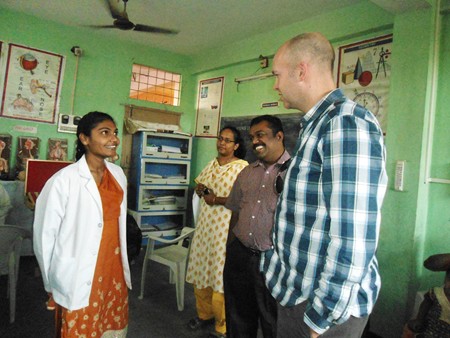
After venturing into Rasoolpura with our team, I realized very quickly that Operation Eyesight’s activities are a catalyst for broader economic and community development. Rather than purely concentrating on eyesight issues, we are embedded in broader community initiatives, which helps us track the people who need support when it comes to preventing and treating avoidable blindness.
One of the earliest and most important activities Operation Eyesight undertook in Rasoolpura was a complete census and mapping of area residents. Every dwelling was visited and instances of eye issues and blindness were noted, along with other health conditions. As a result, targeted work that addressed the issues facing residents could begin. Today, avoidable blindness is almost eradicated in Rasoolpura!
In addition, by partnering with other non-governmental organizations and government agencies, we help bring complementary services, skills and education to the community’s residents.
For example, on our way to visit the testing centres where our vision technicians work, we passed a young mothers’ nutrition class being conducted on a street corner. In another area of the community, babies were being weighed, which helps Operation Eyesight teams monitor possible pockets of nutrition or vitamin deficiency. We also visited cooking and sewing classes. While Operation Eyesight doesn’t provide these services directly, we refer residents to other organizations that do.
As we toured Rasoolpura, what became very clear to me is what makes Operation Eyesight different from other organizations: our community outreach. It’s how our staff reach out to find health issues and then connect people with organizations who can help (if it’s not us). Our community health workers, who themselves live in Rasoolpura, are an integral part of the community.
My lasting impression is that the project and our staff members are empowering the community through education and organization to better look after and develop itself from within.
It’s not about outsiders coming in and throwing around money and expertise. It really is about sustainable development – enabling members of the Rasoolpura community to take care of their own, now and in the future.
And it’s all made possible by you, our donors and supporters. Thank you!
This is just a note to say thank you for reading Grey Mist Lifting this past year. We've enjoyed writing it and we hope you've enjoyed reading each post. There's a lot more where that came from -- great stories and terrific photos describing people whose lives have been changed. So stay with us and keep reading. To all our supporters, we say thanks, and we look forward to working with you in 2012. Truly, the best is yet to come!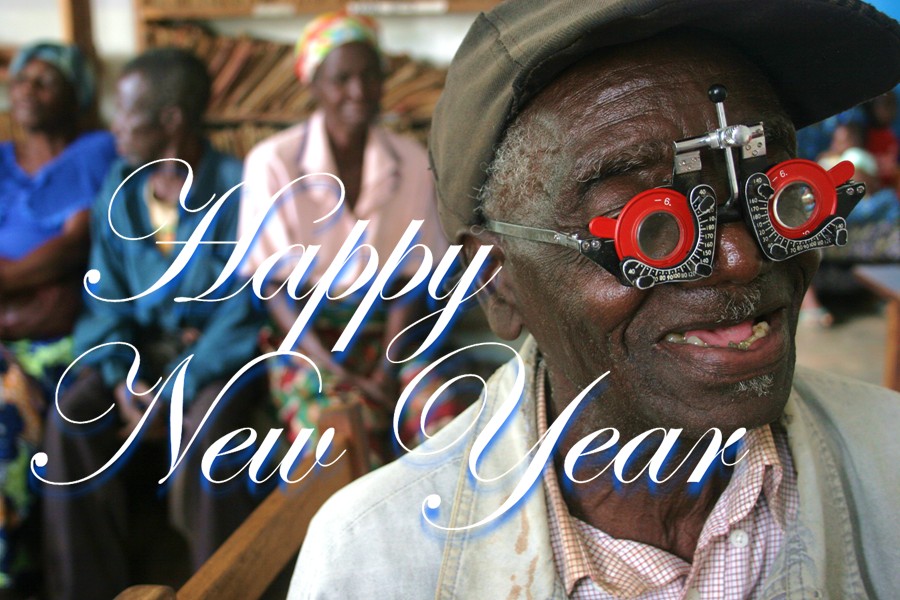
Have you ever heard the term “blind charity?” If you’re guessing that’s what Operation Eyesight is about, you’d be mistaken. Of course, our work deals with blindness prevention and treatment, but we don’t expect our donors to give blindly, which is what the term refers to. Our wish is that our donors are fully aware of what they are supporting, and more fully engaged.
Let me explain. Charity, when applied to international issues, often refers to aid or relief in times of crisis. It suggests short-term solutions and limited relationships between the benefactors and the beneficiaries.
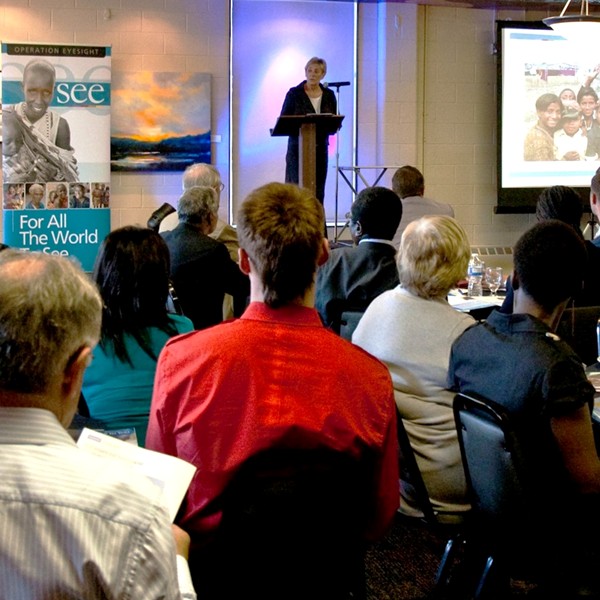
Operation Eyesight, on the other hand, has always been a true partnership with eye care professionals in the developing world, working on behalf of people threatened by blindness and low vision. In other words, mutual respect and expertise travels in both directions.
Our partners in India and Africa have identified specific approaches and projects that will put in place an eye care system able to prevent as well as treat blindness for years to come and finally achieve our objective of eliminating unnecessary blindness. We understand this as going “narrower and deeper,” an approach that you can read about in the winter issue of SightLines newsletter (now on our website).
Are these activities going according to plan? Well, in 2012 we’ll be working with expert researchers to evaluate our programs. We want to be sure that our achievements are real, not just perceived, and we’ll want to share those results.
An objective evaluation will help us strengthen our strategy where necessary and confirm our donors’ trust in us to use their money wisely. You’ll also see Operation Eyesight speaking more boldly to the international development community about the powerful impact of community-based eye care.
As president of Operation Eyesight, I have the pleasure of speaking to our donors in many ways. Among my favourites are the informal “donor teas” that we host across the country. Some of you have been with us for many years, and have seen our growing determination to get at the root causes of blindness.
When I’ve described our investment in community programs, infrastructure and primary care, I expected to hear comments like, “Why don’t you just stick with eye surgeries?” Instead, I’ve heard people (including long-term donors) say things like, “What you are saying makes sense. This is the best initiative I’ve ever heard of.” To hear this endorsement was gratifying, and deeply inspirational.
I envision an Operation Eyesight with donors who think about more than individual eye surgeries, and instead look at the big picture. I believe that the eye care programs we support are working over there, and that the ideas behind those programs are resonating over here.
Blindness and poverty is a terrible combination, and we will always deal with individual cases through direct intervention. But the bigger vision is a world where the most common eye problems never have to happen (or if they do, they will never again lead to despair or death). Instead of one surgery or treatment at a time, how about one community at a time – an entire village or district free of avoidable blindness?
I hope you’ll support Operation Eyesight even more strongly in 2012 – with your eyes wide open. Thanks for everything!
Read the blog posts below or our recent newsletters to learn more about our 2011 achievements ... all made possible by you, our supporters!
Today I’d like to tell you about a couple of photographs that mean a lot to me – and why.
I currently serve Operation Eyesight as vice-president of Advancement, but back in 2002, I was volunteering on the Board of Directors. In that year I made my first visit to Africa and India to learn what was happening, and I took a lot of photographs. Two shots really stand out.
One photo shows me with a group of children from Zambia. Whenever I see this one, it reminds me of the contrasts between me and these kids (age, height, colour, nationality, etc.) but also of the things we share in common. When it gets right down to it, we’re not so different. These kids have tremendous energy, enthusiasm and initiative, and their hopes for the future are basically the same as mine.
Although I may never see them again, I am confident that these kids turned into fine young adults. My role in their lives, as a stranger who came to visit, was momentary. But my interest in their lives, and in their country, has only strengthened over the years. Through my colleagues in Zambia I know for a fact that the work of Operation Eyesight is bringing lasting improvements. Yes, I made a contribution to their lives, but meeting them changed my life too.
The same goes for a group of kids from a slum in Mumbai, India. I love this photograph – I have it displayed on the wall of my office.
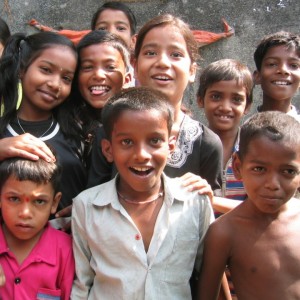
I was walking down a narrow street with a stream of waste water running down the middle, when three girls appeared on the opposite side. Their faces were beaming, so I reached around to get the camera out of my bag. When I turned back around, three kids had turned into 10, as if out of thin air. The group happily posed for the camera and then they scattered, back through the warren of alleyways and tiny dwellings.
What impressed me was their health and happiness. Aren’t slum people supposed to be wretched? That puzzled me at the time, but now it makes sense – for kids like these, the slum is only their present, it’s not their future. And they know it.
Photographs like these help me remember that when people work together, amazing things can happen. But you don’t have to travel to India or Africa to be a force for change in their lives. Your concern and care can take many forms, such as financial gifts. And through Operation Eyesight they are having the intended effect, which is to build communities that are free of the threat of blindness and low vision.
If you would like to help children like these see a brighter future, the opportunity to make a gift in 2011 is drawing to a close. In order to receive a 2011 tax receipt, please make your donation before December 31 using the convenience of online giving.
Last week I wrote about this village in Kenya, and how the Maasai people suffered from the agonizing trachoma disease, largely due to lack of water. After Operation Eyesight drilled a water borehole in 2007, everything began changing for these people.
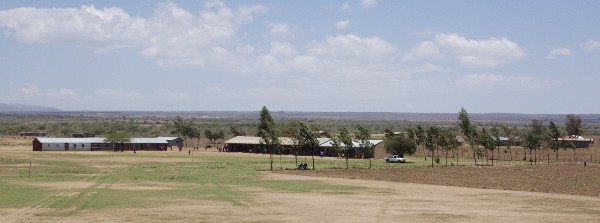 The difference between my first visit to Ongata Naado in 2006 (before the well was drilled) and my return visit in 2009 left me with the distinct impression that things were going to happen, but there wasn’t a lot you could put your finger on.
However, upon my third visit earlier this year, the changes I saw were stunning – I thought I was in the wrong village. This dry, dusty outpost on the Kenya plains has come to life! There are fruit trees and acres of gardens growing soy beans, cabbage and other crops, all looking neat and tidy.
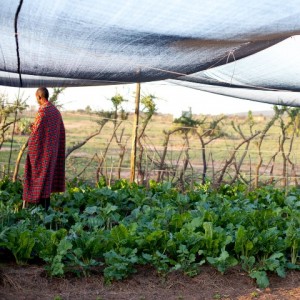
Well-built brick buildings have popped up, including a new school, a dormitory, and a community dining room. The school now serves 648 children from Ongata Naado and four nearby villages. There are now 10 teachers, and the headmaster (who was the original teacher in the village) told me that being sent to teach at Ongata Naado “used to be punishment,” but not anymore.
The borehole has its own building which contains the pump and generator, and an electric fence surrounds it to keep elephants away. Water pipes are laid strategically to a long concrete trough for livestock as well as downhill to the gardens and even to other villages. This well is supplying water to some 3,000 people. The people of the village have so much initiative that they are even talking about bottling water for sale.
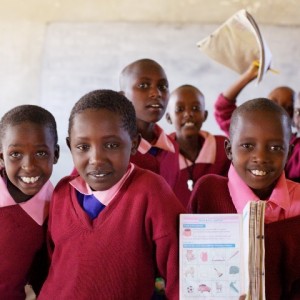
What really struck me was the mood. The women are thrilled that they don’t have to walk far for water every day, and their plans for the future are exciting. The community is resourceful, progressive and organized to seize opportunity.
This shows you what water can do. Oh, and trachoma, the original reason for the water well? This terrible eye disease has disappeared from Ongata Naado – it is gone, eliminated. The cycle of recurring infection that antibiotics and treatment could not stop has received, you might say, the final nail in its coffin.
I know you’ll agree that this is a wonderful story. But Ongata Naado is only the first of 51 waterpoints in the Narok district where Operation Eyesight began to drill boreholes. Wait until you hear about what happens with the other 50!
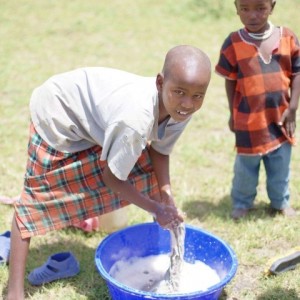
And remember – none of this would be happening without the generous support of our donors. So please help us continue this work as we reach into other parts of Africa. Take a look at our Gift Guide to see how you too can help change lives.
Imagine growing up in a slum where your family sleeps in a cramped hut and can barely afford to eat. Now imagine rising out of that poverty and becoming a respected medical professional in the community. That’s the story of Mabbula Liviza.
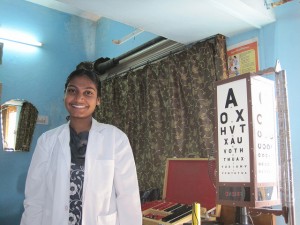
I met Mabbula earlier this year while in Hyderabad, where I visited the Rasoolpura slum. Hyderabad may be a glamorous and prosperous place, but like most cities in India, it has large pockets of dire poverty. But here’s the funny thing about India’s slums. Yes, they are squalid and unpleasant, but a slum is not necessarily a dead end. Typically, it is a way-station for people seeking opportunity.
That opportunity came to Mabbula thanks to free training, made possible by Operation Eyesight donors.
This bright young woman serves as the vision technician at the eye clinic in Rasoolpura. When she was a child, her family took full advantage of what education was available in the slum, and Mabbula excelled.
But regardless of her education, she might have lived her life in poverty if she hadn’t learned about the opportunity to be trained at the LV Prasad Eye Institute (LVP), also in Hyderabad. She faced stiff competition for a place in the class, and she had to work hard throughout the accelerated three-month training program. The fact that she is female made the process even more challenging, but she did it.
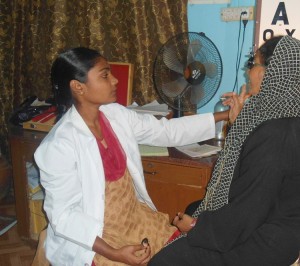
Mabbula is very good at her job. Not only has she been well-trained, she is part of a network of support and professional development opportunities, with LVP at the hub.
But perhaps most important of all, she is already acquainted with the people who come to her – she’s one of them. They are comfortable discussing their health issues and she gives them information and advice which serves to prevent eye problems in the first place. She is helping her community to be free of avoidable blindness.
When I met with Mabbula, she smiled a lot – it was clear that she is thrilled with her job and very appreciative for the changes in her life. She in turn is helping to change the lives of struggling people around her. To the generous donors who give to Operation Eyesight and made all this possible, Mabbula says thanks.
Vision technicians like Mabbula are desperately needed throughout India. Their ability to provide primary eye care through diagnosis and basic treatment is the foundation of an effective eye health system. You can provide training for someone like Mabbula – visit our online Gift Guide today to learn how.
Water is a powerful force. In rivers, it pushes huge generator turbines. In the ocean, it covers most of the earth. From the ground, it changes people’s lives in ways I never would have imagined unless I had seen it with my own eyes.
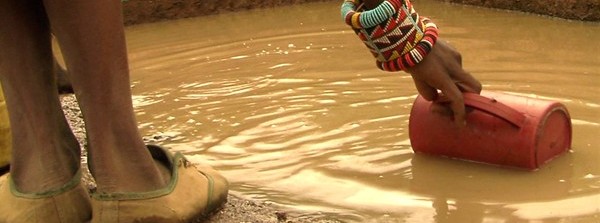 In Kenya, Operation Eyesight has been fighting the terrible trachoma infection for many years with antibiotics and surgery. But despite our best efforts, this eye disease just wasn’t going away.
We decided that if trachoma was to be beaten we had to deal with the root problem of personal hygiene, which can only happen with a reliable source of clean water. In Kenya, that means deep water wells, which led us to Ongata Naado.
I remember first visiting this village in 2006. It is located on a vast prairie region of Kenya where the Maasai people live. The village wasn’t much to look at because these nomadic people don’t stay in one place for long. It was dry and wind-blown with a ramshackle school that held only 20 students.
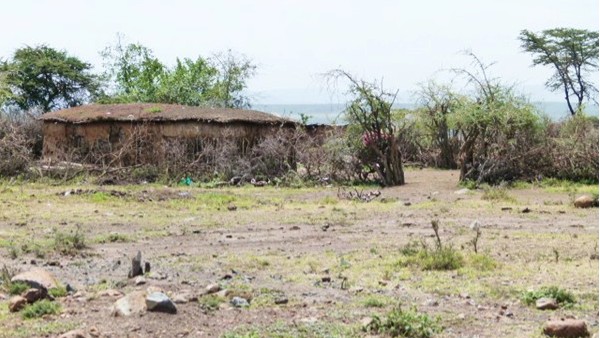
Every Tuesday the teacher would shut down the school and ride his bike for 20 km to get 27 litres of water that would last him and the children a week. Families would also forage afar to find water, so whatever they collected was used for drinking and cooking, not for washing. You can imagine how the kids’ faces were like fly magnets. Disease traveled from face to face, with new infections popping up constantly.
The first bore hole that Operation Eyesight drilled was in Ongata Naado. It took the people there a bit by surprise, because they couldn’t immediately see the link between water and eye health. The big drilling truck that rolled into town must have had the same impact as a three-ring circus. When the water started gushing out of the ground, everyone showed up to watch in amazement. One older man was heard to say: “I have seen water from above, but I didn’t know it could come from below!”
The community set up a committee to get the pump and generator installed and fund the rest of the pieces they would need, and they really took ownership. Donors through Operation Eyesight paid for the drilling and brought in technical expertise, but the people of Ongata Naado supplied everything else.
Like a seed sprouting, something was happening among these people – slow at first, but growing. I became aware of it when I returned in 2009. The village didn’t look much different, but the people were energized with plans for the future. Plus, everyone looked healthier and their new water source was in full operation.
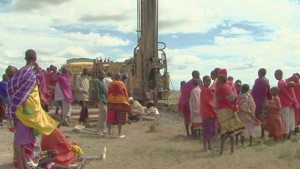
Little did I know that the best was yet to come…
Read Part 2 and learn what happens in Ongata Naado. And if you’d like to help bring water to parched communities, visit our Gift Guide to learn how.
Today the word “remembering” is on my mind as we observe Remembrance Day in Canada and many other nations around the world. In terms of Operation Eyesight, that got me thinking about our beginning almost 50 years ago. As our founder, the late Art Jenkyns, listened to Dr. Ben Gullison speak in a Calgary church basement, he caught the vision for a world in which every person could see.
In those days, Operation Eyesight focused mainly on people with cataracts. Cataract surgery is still an important part of our work because cataract remains the world’s leading cause of avoidable blindness. In fact, more than half of the world’s blind people are blind because of cataract. Have a look at this short video to learn more about this common condition.
For a child, being blind means she can’t go to school – and education is the ticket to a better life in the developing world. Blindness for an older person means that he is totally dependent on family for even the simplest things like food and finding his way to the outhouse. In the developing world, a blind woman may be outcast, abandoned by family because she is seen as a burden.
As the countries in which we work develop functional health care systems, hospitals become more efficient and can meet international standards. And strengthening the health care systems is the best strategy to deal with the backlog of cataract cases.
When you donate for a cataract surgery, you’re not only giving a person in Africa or India the gift of sight, but you’re also contributing to the operating costs of that hospital until that hospital is self-sufficient and can cover these costs themselves.
Subsidizing operating costs is important for new partners in India, and for partners in Africa where achieving self-sufficiency is a longer process.
Ultimately, a more efficient, productive hospital means that it will eventually be able to fund the surgeries and other necessary costs itself. That is Operation Eyesight’s goal – strong hospitals and health systems that can operate successfully without any outside intervention. Most importantly, it gets us closer to a world free of avoidable blindness.
I remember, some years ago, when I first learned about the intrepid nuns of Assumption Hospital’s Kanhirapuzha Eye Unit who took eye care into remote areas on motorcycles. It made me smile, imagining these dignified women weaving in and out of traffic (I now know that such a sight is not the least bit unusual in India). But I knew they were on to something.

Flash forward to 2011, and the concept of hospital-based community eye care employed by these women is now a major feature of Operation Eyesight’s approach in India, and is being applied in Africa as well. We now know that many people with eye problems never get the treatment they need, even if an eye clinic is not too far away.
For years Operation Eyesight has been helping our hospital partners in India to run efficient and sustainable operations in order to eliminate avoidable blindness in the districts served. But in many cases, these hospitals were only reaching 35 percent of the local population.
Before, the hospital would send medical teams to outlying districts three or four times a year – it wasn’t enough, and it was expensive. A steadier presence was required to get to know people and earn their trust.
A new approach of working more closely with the community, and sending workers deeper into the community, is really paying off. Now, hospitals hire and coordinate community workers (many of them recruited from the very villages they serve) who move from place to place offering health education and basic diagnosis. They travel on bicycles or motorbikes, along roads and pathways that only a 4x4 truck could navigate.
But a $40,000 4x4 vehicle isn’t always necessary; if there’s no need to bring equipment or transport patients, sometimes a $1,500 motorbike or any ordinary bicycle will do. Two-wheeled transport is easy to maintain, and fuel for motorbikes costs peanuts. In this way, it is possible to reach just about everyone in the district served by the hospital, and problems with blindness and low vision are dropping exponentially.
Would you like to help? This year, for the first time, we’re featuring motorbikes and bicycles in our Gift Guide. Have a look – it’s the kind of gift that everyone can understand, and it helps these hospitals reach everyone possible.
Operation Eyesight is, at its heart, a community of support. In addition to a small number of employees and volunteers, it’s our large group of active supporters that really makes this organization tick. These supporters come from all walks of life and have a wide variety of gifts to share.
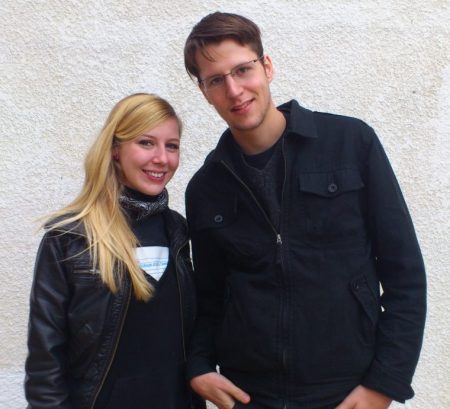
Take, for example, Alana Thorburn-Watt and Levente Kovacs. These two fourth-year students from the Alberta College of Art and Design (ACAD) have a deep interest in the people of the developing world, especially those with special challenges like vision impairment.
We met Alana and Levente through a very interesting project – our need to express the central issues around global blindness in a fresh but effective way, which led to a form of storytelling we had never explored before. We needed something for our website that would grab viewers and quickly explain the urgency behind avoidable blindness, in terms that everyone can understand.
Levente and Alana learned about our communications challenge through ACAD’s Student Resource Centre blog. They, in turn, wanted to contribute their expertise to making a difference in the world, as well as expanding their portfolio to different kinds of projects.
What followed was a series of successful meetings and a true merging of creative possibilities with organizational objectives. Alana’s and Levente’s skill with digital animation and storytelling gave life to the central message that millions of people can’t see things that you and I take for granted – and we can all do something about it, right now.
The result of our collaboration was a two-minute animated video called “See This.” We feature it front and centre on a very different kind of home page, launched on World Sight Day (October 13, 2011). Have a look! What do you think of our project? We’d appreciate your feedback!
We believe the video meets all our objectives, and are very pleased with the outcome, and we really enjoyed working with these talented young people. I’ll close with Alana’s words, which I hope will strike a chord with our other supporters – people like you.
“Be open-minded to different causes. Look around and see the good things people are doing in your community and around the world. You never know what will touch your heart and resonate with you.”