

Last week was a really good week for Operation Eyesight. We released our 2010 Report to Donors and shared the impact of the past year with our guests at Operation Eyesight’s 48th Annual General Meeting.
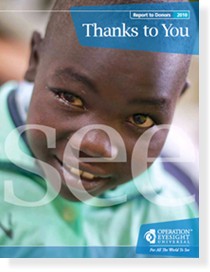
This year, we found it particularly inspirational to look back at a highly successful year, and also to look forward at the emerging opportunities on the horizon. Daniel Etya’ale, MD, executive director of the International Agency for the Prevention of Blindness’s African region, was in Calgary to speak at our AGM. He confirmed that Operation Eyesight is on the right track, and that our hard work is paying off.
Of course, at the very heart of our successful work is the generosity of our supporters around the world – people like you. Because of your gifts, millions of people have been spared the tragedy of needless blindness. They are able to carry on with their lives and provide for their families.
In addition, thousands of lives have been transformed and even saved from death as Operation Eyesight works to eliminate the root cause of blinding diseases like trachoma, and to provide basic sanitation and clean water. These are key components that open up the door to sustainable socioeconomic development – this is how avoidable blindness will be beaten.
Imagine a day when people no longer fear for their eyesight. Dr. Etya’ale believes that day is coming sooner than later – amazing!
Operation Eyesight is at the forefront of these efforts, and you are helping make it possible. Thanks to your generous support, we’re working to address the factors that are causing people to lose their sight. I invite you to read the facts about our successes in our new Report to Donors, and also watch the video of Dr. Etya’ale in last week’s blog.
Thanks again; your support is valued! We look forward to working with you in the year ahead. Together, we are building sustainable eye care services that will prevent unnecessary blindness from happening in poor countries.
As a first-time visitor to Kenya, I’ve experienced firsthand its beauty. In Nairobi, I watched in amazement as beggars and hawkers expertly threaded their way through the chaos of traffic, hopefully holding up roasted corn on a stick, bouquets of roses, clothing, DVDs and even puppies to bored drivers and passengers. In the smaller towns, I enjoyed colourful signs on the stores, tiny donkeys pulling carts as motorcycles roared past them, and bright smiles and waves from uniformed schoolchildren at the side of the roads. In the countryside, I marvelled at the sight of scarlet nandi flame trees in full flower, zebras calmly munching on yellow grass, and the endless vistas of red-gold land and bluest sky. Kenya is a visual feast! But if you are avoidably blind, this country of blazing sunshine might seem as dark as night, or as dim as a smoke-filled room. You might feel the sun’s rays but not be able to enjoy the way it illuminates the brilliant colours that abound in nature and culture. As Operation Eyesight’s director of communications, I’ve been in Kenya for almost two weeks now, along with a talented photographer, Ric Rowan. Together we’ve been gathering stories and photos about the women, men and children whose lives are impacted by Operation Eyesight’s work. Over the coming weeks and months, we’ll be sharing them with you. I was familiar with these projects; yet experiencing them first-hand has been a powerful experience unlike any I could have imagined. For instance:I often think that those of us in prosperous countries have a hard time understanding what it’s like to live in a place with no public health care, as many developing nations can be. Imagine the impact that this has on economic development and general health.
I heard an interesting comment from G. Chandra Sekhar, the director of the L.V. Prasad Eye Institute in India. Dr. Sekhar has a lot of experience working with the really poor people of India. He said,“Mothers who raise their children in poverty must teach them how to go to bed hungry.”
Can you imagine – kids having to learn how to ignore their empty stomachs? When you come to terms with that concept, you come to terms with the extreme circumstances that some people live in – it must be terrible to endure. They survive day-to-day on the bit of money they can generate, often less than a dollar a day, which isn’t enough.
In my line of work, we tend to talk so much about eye care that we may miss the reasons why people go blind, or what day-to-day living can be like for the poorest people, and how mean and grim it can be.
The link between poverty and blindness is very strong. And yet a little bit of community development help can change lives dramatically. By community development I mean that which prevents eye disease – sanitation, education and basic health care that includes eye care. When they get these things into their daily lives, people move from poverty to sustainability, and even to prosperity. This is the key to preventing blindness and to greater health all around, something I have seen with my own eyes.
I believe there can be no long-term vision for a healthy community until the basic stuff is taken care of. I can’t imagine us teaching our kids how to go to bed hungry, and neither can you. That’s why Operation Eyesight has added community development elements to our hospital-based activities. We’ve learned that, properly done, community development can have a huge effect without a huge investment. This is especially true with communities that want to engage with us and want to help themselves. That’s when really amazing things start to happen.
Amazing things are happening, and you can read about them here in the weeks ahead. Next week, come back to read about Africa. Lynne Dulaney, our director of Communications, will be visiting our programs in Africa for the first time, and she’ll have some great observations to share. Thanks for reading our blog, and thanks for giving the gift of sight.
Casual. Frank. Insightful. Those are some words that describe the content you’ll read here in the weeks ahead.
Welcome to Grey Mist Lifting – the official online journal of Operation Eyesight. Over the years, we’ve learned that the people who support Operation Eyesight love to hear stories about people in need of help, and how that help was delivered.
This new web log (or “blog”) is an opportunity to add colour (maybe even humour!) to a serious topic – eye care in the developing world. We hope to fill in some of the gaps on our work in India and Africa, so you can see what we see.
Because it’s weekly, what you read here will be more timely – more fresh – than what we normally print in SightLines. As a newsletter which comes out only three times a year, SightLines is tightly focused. This blog, on the other hand, is designed to cover a wider range of topics, and to generate feedback. That’s right – you’ll also be able to submit comments on what you read.
About the title, we’ve decided to call it Grey Mist Lifting because this expression – or words like it – are commonly heard in the clinics we support. When the bandages come off after cataract surgery, patients often describe what they are experiencing. For example; “Yesterday, all I could see was a grey mist. Today, the mist has lifted. I can see again.”
Imagine what that must be like!
Next week I’ll be back again, so please return. And in the weeks ahead, you’ll hear from others on our leadership team in Canada as well as our staff in India and Africa, and other guest bloggers.
On February 25, Lynne Dulaney, our Director of Communications, will tell you about her fact-finding mission through Africa. This is her first trip to that beautiful continent, and she will help you see it through her eyes.
Thanks for joining the conversation!
Travelling by vehicle on the highway from Nairobi to Narok, Kenya, the first glimpse of the Great Rift Valley is staggering. Your eye cannot take in its breadth and its beauty. This is the panoramic road I travelled a few short weeks ago on February 19.
As we drive down the mountain on the narrow yet well-paved road, the valley opens up into a wide flat expanse that is harshly beautiful. There is no water here, although signs of flooding are visible in the deeply corrugated clay – but this is February and there is little rain. The grass is scorched; the trees are no larger than bushes. The sun blazes in the bright blue sky.
Bundles of branches with green leaves sit by the side of the road. The local people make charcoal and package it in the leaf bundles to market it. There is little commerce around here for locals; our driver, Eric, says multinational corporations buy or lease most of the land in the valley to grow wheat. The corporations farm with machines and spray with crop duster airplanes, so they don’t provide any local employment.
I catch my first glimpse of a Maasai man herding sheep, his bright red cloak blowing in the breeze. Later, passing through a small village, I see a man wearing jeans on a motorcycle roar past a group of Maasai women sitting by the side of the road in their traditional attire. My travelling companions don’t think anything of this cultural juxtaposition, although I find it amusing. (But then, they don’t think my first sighting of zebras grazing placidly by the side of the road is that exciting, either!)
As part of a team from Operation Eyesight, we are on our way to Narok District to review our trachoma and water projects. In a land where clean, safe water is in short supply, the boreholes and water points that Operation Eyesight’s generous donors have provided have brought newfound life to many communities.
Maasai women and children walk for miles each day, generic yellow plastic containers in their hands, to the nondescript concrete buildings that house boreholes. They line up patiently twice a day, waiting until the borehole administrator arrives to turn the generator on and start the water flow. (The precious water doesn’t run all the time as it would be wasted.)
In times of drought, there is a separate tap that flows into huge concrete troughs, where thirsty herds of cattle, goats and sheep jostle for position to drink. The tiny goats are so eager for a drink that they climb right inside the troughs.
As the tap is turned on, children wash their dusty hands and faces in the cool water, grinning at me as they shake their wet heads. Not only does it feel good in the heat, but they are learning to keep their faces clean, which helps prevent the agonizing bacterial infection of the eyes known as trachoma.
As I look out at the expanse of dry earth around us and hear the laughter of the children and the happy chatter around me, I am so proud to be a part of Operation Eyesight, bringing water – the source of life and health – to this and other communities here in Kenya. If you could see these happy smiles, you would know that our donors and supporters have truly made a remarkable difference to the people of Narok District, one that warms the heart as much as the sunlight warms my back.
Lynne has been traveling throughout Africa since mid-February visiting the nations of Ghana, Kenya, Rwanda and Zambia.
A few musings about my month spent in four African countries:
Traffic: Compared to North America, the general African public has a serene obliviousness to traffic. Vehicles, not pedestrians, have right of way. Even women carrying babies aren’t given preferential treatment; they have to wait for a lull in traffic to cross a street. Transport trucks, buses, motorcycles, men driving carts pulled by donkeys, bicycles, pedestrians (including schoolchildren) plus chickens and goats in the rural regions all share the road in an endless stream. In the major cities, there are huge traffic circles. In Nairobi, they are meant to be three lanes, but at least five lanes of vehicles go around at all times. No one signals; you might get one quick tap of the horn if you are in someone’s way, but really it is remarkably controlled chaos with no observable road rage.
Road travel: Distances in Africa are vast, and in some of the rural areas, the roads are abysmal. I have spent too many painful hours bumping and rattling along roads that have potholes three or four metres in diameter, and large ruts and rocks besides. In many cases, drivers veer off the “roads” onto the packed clay on the sides. Vehicles take a pounding under such conditions, of course, and our Operation Eyesight vehicles, which travel to remote areas much of the time, are no exception. Mostly hardy Toyota Hilux 4x4 trucks, even they have a life expectancy of only three or four years on such roads. When one of our Kenya drivers told me this, I asked how old was the vehicle we were currently in. He smiled. “Four years old.” Great.
Cell phone mania: Africa is connected. Even very poor people have cell phones attached to their ears like exotic earrings. Since many homes in rural areas don’t have electricity, there are cell phone charging stations every few kilometres down every highway, even in remote villages.
Education: Schooling is vitally important. There are flocks of school children, usually in colourful uniforms, and schools everywhere, from cities and towns to “the middle of nowhere” in the rural areas. Schools are obviously a central point for the communities.
Religion: Christian churches are equally vital in all communities I was in, at least, and praises to God are given in a public manner unaccustomed in mainstream North American culture. While in Accra, Ghana, on one street alone I saw: God is Great Plumbing, Blessed Prayer Hardware, My Saviour Lives Beauty Shop, God’s Good Name Chemical Store, and Time of the Redeemer Tire Shop. Lusaka, Zambia has a line of small buses called God is Great. Around Nairobi, Kenya, there are big trucks that have “God Bless Kenya” emblazoned across the back. Indeed.
People: Without exception, I’ve received extraordinary kindness and helpfulness from people I’ve met in all four countries. They translate for me when they can, and we resort to sign language when no translator is near. The children are great fun. I’ve played “peek a boo” with babies and toddlers and exchanged smiles with schoolchildren in each place. Only once, in a remote village near Narasoora, Kenya, did I make a toddler cry – she had never seen a “mzungu” (white person) before, and was clearly frightened of me.
Operation Eyesight's people: And finally, a big bouquet for all the Operation Eyesight staff and partners I met over the past month. I have great admiration for the people who choose to work for Operation Eyesight here in Africa (and I’m certain the same applies to our India staff). From ophthalmologists to drivers to nurses, from optometrists to clinical officers to cataract surgeons, their outreach work is physically demanding and mentally exhausting. Almost invariably, they could find higher paying, less demanding jobs elsewhere. Yet everyone I talked to took great pride in their work, and has no intentions of slowing down. They know women, men and children need their help, and they are making great progress in preventing blindness in Kenya, Ghana, Rwanda and Zambia.
Work that is meaningful and rewarding: there can be no greater gratification!
Lynda is currently on a whirlwind tour of Operation Eyesight's program partners in each of the countries where we work.
There are blossoms on the almond trees in Himanchal Pradesh and the comments circulating in this Himalayan state, as the temperatures reach above 20 C, are “winter is over and summer is coming.” Interesting how seasons are defined and some (like spring) are skipped altogether. Snow still comfortably caps the higher peaks of the mountain range in this area, but the sun quickly warms me as I take a brief moment to observe the passing scene of families enjoying a Sunday afternoon in the country and communities of friends and families enjoying each others’ company.
Six weeks, six countries, thousands of miles and scores of people to meet. How can I begin to describe the energy of all the people I have spoken with and the inspiration they give? And at the same time, how to convey the drain of constant flights and frequent changes of location?
If there is a recurring theme throughout my recent travels, it seems to be “community.” And if I have a recurring thought, it is how much pleasure there are in things we take for granted when at home. The communities of colleagues, partners and government and corporate leaders in South Africa, Zambia, Kenya, Rwanda, Ghana and India that I have had the privilege to meet all have varying perspectives, but they share the same intense passion. They believe that engaging communities at the grassroots is critical in building and strengthening larger systems, be they health, education or social welfare.
Daniel Etay’ale, executive director of IAPB* Africa, recommended that I read The Community Is My University – I am looking for it in bookstores and will rely on Amazon.com if unsuccessful. Naheed Nenshi, the mayor of Calgary (where I live), is passionate about community as well and I wish he could see how well community engagement works with some of our programs. Now is the time to recognize there is much we can learn from developing countries, and that international development is a reciprocal effort.
And thank goodness for texting and emails to keep in touch with my home base community. I look forward to more active engagement when I get home!
*International Agency for the Prevention of Blindness
World Water Day, earlier this week on March 22, tells us not to take water for granted.
About five years ago Operation Eyesight realized that treatment and surgery alone were not going to win the battle to eliminate unnecessary blindness. Indeed the evidence was that a good deal of blindness could be prevented if we were prepared to think broadly about the root causes of unnecessary blindness.
We looked at what defined poverty and what were those elements of poverty that were directly linked to blindness. Actually, there are several, but there is one in particular – a nasty eye disease called trachoma that is the direct result of poor sanitation and, critically, the lack of clean water. We had been treating patients for trachoma in endemic areas in Africa for more than 20 years. Treatment included lid surgery to correct eyelids so disfigured that the eyelashes turn in and scrape the cornea, as well as antibiotic ointment to stop the bacteria. But repeatedly, the infections returned.
Operation Eyesight made a bold decision to change tactics and provide clean water to dry communities by providing “water points” – that is, water catchment devices and boreholes. This is a more expensive strategy on the front end but, by far, more effective and less costly, even in the midterm. Face washing is the key to keeping the bacteria away from the eyes and preventing infections. Today, our surveys in affected communities are proving that infections are decreasing dramatically and, one day soon, trachoma will be a thing of the past.
Just as gratifying are the other dramatic changes that water is bringing to previously dry communities. It truly is the first rung on the development ladder. Women are no longer making long treks to bring water back to their families – they have the time and the means to keep themselves and their families clean. Clean clothes and bodies reduce the incidence of skin and respiratory diseases. Communities are taking the initiative to plant gardens and feed starving children from communities hit by drought. They are also investigating new crops and making plans to pipe water to dry communities.
Water in a community means teachers will be willing to move there and offer education to the children for the first time. Some communities have even constructed large boarding facilities so children from other villages can benefit as well. Water in a dry community is like planting seeds in fertile soil. The community flourishes. It brings new life and opportunity. Social and economic development takes hold. Women are able to play a key role in the sustainability of the water resources and are central to the planning of community initiatives.
It's achievements like this that World Water Day celebrates. Thanks for supporting Operation Eyesight's efforts to bring eye health to people who lack it just because they don't have ample water.
I recently spent three days in the Solwezi region of Zambia’s North-Western province (that’s its name, like Alberta), in the very pleasant company of Operation Eyesight ophthalmologist Dr. Edith Pola.
On March 10, I accompanied Edith and her team to an eye screening clinic at Meheba Refugee Camp, one of the longest-standing refugee camps in Zambia.
Meheba and other camps like it are supported by UNHCR (the United Nations refugee agency). It occupies about 50 square kilometres, and was once home to almost a quarter-million refugees from African countries like Rwanda, Burundi, Uganda, Sudan and the Democratic Republic of Congo. Fleeing brutal regimes, men, women and children walked thousands of kilometres through the jungle to get to the safety of Zambia.
Over the years, more than half of the camp’s residents have been repatriated to their home countries, although many people refuse to return because they don’t trust their own governments. Some refugees have lived at Meheba over 20 years, and children have spent their whole lives there.
Living conditions in the camp are harsh, and health care facilities are limited. As the only ophthalmologist working in the province, Dr. Pola and her team of four ophthalmic clinical officers and two ophthalmic nurses find themselves stretched to keep up with the need for eye care.
Splitting into two groups to work long hours out of the camp’s small health clinics, the teams individually screen hundreds of refugees for cataracts, glaucoma and other eye diseases, as well as low vision. Mothers with babies and young children, classes of uniformed school children, and the elderly make up most of the long queues.
Many patients suffer from infections and/or mild acid burns in their eyes, due to treatment with traditional eye medications – often urine, cow dung or herbal concoctions. Edith tells me such “remedies” are still common in rural Africa. She and the ophthalmic clinical officers must prescribe anti-inflammatory medications and antibiotics for these people before any other eye health issues can be accurately identified.
Yet while this Operation Eyesight-sponsored team works under challenging conditions, they are obtaining significant results in Meheba and places like it, where residents have no other means of obtaining eye care.
Without them, people like Emmanuel would remain in their worlds of darkness. Emmanuel, a 66-year old Rwandan refugee who has lived at Meheba since 1998, is completely blind in his left eye, and has only limited vision in his right eye because of cataract. He was recovering from malaria when I met him, and still a bit shaky from fever; yet had made his way to the clinic to have his eyes examined.
“The doctor is going to try to help me,” he says hopefully.
At the end of the long day, Edith takes a stretch break while her team starts to pack up their equipment. When I remark that everyone has worked extremely hard today, she smiles.
“This province is very large so human resources are an ongoing challenge for us,” she says. “We need to train many more doctors and nurses to meet the needs of our population.”
Because the eye care staff complement is so limited in this area, the team travels within a 100-km radius from Solwezi over heavily rutted dirt roads that are often impassable in the rainy season.
“We really need jungle cruisers [heavy-duty 4x4 vehicles] to go over these roads,” she says ruefully. “Right now we only have one such vehicle. The need is great.”
In my travels, I have made it a point of understanding how other organizations work, their strategies and funding priorities, and comparing them to our Operation Eyesight partnerships and support. On my last visit to India, I was able to visit two of our partner hospitals and here are my observations. If the key to eliminating avoidable blindness is the development of sustainable health infrastructure (which includes eye care that does not require foreign support) then we are on our way to achieving that goal in India and using our experience and knowledge there to achieve similar results in Africa.
Together with my colleagues Lynda Cherry and Kashinath Bhoosnurmath, I travelled to the Siliguri Greater Lions Eye Hospital in northern India. This hospital was established in 1983 by the local Lions Club and its members comprise the trustees of the hospital. I believe it has been an Operation Eyesight partner hospital since that time.
The hospital in Siliguri was one of the original 41 that accepted Operation Eyesight’s challenge to improve their performance and the quality of their surgery. Like most of the hospitals they made reasonable progress towards that goal, but seemed to stall a couple of years ago. Since his appointment as our Senior Director India Programs, Kashinath has met with all our India partners to review their progress against the original evaluation and recommendations made by the L.V. Prasad Eye Institute (LVP). Kash (as we call him) and his team were able to work with the staff of the Siliguri Greater Lions Eye Hospital to help them move forward again and this hospital is now an outstanding success.
Just to detail that success, compared to typical “charity” hospitals in India (and not including government hospitals which are in appalling condition with very low productivity) the Siliguri Greater Lions Eye Hospital was spotlessly clean and very well maintained. It was quiet and orderly – many such hospitals are crowded, chaotic, noisy and difficult to negotiate through. Waiting rooms in the hospital are well organized, patients move smoothly through the consultation process and treatment areas.
The Board of Directors and management have recognized the need for well-trained and motivated staff at every level. They have instituted everything from training and quality review programs to award programs, and they recognize exceptional employees. The hospital is also implementing an electronic admissions and record system. The ophthalmologists* are passionate and dedicated, and the management and Board have a long term vision and plan for the hospital which is not typical. In fact, they have been invited by the government of Bhutan to help establish eye care services there too, which is severely lacking in that country.
The Indian state of Sikkim, to the north, is also keen to partner with the Siliguri Greater Lions Eye Hospital on the same basis. The hospital is in discussion with Operation Eyesight India to develop plans for Sikkim and Bhutan. Kash, Lynda and I paid a site visit to Sikkim for that purpose.
The Siliguri hospital, through the Lions Club, has been successful at augmenting revenue through fundraising. At this point, Operation Eyesight only needs to support for the Community Eye Health Program which will also become sustainable. The hospital itself is 130% cost recovery on fee revenue, which is excellent.
I also want to touch briefly on another hospital I am very impressed with. In 2006, Operation Eyesight funded the construction of a new home for the Siloam Eye Hospital. Previously in a rented facility, this hospital gained a brand new building and a new identity as an LVP satellite hospital. I opened it with Dr. G.N. Rao, founder of LVP, in 2007. The Siloam Eye Hospital is located in the state of Andhra Pradesh about a two and a half hour drive from Bangalore. It is a poor rural area where agriculture is the primary industry, including the production of mulberry bushes which feed the silk worm industry. Dr. Shoba Naveen, the Medical Director, is an extremely competent ophthalmologist. Again the hospital is fully financially sustainable and quality outcomes are the priority.
I am confident in saying, and it is important to note, that Operation Eyesight partner hospitals in India can compete with any private hospital in India when it comes to physical facility presentation, financial sustainability and, most importantly, quality outcomes. And further, Operation Eyesight requires that all partner hospitals provide optical services including free eye glasses to anyone who cannot afford to pay. This is an outstanding success for us. We have accomplished this through the comprehensive development and change management support and strategies led by Lynda, facilitated by the Operation Eyesight India team and with the very important partnership of the L.V. Prasad Eye Institute in Hyderabad which is our global training resource.
*Ophthalmology is the branch of medical science that studies the eyes, their diseases and defects. Ophthalmologists are eye specialists that are able to perform many procedures, such as eye surgery.