

Gwendolen and John Crowe, from Delta, BC, donated to Operation Eyesight for many years, and together they made the thoughtful decision to continue supporting our work beyond their lifetime, leaving a legacy of sight and hope for generations to come. Our vision centre in Chitipa, Malawi was made possible thanks to a generous gift left in Gwendolen’s will.
You don’t need a large estate to make a meaningful charitable gift in your will. In fact, most bequests in Canada come from people of average net worth. Every dollar counts, and charities appreciate final donations of any size.
We recently sat down with Nathalie Farrah from our fundraising team to help demystify the ins and outs of legacy giving.
Who should consider leaving a gift to charity in their will?
Anyone can leave a gift in their will to a charity that’s close to their heart, and you can designate the donation as a percentage or share of the estate. Your will is your last voice; it’s your opportunity to support the causes you’re passionate about and continue creating an impact beyond your lifetime.
What if someone pledges a donation, but their financial situation changes?
Most people change their will four to five times in their lifetime. It’s normal for things to come up that will impact your financial planning, like buying a house or having grandkids. You can change your will or adapt it whenever these events happen.
Let’s talk taxes. Are there any incentives for making a charity gift in your will?
Absolutely, the Canadian government has made it very compelling to donate in your will. I’m not a financial advisor so I won’t get into the formulas, but I can say that legacy giving significantly reduces the impact of taxes on the estate.
Anything else people should keep in mind?
If you plan to leave a charitable gift in your will, make sure you talk to your loved ones about it. The more informed they are about your wishes, the better everything will be executed.
Thinking about your own legacy? If you’d like to talk to someone about making a bequest, you can reach our team at the contact information on this page - operationeyesight.com/legacygiving
Students at Kiserian Primary School in Kajiado County, Kenya show off their “new shades,” which are prescription eyeglasses with transition lenses. These photochromatic lenses darken automatically when exposed to sunlight and clear when the UV source is removed, protecting young eyes from harmful sun rays, which can contribute to the development of cataracts and other eye problems.
Each year, thousands of students receive prescription eyeglasses through our School Eye Health Programs, allowing them to learn, thrive and live up to their full potential.
Go to operationeyesight.com/schooleyehealth to learn more.
On October 9, we celebrated World Sight Day with events across the globe.
In Canada, our colours lit up the skylines in Calgary, Winnipeg, Guelph and Toronto to raise awareness about eye health and the passing of the National Strategy for Eye Care Act, which will help make vision care a national priority.
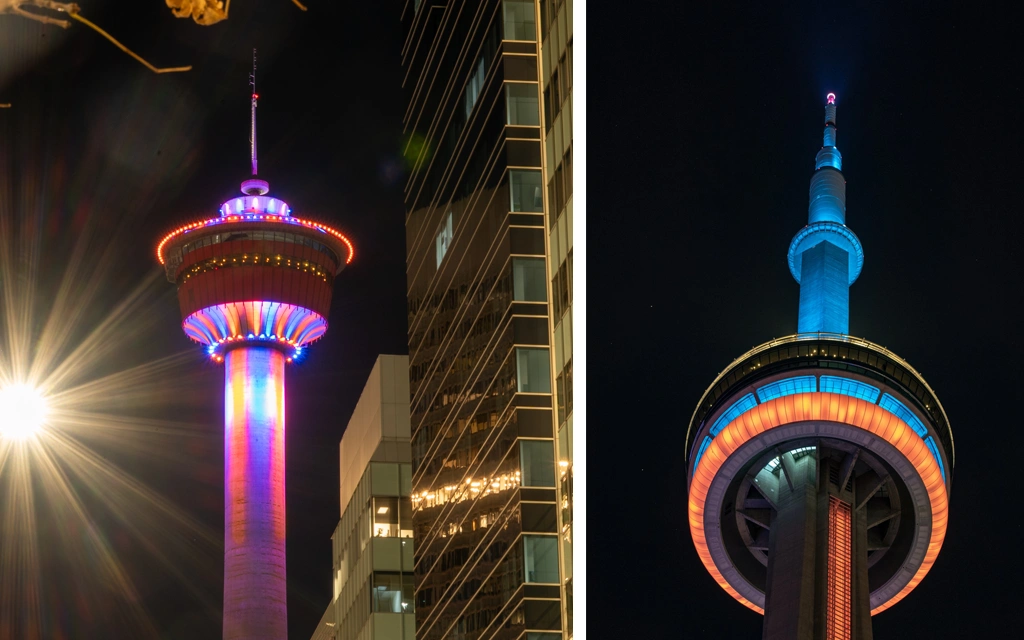
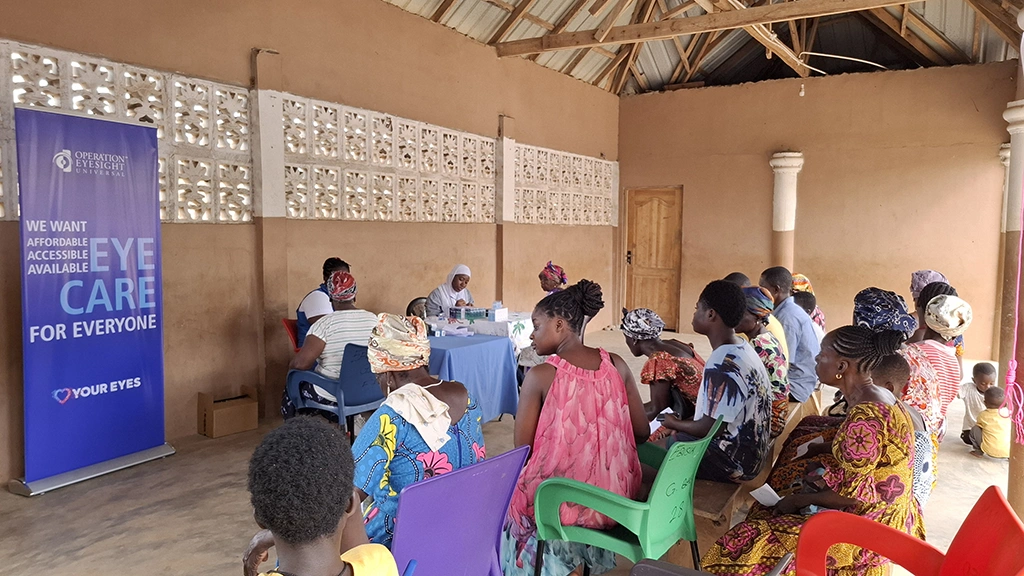
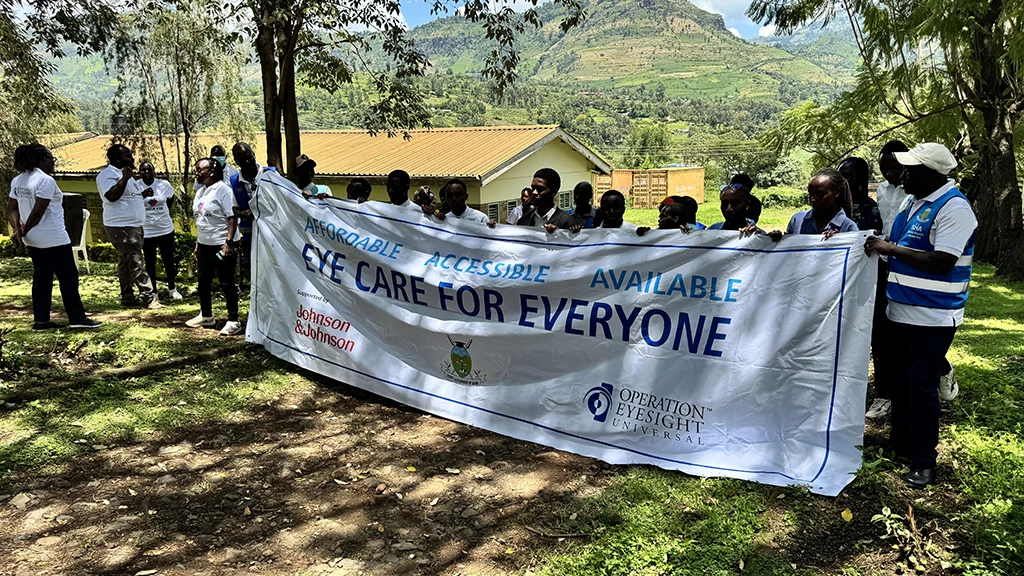
In Ghana, our team participated in a media launch with Ghana Health Service, along with regional awareness activities, while in Kenya, the day was marked with an awareness march, the opening of a new eye clinic and various screening camps.
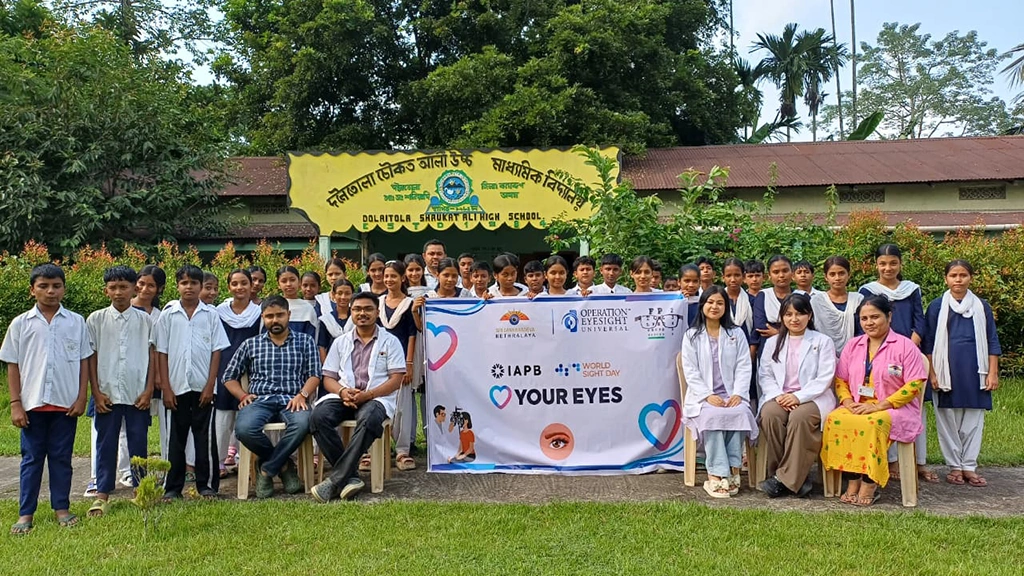
Throughout Bangladesh, India and Nepal we organized more than 20 screening and surgical outreach camps, and in Zambia we launched a new radio series about eye health and organized various school eye health screenings.
Each initiative brings us closer to a future where eye health is accessible to all. These events are more than moments; they’re movements towards lasting change in global eye health.
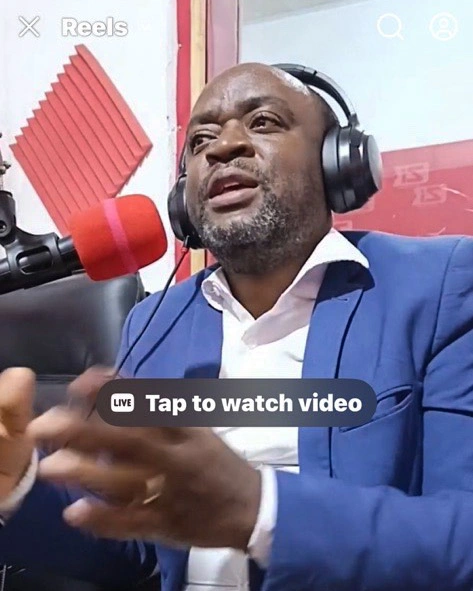
Dr. Chisanga Chelu, an ophthalmologist from Kabwe General Hospital in Zambia, discusses eye health in an hour-long program we are running on a local radio station in Kapiri Mposhi, Central Province. It was the first of a 13-week series in which listeners can learn more about eye health and call in with their questions. In areas where access to smartphones is limited, radio is an effective channel for sharing important eye health messages and encouraging people to seek care.
In the hills of Meghalaya’s Ri-Bhoi District, Robiroy, a young community health worker from Nongpoh Vision Centre, was assigned to serve 47 villages with a population of more than 16,000.
Initially, he encountered skepticism from the community, as people feared medical interventions or had misconceptions. For many, fading vision was simply part of growing old.
To overcome these barriers, Robiroy put aside his medical charts and stepped into courtyards, looking to connect with people with warmth and empathy. Over cups of tea, he listened, shared stories, and spoke of restored sight as a path to dignity and independence.
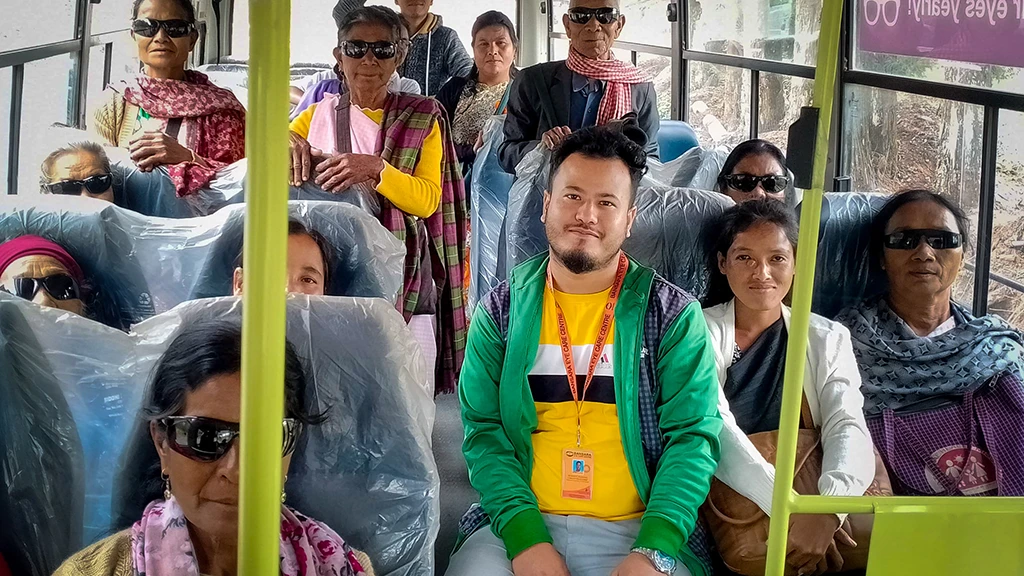
Small victories soon blossomed. An elder who had received eye care could weave again. A farmer saw his fields clearly. Success stories spread across villages. Soon, Nongpoh Vision Centre saw patients surge, and 520 seniors received cataract surgeries. Families began prioritizing eye care across generations.
Currently, five of Robiroy’s 47 villages will soon be declared Avoidable Blindness-Free. He is not just restoring vision – he is sparking an eye care movement!
With files from Emmanuel Benia Tanti, Program Manager, India.
Did you know? Donations to Operation Eyesight help us train community health workers like Robiroy to deliver primary eye care in remote, rural and underserved communities. Donate today.
Calgary, November 19, 2025: Operation Eyesight has been recognized by Charity Intelligence Canada (Ci) as a 2025 Top 10 Impact Charity (this is the eighth consecutive year for this recognition) and a Top 10 International Impact Charity for the sixth consecutive year. Ci evaluates more than 800 Canadian charities based on five criteria: financial transparency, results reporting, demonstrated impact, need for funding and cents to the cause.
Operation Eyesight is an international development organization and registered charity, founded in Calgary in 1963, that works to prevent blindness and restore sight in 11 countries across Africa, North America and South Asia. Work is supported by generous donors and a growing global community.
Globally, 1.1 billion people live with vision loss, which is projected to reach nearly 1.8 billion by 2050, costing the global economy an estimated $411 billion USD annually. Fortunately, 90 per cent of all vision loss is preventable or treatable. That’s where Operation Eyesight comes in.
With a global focus and a local approach, Operation Eyesight's work is fueled by the belief that everyone should have access to quality, affordable eye health care, regardless of ability to pay, gender, age or location. People in low- and middle-income countries as well as in rural and remote communities everywhere are often underserved. Addressing avoidable vision loss for all helps people better secure quality education, employment, independence and opportunities. This helps people transform their lives – see Benjamin's story to learn how.
Operation Eyesight’s impact comes from facilitating locally driven solutions. In-country teams are on the ground, building partnerships with communities, ministries of heath and education, and like-minded organizations. This builds local eye health systems that communities run now and for generations to come – For All The World To See.
Impact in 2024
Vision is about far more than sight – it is about reducing poverty, improving good health and well-being, supporting access to quality education, contributing to gender equality, ensuring clean water and sanitation, addressing climate action and building partnerships for the goals. These are all United Nations Sustainable Development Goals that will help to build a more peaceful and prosperous world for all. Through the support of its generous donors, Operation Eyesight has been contributing to building a more equitable world for more than six decades.
In 2024 alone, through local partnerships, Operation Eyesight screened 2.36 million people, performed more than 280,000 eye surgeries and distributed more than 270,000 pairs of prescription eyeglasses, while also declaring 233 villages Avoidable Blindness-Free. Read Operation Eyesight's Annual Report to learn more. View 2024 highlights below.
About Operation Eyesight
Operation Eyesight Universal is an international development organization working to eliminate avoidable vision loss and bring quality eye health care to communities where it’s needed most.
Founded in Calgary, Canada in 1963, over the past six decades Operation Eyesight has grown to become a global community that spans four continents and includes health workers and volunteers, physicians and ophthalmic personnel, donors, partners, staff and board members.
Whether it’s a simple pair of eyeglasses or a more complex eye surgery, Operation Eyesight believes that everyone should have access to affordable, quality eye health care services. Operation Eyesight's mission is to prevent blindness and restore sight – For All The World To See.
Operation Eyesight exists due to the generosity of donors who have supported this work for more than 60 years.
Donate today to make a lasting impact.
From her earliest days in school, 13-year-old Zara in Nepal struggled to get by. She couldn’t read what her teachers wrote on the blackboard, and she often rolled her eyes around and made unusual body movements, instantly making her stand out as “different” to her peers. We can only imagine how lonely and confusing life was for the girl – not knowing why she was so unlike the other children.
What nobody realized was that some of Zara’s actions – the eye-rolling, the strange movements – are typical self-stimulatory behaviours seen in some children with severe vision impairment. As a result of these behaviours, children like Zara are sometimes misdiagnosed with autism or developmental disabilities if their low vision continues to go unrecognized.
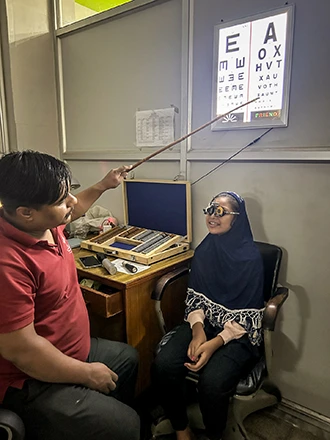
Fortunately for Zara, her school was included in a school eye screening project we had implemented in collaboration with our partner, Nepal Eye Hospital. During the screening, community health workers discovered that Zara had cataracts in both of her eyes, a condition she’d been born with, and that had severely clouded her vision throughout her young life.
The outreach team met with Zara and her mother, explained the condition to them, and told them that treatment was available. They referred the family to the nearby Simara Vision Centre for a thorough examination, where doctors confirmed the diagnosis of congenital cataracts. From there, Zara received a further referral to Nepal Eye Hospital in Kathmandu for surgery.
The Operation Eyesight project team provided crucial support, guiding Zara and her parents through the treatment process and helping them access surgery at a reduced cost, making it affordable for the family, who had limited financial resources.
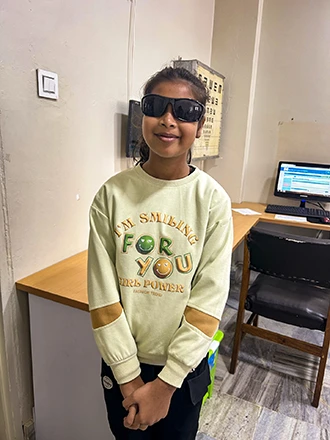
Zara’s first eye surgery was a success, and a month later she returned to the hospital for surgery on the second eye. On her second visit, when she spotted Operation Eyesight’s Project Coordinator from across the hospital, she waved enthusiastically – something that would not have been possible before her first surgery.
Zara’s transformation was profound. The eye rolling stopped, her unusual movements decreased, and she became more sociable with family and friends, even interacting withstrangers. For the first time in her life, she could recognize people from a distance, read the blackboard in class and fully participate in school activities.
Zara’s mother was overwhelmed with relief to see her daughter blossom. She had been extremely worried about her child’s future, and was amazed to see Zara playing, learning and interacting like other children her age. She and her family expressed deep gratitude to the hospital, the doctors and healthcare workers, and to Operation Eyesight’s generous donors, for making this life-changing transformation possible.
Make a donation to help us reach more children like Zara with life-changing eye surgery.
Written with files from Anisha Gurung, Operation Eyesight’s Project Coordinator at Nepal Eye Hospital.
Eight-year-old Fassikaw lives in Bahir Dar, where he goes to a local primary school. A second-grade student, he once faced challenges that threatened his education and well-being.
When Fassikaw was in first grade, he began to have trouble seeing objects far away. Reading books and the blackboard became difficult. Sitting in the middle or back of the classroom, he often had to borrow his classmates’ exercise books to copy notes.
At home, reading took him a long time. His eyes often watered, and his grades began to drop. More than his grades, his parents worried about his worsening vision and the way it was affecting his mood and sleep. Fassikaw even spoke about leaving school.
Around this time, his family learned about our School Eye Health Program run in partnership with Partners in Education Ethiopia. The program offers free diagnosis and eyeglasses to students in need.
After hearing this, his family went to the hospital and Fassikaw’s eyes were checked. At the hospital, tests revealed that Fassikaw’s vision required strong corrective lenses: +15.00 for his left eye and +16.00 for his right. Thanks to our partners and generous donors, he received the eyeglasses at no cost.
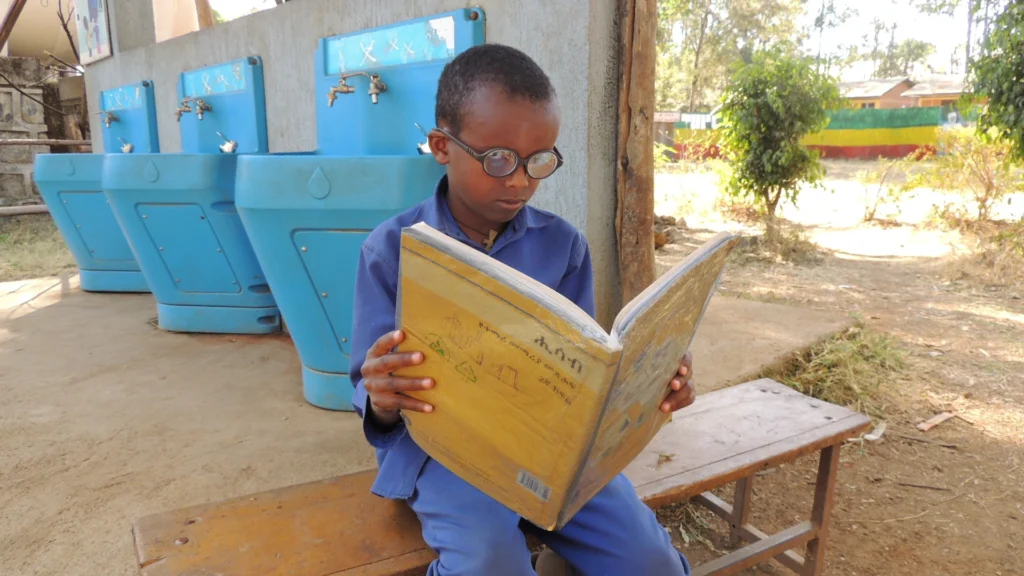
Today, Fassikaw can read easily from anywhere in the classroom. At home, he reads without headaches or watery eyes. His grades have improved, and his class ranking has risen from 27th to 21st, with steady progress.
His father says their son is now happy and confident, and the family can sleep without worry. “With God’s help, we hope you will never have to worry about anything,” he says with gratitude.
By providing eyeglasses through school-based eye health programs, we can transform the lives of children like Fassikaw, helping them see clearly, succeed in school and embrace a brighter future. Give the Gift of Sight today.
Our Work in Ethiopia
Since beginning our work in Ethiopia in 2018, we’ve made significant strides toward preventing avoidable vision loss. In 2024, our programs reached more than 33,424 people through eye health screenings, treatment, training and community outreach. From surveying over 14,000 residents in Debre Work to training frontline workers and teachers, screening students and providing eyeglasses, we are building lasting capacity for quality eye care. Read more about our work in Ethiopia in our 2024 Annual Report. Download it here.

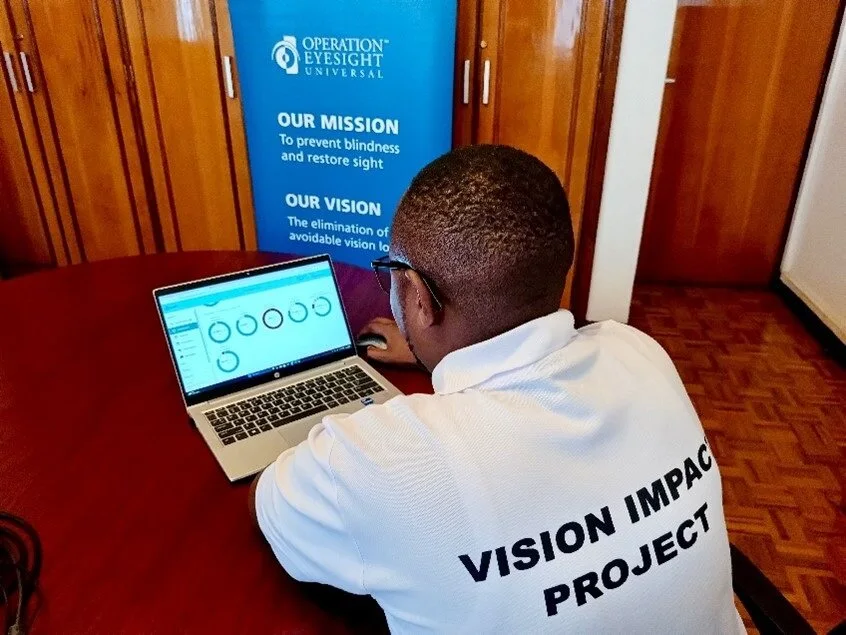
Operation Eyesight Universal is delighted to announce that we have been Certified by Peek Vision in software user training. – Peek Vision is a global social enterprise whose software and data intelligence platform powers eye health programs to strengthen systems and service delivery. Since 2016, we have been working with Peek to implement eye health programs in Kenya through partnerships with CBM Christian Blind Mission, the OneSight EssilorLuxottica Foundation, Seeing is Believing and the former United States Agency for International Development’s (USAID) Child Blindness Program, in collaboration with local county governments.
Members of our Kenya team participated in the Certification, which consisted of rigorous training and assessment by Peek team members over several days. They successfully passed the Certification, which enables them to independently manage Peek-powered programs and train others to use its smartphone-based eye health screening and data capture tools with confidence.
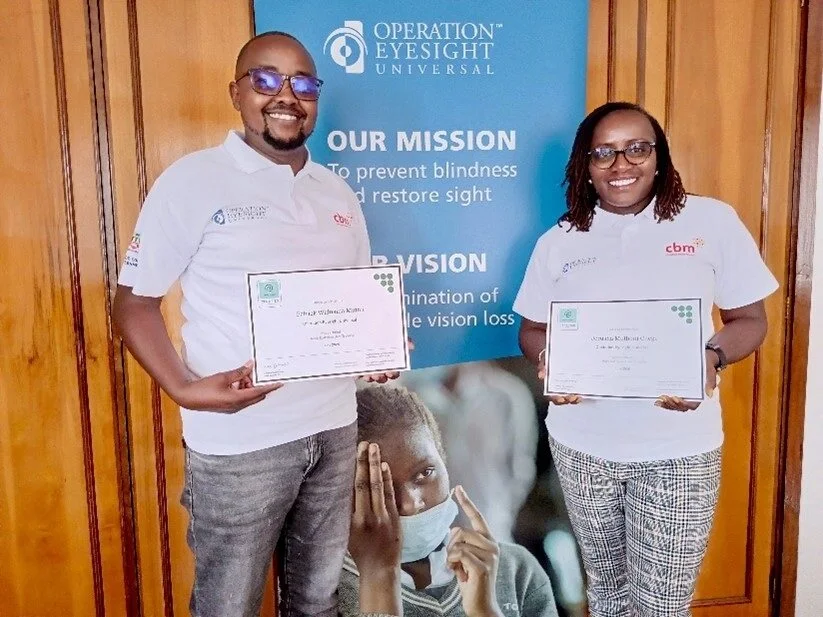
“Peek has become an invaluable tool in our programs by providing real-time data monitoring and analysis, which enhances our ability to respond quickly and effectively to emerging needs,” says Patrick Muthii, our MIS Officer in Kenya. “With accurate, up-to-date information at our fingertips, we make informed, data-driven decisions that strengthen program implementation, improve service delivery and ultimately ensure better outcomes for the communities we serve.”
Peek, which now works with eye health organizations across the world to address the global vision crisis, has been collaborating with us since its early days. With support from Operation Eyesight and local government partners, Peek first developed and tested its software and data intelligence platform in Trans Nzoia County, Kenya, laying the groundwork for its international rollout. Our partnership in Kenya continued with school eye health programs in Uasin Gishu County and expanded to community initiatives in Kajiado County under the CBM-led Vision Impact Project.
Today, Operation Eyesight remains a valued partner, using Peek’s platform in community eye health programs across three counties: Kajiado, Kisii and Nyamira. The collaboration also extends to research, with joint efforts alongside other partners to explore the availability and economic impact of reading glasses.
To see the Peek app in action, watch our video from Uasin Gishu County.
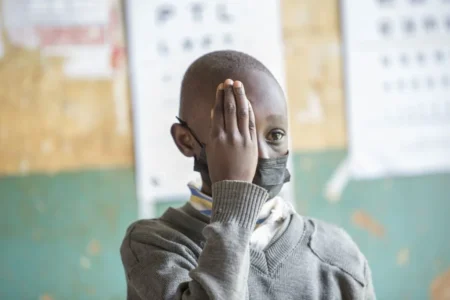
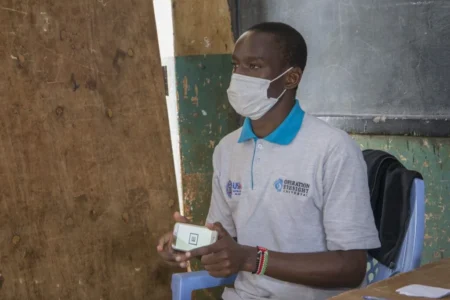
In a small village in Bangladesh, 60-year-old Gulbahar lives alone and supports herself. She works as a maid, stretching every ounce of strength to make it through each day.

Her world grew darker as cataracts began to cloud her vision and left her nearly blind. Everyday things like walking through crowded streets, cooking with the right spices and finding her way around her home became uncertain and difficult.

Despite the challenges, her spirit stayed strong as she searched for the right eye health treatment, only to discover that the surgery she needed was far beyond what she could afford.
One day she heard about a nearby outreach eye care camp by Operation Eyesight. Gulbahar made her way to the camp and embraced the chance for cataract surgery.

She received cataract surgery at no cost. When the bandages were removed, she smiled.
"I can see my world again,” she said. “I don’t need to stumble in the dark anymore. I’ve been given a second chance.”

Today Gulbahar is back on her feet. She works and moves through her days with confidence and no longer depends on others. Her restored vision gave her more than sight. It gave her freedom.
But stories like Gulbahar’s are far too common.
You can help change that. Your contribution provides people with the knowledge and resources they need to regain their vision and independence.

By giving the Gift of Sight, you can help prevent blindness, restore sight and create second chances for more people like Gulbahar. Thank you for your support!
Operation Eyesight is excited to participate in the Rotary International Convention in Calgary in June 2025. Be sure to stop by our booth (#355) in the House of Friendship to learn more about our work with Rotary Clubs around the world. You can also visit operationeyesight.com/Rotary2025 for more information.


Rotary Clubs: Longstanding champions of sight
In the mountainous Kathmandu Valley of northern Nepal, one in five people lives with vision loss or blindness, according to the Country Data from the International Agency for the Prevention of Blindness. For many families in these isolated areas, the journey to access even basic eye care is long, difficult and often impossible.
But through an inspiring partnership between Rotary Clubs and Operation Eyesight, eye health services are now reaching communities once left behind – thanks to innovation, compassion and more than 60 years of partnership.
Vision on Wheels: A lifeline to rural communities

Powered by the Rotary Club of Simcoe, Vision on Wheels is a mobile eye unit that delivers vital health services directly to the doorsteps of rural families in Nepal. From vision screening and prescription eyeglasses to life-changing cataract surgeries and health education, the Mobile Vision Centre eliminates the barriers of geography and cost – restoring not only sight, but also dignity, hope and opportunity.

“Rotary International and local Rotary Clubs have long played a critical role in advancing global health initiatives, particularly eye health, and we are incredibly grateful for their longstanding support,” says Kashinath Bhoosnurmath, our President & CEO. “Together, we are now addressing the new and emerging causes of blindness and vision loss, renewing hope for families and entire communities.”

A legacy rooted in Rotary values
The connection between Rotary and Operation Eyesight runs deep. In fact, Operation Eyesight’s founder Art Jenkyns, seen in this archival photo (far left), was himself a Rotary member. Since the 1970s, Rotary Club Members have been instrumental in shaping the organization’s mission – contributing more than $1.4 M USD through more than 3,100 individual gifts, including $748,565 since 2020 alone.
Through these donations, Rotary members have supported Operation Eyesight in:
Their impact spans continents – from the bustling cities of India to remote regions of Kenya, Zambia and Ethiopia. “I believe Rotary’s confidence in Operation Eyesight is rooted in our shared commitment to fighting disease, providing clean water and sanitation, supporting education and promoting gender equality, particularly for mothers and children,” Kashinath adds. “The collaboration between our organizations showcases how Rotary’s local presence and Operation Eyesight’s global reach can have a lasting impact on underserved communities.”
A Centennial vision becomes reality
In 2005, to mark Rotary International’s 100th anniversary, the Rotary Club of Calgary Heritage Park, jointly with Rotary Zones 22, 5 and 6A, partnered with Operation Eyesight in an ambitious goal: to provide 100,000 free cataract surgeries across India, Nepal and Sri Lanka, through a “Partners in Vision” campaign.
A Rotary Club of Calgary Heritage Park Newsletter states that two major approvals were provided in December 2004, which covered 48,600 surgeries for a total cost of $1,065,000 USD. Operation Eyesight provided 50 per cent ($533,000 equivalent in USD) of the total funding matching every dollar raised by Rotary Clubs and Districts and other Rotary contributions. In June 2005, three other contributions were approved to fund an additional 16,400 surgeries for a total cost of $367,000 USD. To this amount, Operation Eyesight added 50 per cent (the equivalent of $184,000 USD) of the funding. Operation Eyesight also matched each Rotary dollar with professional expertise and local partnerships.
More than a surgical campaign, the initiative strengthened health systems by requiring participating hospitals to undergo training at the world-renowned L V Prasad Eye Institute – ensuring quality care and sustainability for years to come.
From boardrooms to boreholes
Rotary’s commitment goes beyond eye surgeries. Recognizing the link between clean water and eye health, especially in preventing trachoma – a devastating bacterial infection that causes irreversible blindness if left untreated – Rotary members have supported water and sanitation projects in Ethiopia, Kenya and Zambia that protect and uplift communities.
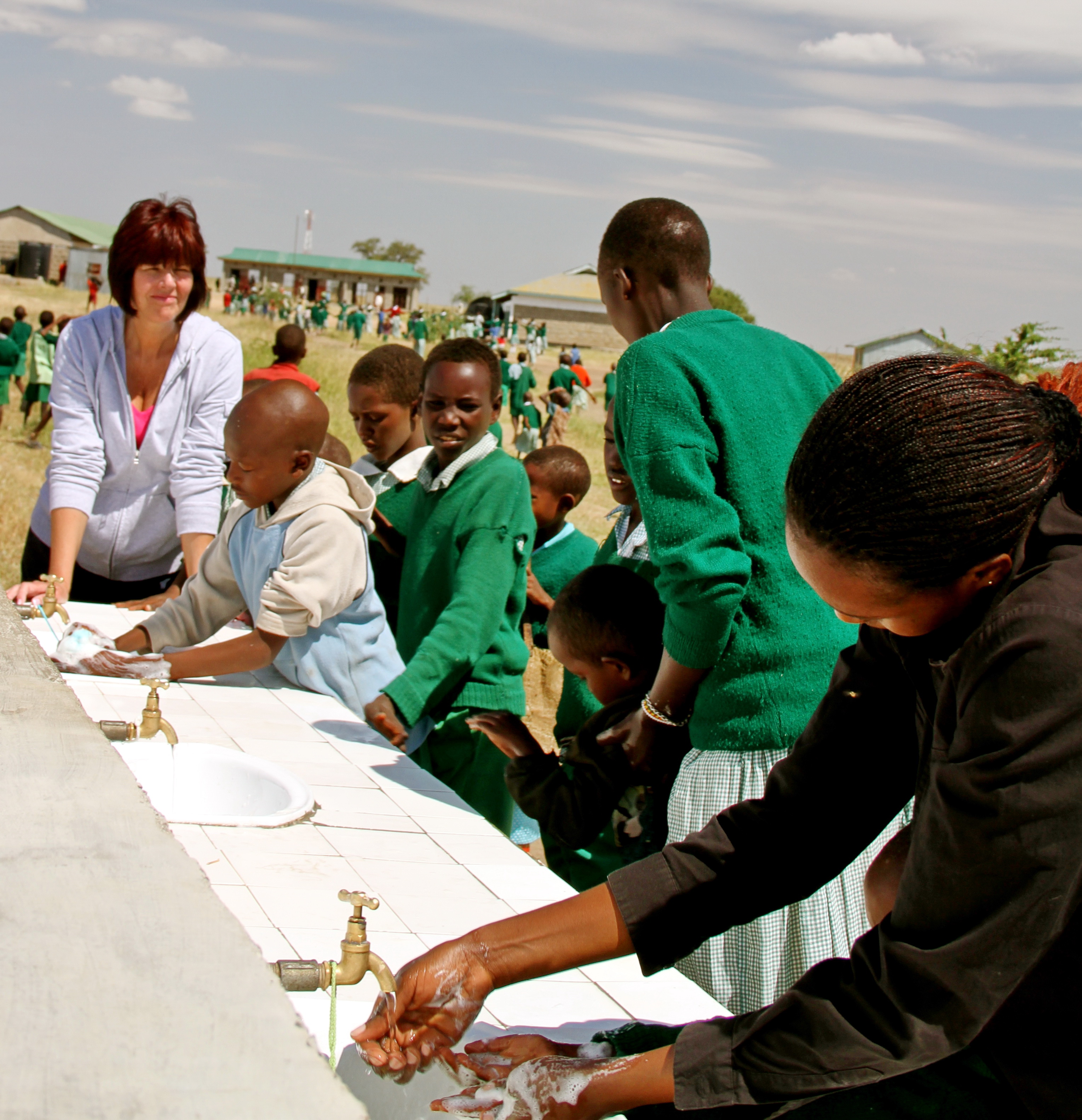
In 2008, the Ridgewood Rotary Club of New Jersey funded a pump house and handwashing station at Kishermoruak Primary School in Kenya, where a borehole had been drilled by Operation Eyesight. This project now provides clean water to more than 1,000 people, transforming health and education outcomes for the entire community.
“Access to clean water not only prevents the spread of trachoma and other diseases, but also means young girls are able to attend school, because they no longer have to haul water long distances for their families,” explains Caroline Nginda Ikumu, Operation Eyesight’s Country Director for Kenya and Ethiopia.
“Through the generosity and vision of donors and partners, together we are building healthier communities.”
Looking ahead: a shared vision for the future
Our shared vision for a healthier, more equitable world continues to inspire many Rotary members to join Operation Eyesight’s global community. Rotary Clubs have the opportunity to partner on a variety of projects that bring eye health solutions to communities that need them most:
WASH (Water, Sanitation and Hygiene) and Health System Strengthening – Integrates eye care with water, sanitation and hygiene, and works with governments to embed services into public health systems, particularly across sub-Saharan Africa.
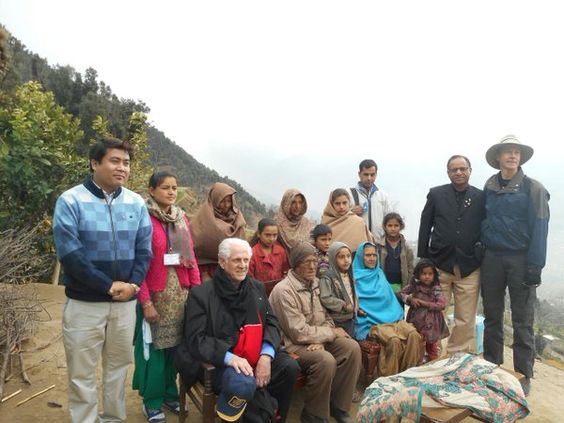
Together with donors and dedicated partners, Operation Eyesight works with local governments and hospitals to create local eye health solutions that address the root causes of vision loss, including lack of access to fresh water, gender inequality, and inadequate education and access to health services. By leveraging the unique strengths of communities, we help ensure the impact of donors is felt long after a project is finished.
Throughout the years, Rotary Clubs like Calgary West, Grimsby, North Scarborough and Norfolk Sunrise have consistently stood shoulder-to-shoulder with Operation Eyesight. Together, our work has transformed lives in communities across South Asia and Africa.


Partner hospitals in Operation Eyesight’s countries of work play a key role in the sustainability of services after projects end. In India, facilities established and supported by Indian Rotary Clubs remain key partners in our work to end avoidable vision loss on the subcontinent. The Mela Mal Sood Rotary Eye Hospital in Palampur, Himachal Pradesh, pictured here at its inauguration in 1985, is one of more than two-dozen Rotary eye hospitals we work alongside in partnership and collaboration.
Through Rotary investments, eye health care is becoming a standard part of health systems in not only India but our other countries of work as well.
In addition to providing state-of-the-art affordable ophthalmic services, these facilities offer sight -restoring surgery, treatment and specialized care. Our Rotary partner hospitals in India often function as regional hubs for community outreach, supporting large-scale eye screenings and surgical camps in rural and semi-urban areas. It’s these local and international partnerships that make our work possible.
“Rotary’s confidence in Operation Eyesight is rooted in our shared commitment to fighting disease, providing clean water and education, supporting education and promoting gender equality,” says Bhoosnurmath. “Together, we are restoring sight, dignity and hope.”
One vision, countless lives transformed
The partnership between Rotary and Operation Eyesight continues to evolve. Through initiatives like the International Agency for the Prevention of Blindness (IAPB)-Rotary International Service Partnership, Rotary Clubs are now helping integrate eye care into broader health systems, train local health workers and promote sustainable change.
As Operation Eyesight continues its mission to prevent blindness and restore sight for good, Rotary Clubs remain vital to making this a reality. The tireless energy, strategic leadership and generous spirit of Rotary Club members continue to serve as a beacon of what’s possible when we unite for a greater purpose.
Thank you, Rotary, for helping us see a brighter future – one person, one community and one gift at a time – For All The World To See! Operation Eyesight is excited to participate in the Rotary International Convention in Calgary in June 2025. Be sure to stop by our booth (#355) in the House of Friendship to learn more about our work with Rotary Clubs around the world. You can also visit operationeyesight.com/Rotary2025 for more information